Between Moral Obligation And Political Pragmatism: Syria’s Embrace Of Israel
Developing Just LeadershipMohamed Ousman
Sha'ban 13, 1447 2026-02-01
News & Analysis

by Mohamed Ousman (News & Analysis, Crescent International Vol. 55, No. 12, Sha'ban, 1447)
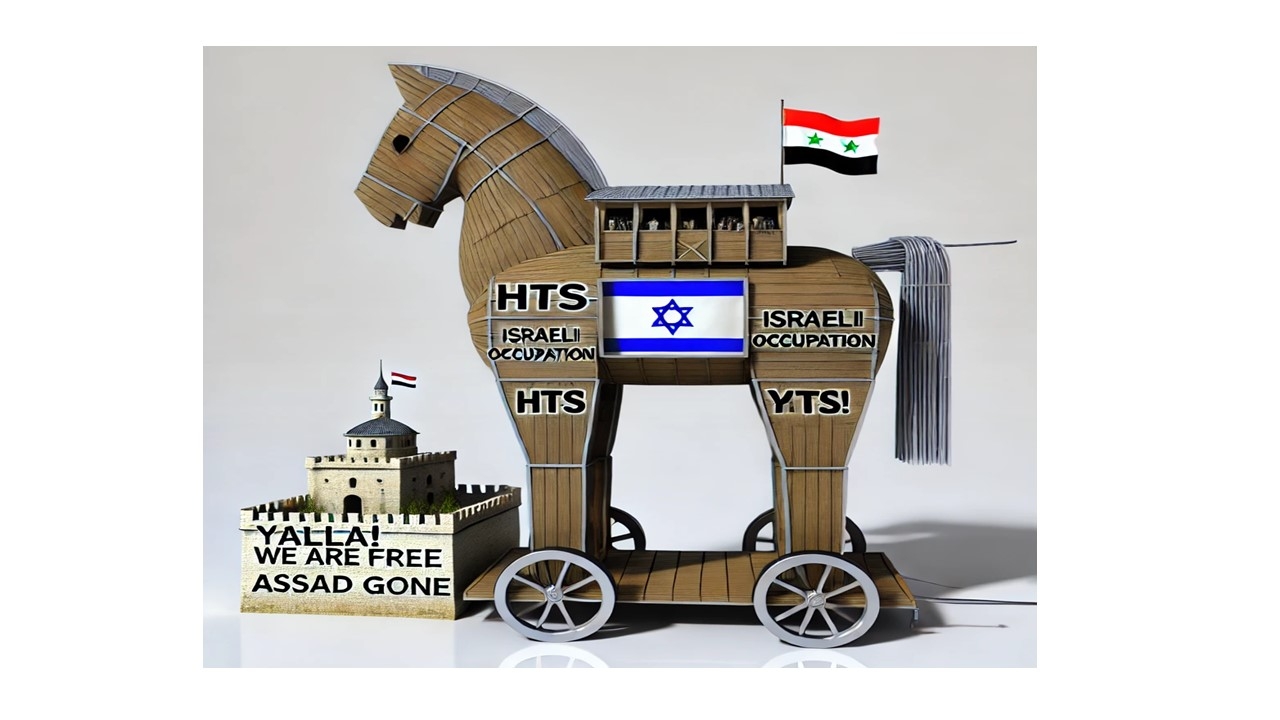
Reports of diplomatic interaction between Syria and Israel have re-ignited debate concerning the regional balance of power and the ethical dimensions of political decision-making in West Asia. Such developments are frequently presented not merely as geopolitical manoeuvres but as moral and ideological acts with implications for the Palestinian struggle.
This is consistent with the tendency of Arabian and Islamic political commentary to frame regional diplomacy within narratives of loyalty, resistance and betrayal. Syrian diplomatic engagement with the zionist entity needs to be examined through a multi-layered analysis and the framing of such engagement as a betrayal of the Palestinian cause.
Three major Islamic intellectual frameworks will be utilized: Dr. Kalim Siddiqui’s Islamic Movement Theory, Imam Zafar Bangash’s Sirah-based analytical model, and Imam Muhammad al-Asi’s Qur’anic hermeneutical approach. These provide rich lenses for understanding how such discourse operates at the intersection of politics, ethics and “religious” identity.
Key Statements
The following statements represent a synthesis of publicly documented themes commonly associated with commentary on Syria–Israel diplomacy:
1: Syria and Israel have engaged in direct diplomatic or security negotiations after decades of conflict.
2: Such negotiations are characterized by some commentators as a betrayal of the Palestinian cause.
3: Normalization with Israel is framed as undermining Islamic solidarity and resistance.
4: Historical agreements, such as the 1974 disengagement accord, are invoked to frame current negotiations.
5: Pro-Palestinian analysts argue that any negotiation not centred on liberation constitutes ethical compromise.
These serve as the basis for multi-layered analysis.
The commentary explicitly identifies:
- the existence of Syria–Israel negotiations,
- accusations of betrayal,
- historical precedents,
- political consequences for regional solidarity.
At the surface, the narrative presents diplomatic engagement as a moral dilemma rather than a strategic decision. It centres on the event of negotiation and its immediate perceived ethical ramifications.
Implicitly, the repeated invocation of “betrayal” suggests:
- an assumed moral obligation between Arabian or Muslim states and Palestine,
- expectations that state policy must align with a collective identity rather than sovereign calculus,
- a perception that diplomacy equals ethical surrender unless it explicitly advances Palestinian liberation.
These themes reflect deeper ideological frameworks that shape interpretive communities around Palestine.
Key discursive features include:
- framing Syria as morally accountable to a transnational cause,
- positioning Israel as a hegemonic actor whose engagement automatically implies imbalance,
- constructing identity through resistance,
- delegitimization of diplomatic pragmatism.
Such discourse enforces a moral binary: resistance = loyalty, negotiation = betrayal.
Within the expected imagery and rhetoric:
- “Betrayal” functions as a sign of moral rupture.
- Palestinian symbols (maps, refugee camps) operate as icons of suffering and resilience.
- Diplomatic tables or handshakes carry connotations of compromise or submission.
These symbols are culturally loaded and evoke emotional responses that shape ideological interpretation.
Islamic Movement Theory
Dr. Kalim Siddiqui’s Islamic Movement Theory frames politics as an arena fundamentally rooted in Islamic ethical imperatives rather than secular state interests. Siddiqui’s framework defines true political legitimacy through adherence to moral principles rather than national interest. Siddiqui argues that Muslims bear collective obligations toward justice, resistance against oppression and solidarity with the oppressed. In this framework, the Palestinian cause is not merely geopolitical but an Islamic-ethical responsibility of the ummah.
Applying Siddiqui’s theory, Syrian engagement with Israel is interpreted through ethical, not merely strategic, criterion. The framing of “betrayal” parallels Siddiqui’s assertion that Muslim leaders who align with oppressive structures risk moral delegitimization. He criticizes Muslim nation-states for prioritizing political survival over Qur’anic values, and this critique maps directly onto the portrayal of Syria’s actions.
Within this lens, diplomacy that does not substantively address Palestinian liberation is seen as inherently flawed. Even strategic negotiations may constitute moral surrender if they reinforce systems of domination.
Sirah-Based Approach
Imam Zafar Bangash employs the sirah—the Prophet Muhammad’s biography—as a methodological framework for analyzing modern politics. Bangash argues that Muslim political conduct must reflect prophetic virtues of justice, steadfastness, moral clarity and unwavering commitment to the oppressed. Compromise that legitimizes injustice violates this model.
In this context, the moral framing of Syrian diplomacy would align with Bangash’s concerns about political expediency. He would emphasize that the Prophet’s diplomacy, including the Treaty of Hudaybiyyah, never ceded ethical principles. Instead, it was strategically designed to advance justice without empowering oppressors. Bangash would insist that leaders must uphold similar standards.
Thus, the characterization of negotiations as “betrayal” reflects fears that Syria is sacrificing ethical commitments for short-term political gains. The discourse mirrors Bangash’s critique of contemporary Muslim rulers who, in his view, compromise prophetic principles for foreign alliances or regime survival. From this perspective, diplomacy is not dismissed outright but is judged according to its alignment with ethical norms derived from the sirah.
Qur’anic Approach
Imam Muhammad al-Asi’s Qur’anic hermeneutics prioritize justice (‘adl), protection of the oppressed and resistance to systems of tyranny. He interprets political affairs through Qur’anic imperatives rather than geopolitical pragmatism.
Central to this approach is Qur’an 4:75, which commands those committed to Allah to stand against oppression. Al-Asi stresses that political actions must be assessed based on whether they uplift or further subjugate the mustad‘afīn.
Applying this framework, several layers emerge. First, al-Asi would distinguish between justice-oriented diplomacy and procedural diplomacy. The former actively dismantles unjust structures; the latter preserves them. This distinction is crucial for evaluating Syrian-Israeli negotiations. If such negotiations fail to secure restitution and fundamental rights for Palestinians, they fall into the category of procedural diplomacy, which al-Asi would argue is incompatible with Qur’anic ethics.
Second, al-Asi warns of alliances that reinforce oppressive actors. Qur’an 5:2 advises committed Muslims not to cooperate in aggression. Thus, any diplomatic engagement that normalizes occupation or legitimizes territorial dispossession becomes morally suspect. The portrayal of Syrian actions reflects this concern: that normalization without justice constitutes complicity.
Third, al-Asi’s method emphasizes structural change rather than symbolic gestures. He argues that justice requires dismantling the conditions enabling oppression, not simply altering the optics of political relationships. Therefore, symbolic normalization, without changing material conditions for Palestinians, does not satisfy Qur’anic criteria.
Fourth, al-Asi critiques political actors who invoke Islam rhetorically while enacting policies that undermine justice. If Syria presents itself as part of a resistance axis yet engages in negotiations that do not prioritize Palestinian liberation, al-Asi’s framework would interpret this as hypocrisy.
In this framework, the critique aligns with a Qur’an-centered political ethics that measures diplomacy not by national interest or feasibility but by its alignment with divine imperatives of justice, resistance and defense of the oppressed.
Through multi-layered analysis, it becomes clear that the narrative surrounding Syrian engagement with Israel is shaped by explicit geopolitical claims and powerful ideological assumptions rather than the Islamic moral framework that resonates strongly with Islamic scholarly critiques from Siddiqui, Bangash and al-Asi, each of whom emphasizes justice, solidarity and ethical integrity over pragmatic diplomacy.
Bibliography
Al-Āsī, Muhammad: The Ascendant Qur’an: Realigning Man to the Divine Power Culture. Various Volumes. Institute of Contemporary Islamic Thought, (2008-2024).
Bangash, Zafar (ed): In Pursuit of the Power of Islam: Major Writings of Kalim Siddiqui. Toronto: The Open Press (1996).
Bangash, Zafar: Power Manifestations of the Sirah. Toronto: ICIT. (2011).
Bangash, Zafar: Editorial introduction to Siddiqui’s collected works
Bangash, Zafar: Articles in Crescent International (various issues)
https://crescent.icit-digital.org/articles/power-dimensions-in-the-sirah-of-the-noble-messenger-saws
https://crescent.icit-digital.org/articles/the-importance-of-re-examining-the-seerah-of-the-prophet
Siddiqui, Kalim: The Islamic Movement: A Systems Approach. London: The Muslim Institute, (1976).
Siddiqui, Kalim: Issues in the Islamic Movement. Toronto: The Open Press (1982).
Siddiqui, Kalim: Beyond the Muslim Nation-States. The Muslim Institute (1977).
Siddiqui, Kalim: Stages of Islamic Revolution. London: The Open Press, (1996).