Blowback of Total War: When the Battlefield Comes Home
Empowering Weak & OppressedCrescent International
Jumada' al-Akhirah 18, 1448 2026-11-28
Daily News Analysis

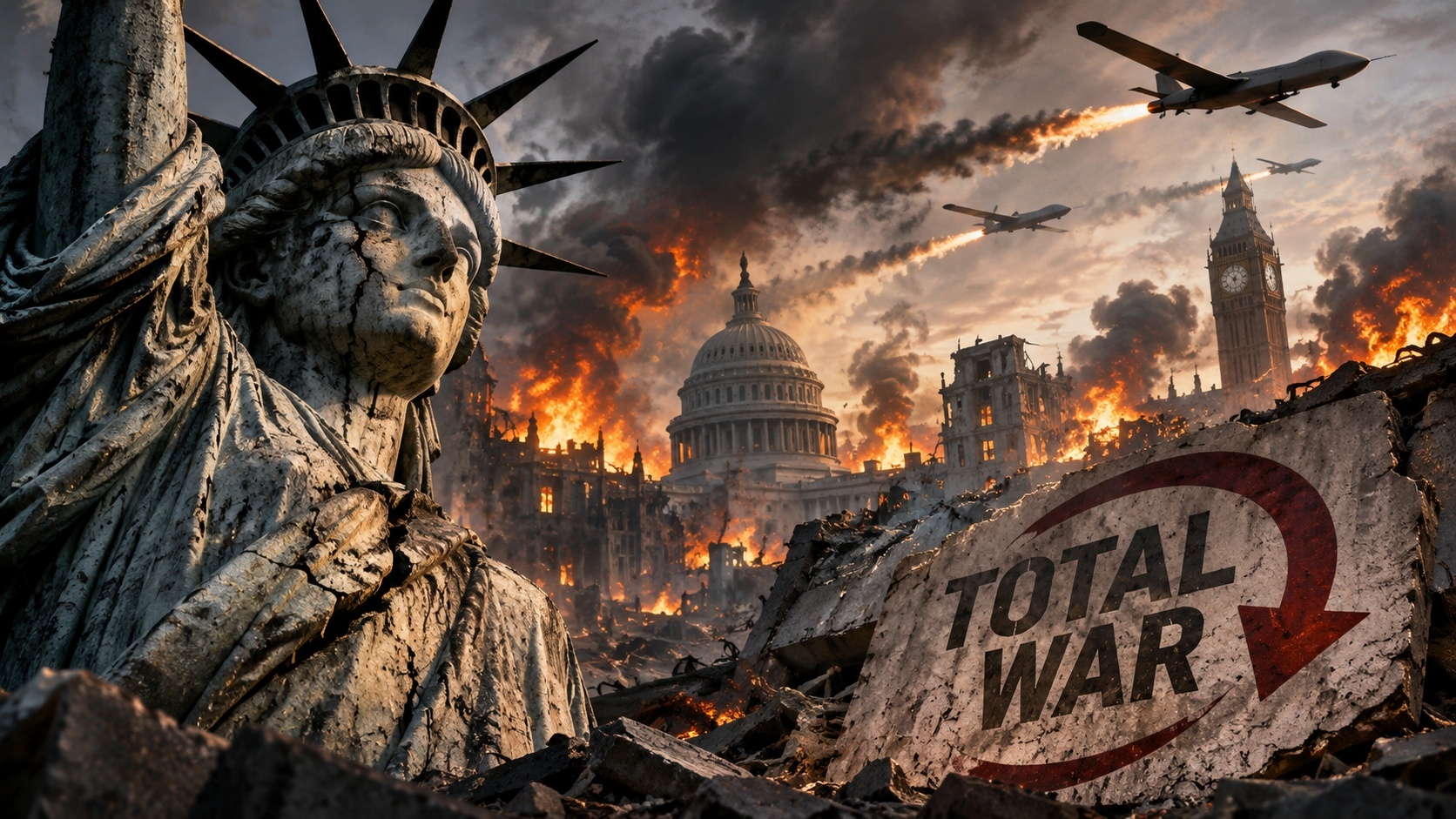
For more than a century, western militaries have progressively expanded the boundaries of warfare, treating civilian populations, economic infrastructure and the industrial foundations of societies as instruments of military pressure.
Today, that doctrine is coming back to haunt them.
As military technology spreads and weaker adversaries acquire the means to strike beyond the immediate battlefield, the societies and infrastructure that once enjoyed relative immunity are increasingly exposed.
The evolution of total war has deep historical roots.
During the American Civil War, William Sherman demonstrated its logic through his march across Georgia and South Carolina. Rather than concentrating exclusively on Confederate armies, his forces systematically destroyed railways, agricultural production, factories, livestock and other economic resources sustaining the Southern war effort.
The objective was to make the entire society feel the costs of war.
In the twentieth century, this logic acquired an even more destructive dimension.
Italian general Giulio Douhet theorised that aerial bombardment could break a nation’s will by attacking its cities, industries and civilian population.
The German bombing of British cities, followed by Allied bombing of German cities, brought this doctrine into practice on an enormous scale.
Hamburg alone suffered approximately 40,000 deaths in the 1943 bombing.
Yet the strategic results repeatedly contradicted the theory.
The US Strategic Bombing Survey found that Germany’s civilian morale and industrial production proved considerably more resilient than advocates of strategic bombing had anticipated.
During the Vietnam War, American intelligence assessments and the JASON study similarly concluded that bombing had not broken Hanoi’s determination to continue the conflict.
Instead, it imposed enormous suffering without producing the political capitulation Washington sought.
The lesson was repeatedly documented but rarely absorbed: destroying civilian life does not necessarily destroy a society’s capacity or willingness to resist.
Today, the strategic equation is changing again.
The same principle of imposing costs on an adversary’s economic and industrial foundations are no longer the exclusive preserve of western regimes.
Iran’s response to the US-Israeli aggression illustrates this transformation.
Iranian retaliations have reached military installations, energy facilities, ports, airports and industrial infrastructure within the GCC regimes which serve as springboards for US attacks against Iran.
The implications extend beyond regional disruption.
Gulf industrial infrastructure is also connected to broader western military supply chains.
A 2018 US Department of Commerce report identified the UAE and China as the only other high-volume producers of high-purity aluminium, a material used in critical infrastructure and defence aerospace applications.
Iranian measures against the GCC industrial facilities therefore expose vulnerabilities with potential consequences far beyond the region.
This does not mean that the military balance has been fully reversed.
It means that overwhelming conventional superiority no longer guarantees geographical security or immunity from economic disruption.
As was the case in Lebanon, relatively inexpensive drones and missiles imposed disproportionate defensive and economic costs on the zionist invaders.
Western regimes have helped normalise the expansion of warfare into civilian and economic life, primarily through their continued support for Israel despite the immense civilian toll upon which Israel’s war doctrine is built.
The diffusion of military capabilities means that the ability to impose such costs is spreading.
Total war is no longer a one-way instrument of western regimes.
Its logic is returning towards the strategic infrastructure of those who helped make it normal.
Related Articles

Conventional war against Iran no longer a realistic option
Crescent International
Jumada' al-Akhirah 03, 1442 2021-01-16