Economic cost to empire: How the Ramadan war deepens Western decline
Empowering Weak & OppressedCrescent International
Ramadan 19, 1447 2026-03-09
Daily News Analysis

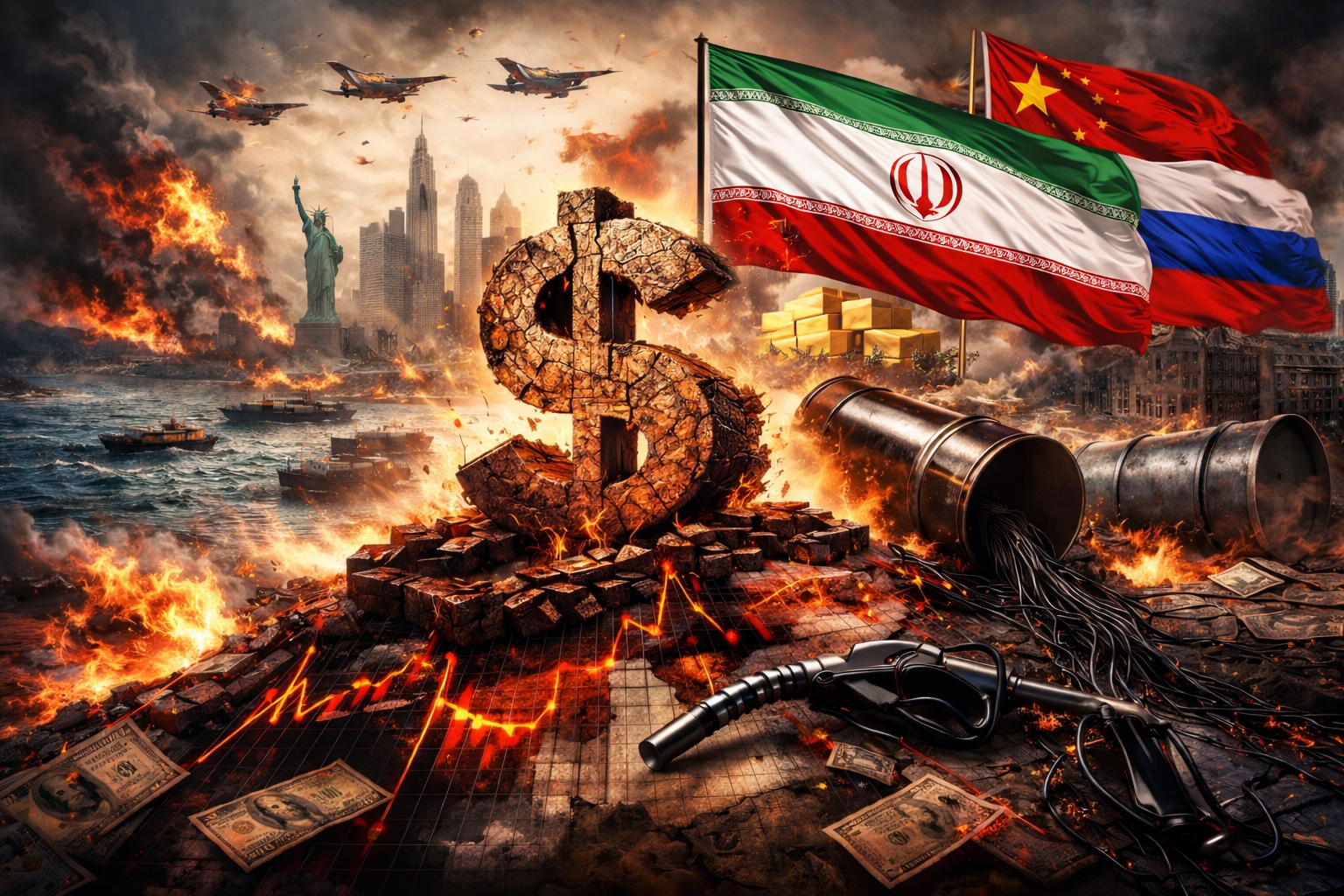
Economic dominance is rarely lost in a single dramatic crisis.
It erodes gradually when credibility weakens, predictability declines, and competitors advance more rapidly.
The economic tremors now spreading through global markets because of the US–zionist aggression against Iran illustrate how such erosion unfolds in real time.
Yet the structural weakening of western economic leadership did not begin with the current confrontation in West Asia.
It had already been underway for years, accelerated by the policy volatility and economic mismanagement of the Trump regime.
Supporters of American imperialism often point to the continued resilience of the US economy.
Brookings Institution argues that despite tariff escalation, tightening immigration policies, expanding public debt, and tensions surrounding the independence of the Federal Reserve, the US economy has continued to grow.
These observations are not entirely wrong.
The sheer size and diversity of the American economy provide considerable shock-absorption capacity.
But short-term resilience does not invalidate structural erosion.
When volatility itself becomes policy, long-term recovery becomes harder—especially in a world that is no longer standing still.
Modern capitalist economies function largely on expectations.
Businesses make long-term investment decisions based on stable trade frameworks.
When governments abruptly escalate tariffs, alter trade relationships, restrict immigration flows, or dramatically expand fiscal spending outside crisis conditions, they introduce strategic uncertainty into the system.
Such uncertainty rarely produces immediate collapse.
Instead, it raises the risk premium embedded in economic decision-making.
Capital becomes more cautious, more geographically diversified, and less willing to commit to long-term investments.
Over time these adjustments compound, gradually weakening economic dynamism.
The US–zionist war against Iran has now added a powerful new layer of volatility.
Global markets reacted immediately to the possibility of disruption to energy flows through the Strait of Hormuz, the world’s most critical oil shipping corridor.
Oil prices surged sharply, with Brent crude briefly approaching $120 per barrel before settling around $104—still significantly higher than the $93 level recorded only days earlier.
Gas prices also jumped, while European stock markets declined as investors reassessed risk exposure.
These movements reflect more than short-term panic.
They highlight the vulnerability of a global economic system already strained by geopolitical instability.
The energy shock also threatens to derail monetary policy across western economies.
Prior to the escalation of the conflict, financial markets widely expected interest-rate cuts later this year as inflation pressures appeared to be easing.
That assumption is now rapidly disappearing.
Rising oil and gas prices feed directly into inflation through transport, manufacturing, and food supply chains.
Equally concerning for global investors is the perceived pressure placed on the US Federal Reserve.
Central-bank independence is essential to maintaining confidence in monetary policy and inflation control.
If markets begin to believe that monetary decisions are influenced by political pressure rather than economic conditions, trust in economic data and policy credibility begins to weaken.
Credibility is also the foundation of the dollar’s global dominance.
In recent years, Washington’s increasing use of sanctions and financial coercion has prompted many countries to consider diversifying away from excessive dependence on the dollar-based financial system.
Central banks across the world—particularly in emerging economies—have accelerated their purchase of gold reserves as a hedge against geopolitical financial risk.
This does not mean the dollar will suddenly lose its global role.
There is no immediate alternative with comparable liquidity and depth.
But gradual diversification reduces the dollar’s exclusivity over time.
Monetary dominance rarely collapses overnight; it erodes slowly at the margins before structural shifts become visible.
The energy shock triggered by the current conflict will simply accelerate all these processes.
European regimes, in particular, face serious economic vulnerability.
Germany—the continent’s most industrialized economy—has already been weakened by the loss of relatively cheap Russian energy following the Ukraine conflict.
Rising energy costs have forced many energy-intensive industries to scale back production or relocate abroad.
Another prolonged surge in oil and gas prices would deepen this trend.
For Europe’s industrial base, the cumulative impact increasingly resembles death by a thousand cuts: declining competitiveness, gradual relocation of manufacturing capacity, and steady erosion of industrial output.
Higher global energy prices simultaneously strengthen Russia’s economic position by increasing the value of its hydrocarbon exports, while placing enormous strain on European economies already grappling with structural energy insecurity.
This development on its own would already be damaging for western regimes but combined with the realities of the war in Ukraine, it represents a severe blow to western dominance.
At the same time, emerging powers are advancing rapidly.
China continues to expand its industrial capacity, technological development, infrastructure networks, and alternative financial mechanisms.
Through supply-chain integration, regional trade frameworks, and experimentation with digital currencies, Beijing is positioning itself for long-term systemic competition.
As western economies become increasingly volatile while emerging powers pursue long-term strategic continuity, the balance gradually shifts.
The real danger for the western system is therefore not immediate recession.
It is the slow but persistent erosion of comparative advantage—a structural multidimensional decline that unfolds quietly while geopolitical competitors consolidate their gains.
In the emerging multipolar world, lost time translates directly into lost power—especially when strategic drift is compounded by a military fiasco now unfolding vis-à-vis Iran.
Related Articles
America Wants Economic War; Iran Will Make It a Wider War
Crescent International
Rabi' al-Awwal 06, 1448 2026-08-19
Why Islamic Iran Will Now Strike More Boldly Across the Region
Crescent International
Dhu al-Hijjah 01, 1447 2026-05-18

No Real “Deal”; Only a Temporary Truce and Long-Term Conflict
Crescent International
Dhu al-Hijjah 16, 1447 2026-06-02