ICJ Verdict on the Genocide of Rohingya Demands Action, Not Diplomatic Evasion
Developing Just LeadershipIqbal Jassat
Jumada' al-Akhirah 21, 1448 2026-12-01
News & Analysis

by Iqbal Jassat (News & Analysis, Crescent International Vol. 56, No. 10, Jumada' al-Akhirah, 1448)
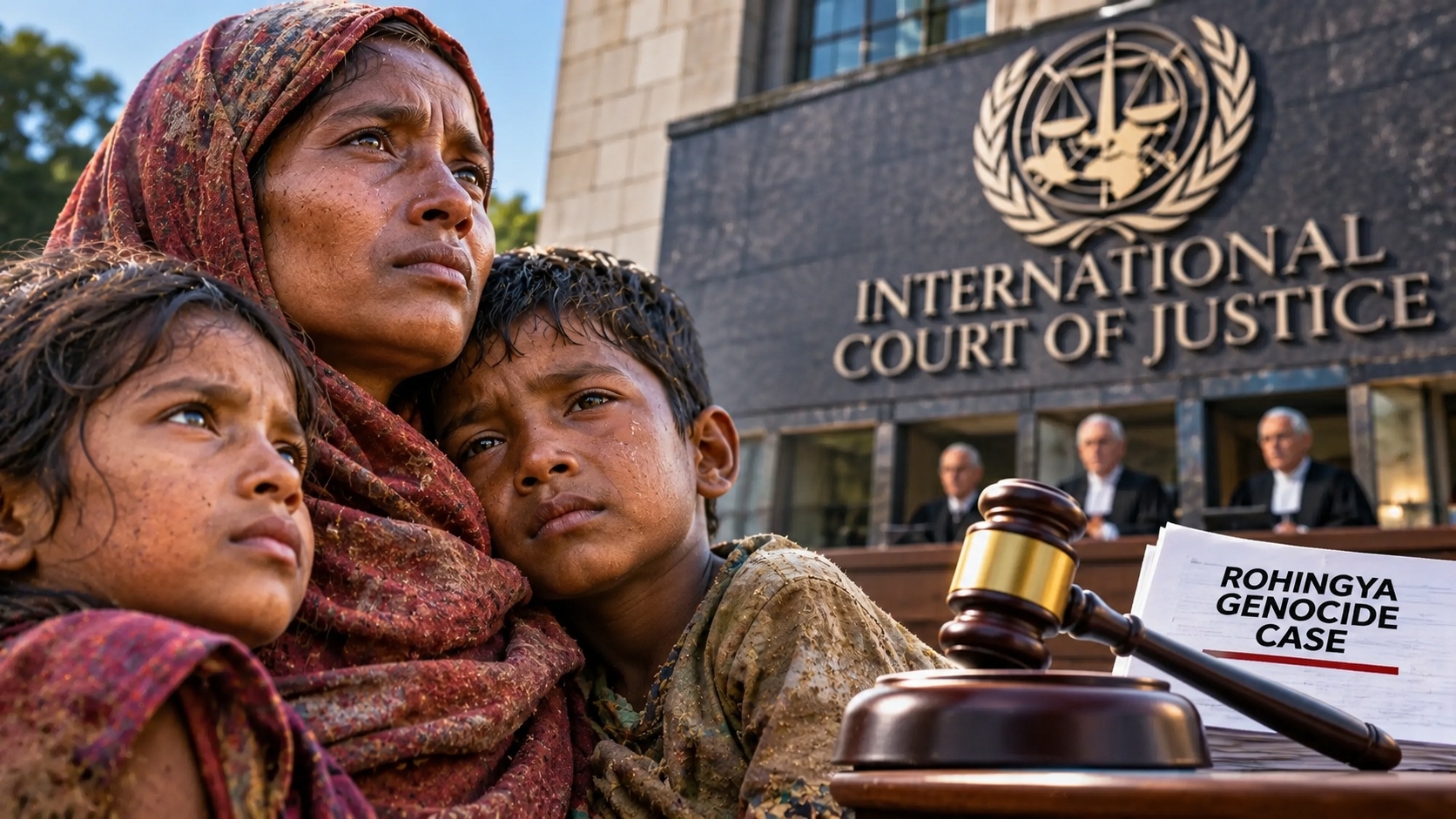
The historic judgement by the International Court of Justice (ICJ) on November 19 found Myanmar guilty of committing genocide against the Rohingya Muslim minority.
Under the guise of counterinsurgency operations, the Myanmar military unleashed the most brutal crimes on the Rohingya leaving thousands dead. Women and girls were subjected to mass sexual violence. Thousands of children were killed and almost 400 villages razed to the ground.
Who can forget the visuals of hundreds of thousand of traumatised, injured and exhausted Rohingya waiting to enter Bangladesh where until today they languish stateless in the world’s largest refugee camp.
For nearly a decade, the international community has tip-toed around the Myanmar junta, dressed as civilian government. Regional powers have taken refuge behind the language of “non-interference”, bilateral balancing, and security pragmatism.
The ICJ judgement went far beyond declaring it a genocide. It ordered Myanmar to protect the Rohingya from further discrimination and persecution, investigate and prosecute those responsible for committing genocide, legislate to prohibit genocide and guarantee non repetition.
The order includes repatriation and restitution, calling for the replacement of property the state is unable to return.
Myanmar must aid the Rohingya to locate the disappeared and provide a dignified burial for their dead as well as provide physical and psychological rehabilitation to victims and offer compensation to the Rohingya.
The ruling is binding and unappealable which may motivate the more than 150 states that are signatories to the Genocide Convention to halt trade with companies linked to the junta and stop the sale of arms and jet fuel to Myanmar.
States have rushed to issue statements of support lauding the ICJ and its historic judgement.
The European Union urged Myanmar to fully implement “without delay” the ruling, stressing that compliance is an obligation under international law but failed to mention the word genocide even once.
It is clear that the Association of Southeast Asian Nations (ASEAN) which comprises 11 Southeast Asian countries, its patrons and regional partners now face an inescapable moral and legal reckoning. For ASEAN, the era of polite consensus and incremental diplomacy must end.
For years, the bloc’s “Five-Point Consensus” served as a convenient shield to avoid confronting Naypyitaw’s military junta.
Even on the eve of the Hague verdict, regional discussions leaned toward pathways for re-engaging Myanmar’s authorities.
Continuing with the status quo after a formal genocide conviction would render ASEAN’s charter commitments to human rights and the rule of law hollow.
ASEAN member states must immediately freeze any moves toward diplomatic normalization, sever military and dual-use supply chains to Myanmar, and establish a coordinated regional protection framework that halts the detention and forced pushbacks of Rohingya refugees.
However, ASEAN’s resolve will falter if member states continue to prioritize narrow geopolitical and infrastructure interests over their binding obligations under the 1948 Genocide Convention.
Malaysia for its part has seen a surge in anti-Rohingya hate rhetoric mostly through online campaigns without the government’s watchdog taking action. It is quick to take down online posts critical of government officials. Calls for deportation of the Rohingya have been widespread. “Anwar’s government… previously announced plans to return 10,000 Myanmar nationals ‘vetted’ by the junta, with 1,476 already deported in the first phase, and close to 8,000 more in December”, according to MalaysiaNow.
Many expressed disbelief when Prime Minister Anwar Ibrahim welcomed General Min Aung Hlaing of Myanmar for an official visit to Kuala Lumpur on October 8. He has been named by the ICJ as the military chief responsible for disseminating hate speech against the Rohingya.
Amnesty International warned Anwar that history will remember whether his administration stood with the persecuted Rohingya Muslims or sent them back to the hands of the same regime which perpetrated genocide against them.
“This should have been a moment for Malaysia to stand firmly on the side of international justice and accountability. Instead, the government appears determined to ignore international crimes that place refugees at risk,” the global rights group’s Malaysian chapter said in a statement.
Anwar not only defended the genocidal general’s visit but doubled down on going ahead with a joint exercise with the Myanmar junta to return thousands of asylum seekers who fled military persecution.
ASEAN countries which engage with Myanmar, like Thailand and Singapore, and even act as conduits for arms transactions and supplies must stop this shameful practice immediately. Campaigners have long called for halt to the supply of arms and the banning of jet fuel sales to Myanmar, a step they see as vital to curbing military airstrikes against civilian infrastructure and civilians. So far only Canada has heeded the call.
India which shares a 1643 km land border with Myanmar is hidding behind the excuse that it is not a party to the 1951 Refugee Convention. It has treated Rohingya as interlopers with the added disdain it reserves for Muslims.
This was made apparent by their exclusion from the Citizenship Amendment Act (CAA), which provides a path to citizenship for non-Muslim minorities from neighbouring countries. India has repeatedly engaged in expulsions, forced deportations and pushbacks of Rohingya to both Bangladesh and Myanmar violating the principle of non-refoulement, which prohibits the return of persons to a territory where they face the risk of persecution.
Following the ICJ judgment, India’s Ministry of External Affairs reiterated its longstanding support for the “safe, speedy and sustainable return” of displaced Rohingya.
India cannot credibly claim to support sustainable repatriation while simultaneously engaging with the very military apparatus found guilty of genocide, supplying military equipment, or treating Rohingya survivors within its own borders as “illegal migrants”. Delhi ratified the Genocide Convention in 1959.
Myanmar and China have criticised the decision and Beijing joined the US and Russia in calling on international bodies like the ICJ to refrain from, “abusing their jurisdiction”. This is a pathetic attempt to dismiss the ruling when Russia, India, Belarus and China are guilty of providing training to the Myanmar military.
The list would be incomplete without mentioning Israel, which supplied advanced military equipment to Myanmar until the beginning of 2022, well beyond the genocide and into the coup period.
America, while historically supporting Myanmar’s democracy movement, now seeks to engage with the regime for resources while simultaneously undermining China. The key issue, moving forward will be enforcement, holding the generals to account.
China and Russia have historically used their veto at the UN to shield Myanmar. If they continue to do so, then the generals may never be held accountable.
South Africa has welcomed the judgement. Unfortunately, it was not one of the 11 states which joined the Gambian case, supported by the 57-member Organization of Islamic Cooperation (OIC), having repeatedly ignored calls to intervene. Pretoria sold arms to Myanmar until 2021.
If South Africa is serious about celebrating the ruling then it must follow with action, as Britain has done by expelling Myanmar’s military attache.
Myanmar’s genocidal conduct has been in the headlines for years but the international community’s interest has dwindled. Given the gravity of the situation, this should not be allowed to happen this time around.
Under Article I of the Genocide Convention, each state party bears an affirmative duty not only to punish the perpetrators of genocide, but to prevent it. This duty precludes lending diplomatic cover, economic lifelines, or military hardware to a convicted genocidal regime.
States in the region and beyond must unconditionally enforce the court’s mandate. Three immediate steps can be taken.
1. Halt All Defence and Security Cooperation: Suspend all arms transfers, military training, and security assistance to Myanmar’s junta until full compliance with the ICJ’s orders is verified.
2. Protect Survivors Under International Law: End the detention and threatened deportation of Rohingya refugees—many of whom hold UNHCR protection cards—and recognize them not as security threats, but as judicially recognized survivors of genocide entitled to non-refoulement.
3. Champion Regional Accountability: Working alongside ASEAN’s democratic and conscience-driven voices, states should condition any future regional integration, connectivity projects, or diplomatic recognition on Myanmar’s verifiable restoration of Rohingya citizenship, property restitution, and cooperation with international accountability mechanisms.
History rarely offers clear dividing lines, yet the ICJ’s verdict has drawn one in unmistakable terms. Genocide is not an “internal affair” of Myanmar, nor a bilateral dispute between Myanmar and The Gambia. It is a crime against the international order. If states wish to claim genuine global leadership, they must abandon strategic hedging and enforce the ICJ’s demands unconditionally and without delay.
By courageously bringing this case before the highest court in the world, The Gambia has reminded us that size and power are irrelevant in the fight for justice.
Iqbal Jassat, Executive Member, Media Review Network, Johannesburg, South Africa, and Advocate Shabnam Ebrahim Mayet, Co-Founder, Protect the Rohingya
Related Articles

Good news at last for Rohingyas in Malaysia – but more needed
Abdar Rahman Koya
Dhu al-Qa'dah 20, 1425 2005-01-01