Implications Of Muslim Armies Joining Trump’s So-called Peace Force For Gaza
Developing Just LeadershipOmar Ahmed
Ramadan 11, 1447 2026-03-01
News & Analysis

by Omar Ahmed (News & Analysis, Crescent International Vol. 56, No. 1, Ramadan, 1447)
As of February 2026, the zionist entity’s military campaign in Gaza has killed more than 73,000 Palestinians. Another 171,000 have been left with life-altering injuries. An entire generation carries trauma that cannot be measured in statistics.
In a territory of just 365 square kilometers, the scale of destruction has stripped bare the fiction of a so-called ‘rules-based order.’ UN Security Council resolutions have piled up, one after another, but they have failed to halt the assault. Ceasefire demands have been brushed aside, and even after a resolution was formally passed, airstrikes have continued.
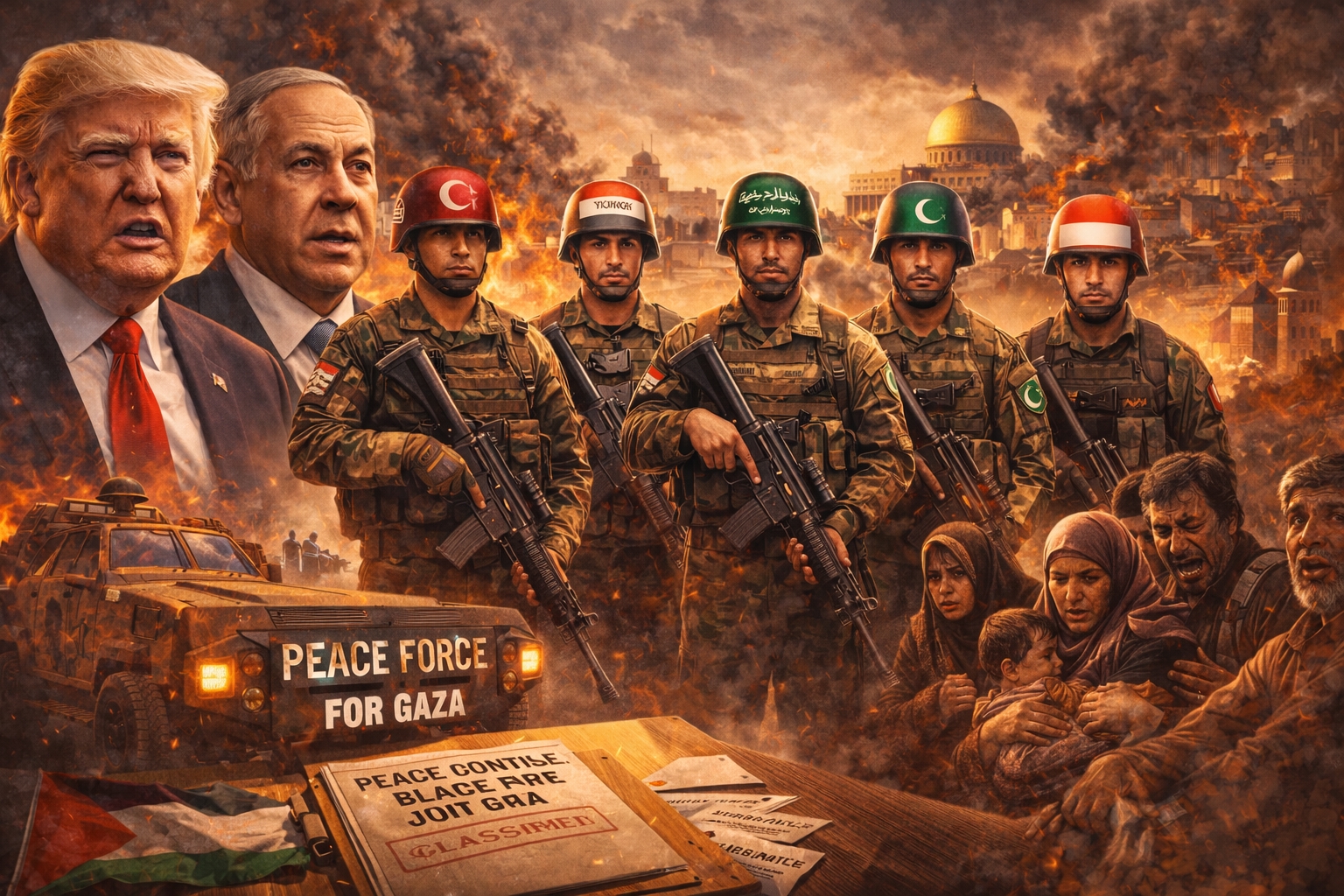
And now, as entire neighborhoods remain in ruins, Gaza is being recast as a reconstruction project – complete with an international stabilization force tasked with managing the transition.
Several Muslim-majority states from the Organisation of Islamic Cooperation (OIC) have expressed willingness to participate. Their entry into this new architecture has triggered a difficult question across the Muslim world: is this an attempt to safeguard Palestinian interests from within, or tacit endorsement of a US-shaped political order for post-war Gaza?
The structure behind the mission
In November 2025, the UN Security Council endorsed a 20-point framework for Gaza and adopted Resolution 2803 authorizing the International Stabilisation Force (ISF). The mandate outlines assistance in demilitarisation, reconstruction, and security. On paper, it resembles other post-conflict peacekeeping missions.
In practice, it does not.
Although authorized under Chapter VII of the UN Charter, the ISF will not operate under UN command. Instead, it answers to a donor-backed executive mechanism known as the Board of Peace (BoP), a structure widely viewed as dominated by the US. The Board and participating states – not the UN Secretariat – determine command and control arrangements. This defines who ultimately sets priorities on the ground.
The structure bears close resemblance to the NATO-led International Security Assistance Force (ISAF) in Afghanistan than to traditional UN blue-helmet missions. Another comparison is the Kenya-led Multinational Security Support mission in Haiti. Like those precedents, the ISF carries Chapter VII authority, including the power to use “all necessary measures” to fulfill its mandate.
Absent the constraints typically imposed by UN operational oversight, that language opens the door to action beyond defensive protection. ISF units could conduct raids against armed infrastructure deemed incompatible with the mandate, rather than limit themselves to civilian protection and self-defense.
While UNSC Resolution 2803 authorizes the force, the specific operational rules of engagement have not been published in the public domain.
The optics are politically fraught. The visible imprint of Washington on the Board of Peace, coupled with the involvement of figures such as former British Prime Minister, and unconvicted war criminal Tony Blair, has fueled suspicion in many Muslim societies.
For publics that have watched Gaza endure relentless bombardment, a US-dominated executive body overseeing reconstruction appears less like neutral stewardship and more like managed containment.
Compounding that perception is the ISF’s explicit mandate to keep Hamas at bay and facilitate the creation of a new Palestinian police force. Given the centrality of the Palestinian cause across the Muslim world, governments joining this framework must justify their decision carefully. Some argue that influence from within is preferable to irrelevance from outside. Others see participation as a strategic necessity in managing relations with the zionist entity and the US.
No one can ignore that the project’s architecture remains US-designed.
Why OIC states are stepping in
For many OIC member states, entry into the ISF structure is framed as an effort to shape what post-war Gaza becomes, rather than leave those decisions entirely to western capitals. The Palestinian cause continues to mobilize public opinion across Muslim countries, with repeated mass demonstrations reinforcing its emotional and political weight.
Turkiye has openly signaled readiness to provide military, humanitarian, and technological assistance, including participation in the stabilization force. Given Ankara’s well-documented political friction with Tel Aviv, despite ongoing trade and diplomatic relations, the zionist entity has objected to the prospect of Turkish troops in Gaza.
At the same time, Turkiye’s relationship with the US is undergoing recalibration. Cooperation in Gaza offers Ankara a channel to strengthen ties with Washington while reaffirming its regional relevance. Turkish contributions are likely to focus on engineering units and institutional support, potentially including training for a new Palestinian police structure, possibly alongside Pakistan.
Pakistan was among the founding members of the Board of Peace, signing its charter on January 22, 2026. Since the return of Donald Trump to the US presidency, relations between Islamabad and Washington have warmed noticeably. Under Field Marshal Asim Munir and Prime Minister Shahbaz Sharif, Pakistan has pursued an assertive defense diplomacy strategy, deepening coordination with Saudi Arabia and other Gulf states.
Saudi Arabia, alongside other Gulf Cooperation Council members and Jordan, is expected to contribute diplomatic oversight and significant reconstruction funding. Within this configuration, Pakistani participation offers Riyadh a trusted security partner should disputes arise on the ground.
For Pakistan’s leadership, involvement in Gaza also carries symbolic weight. Munir has cultivated an image of restoring Pakistani military credibility, particularly after the confrontation with India in May 2025. Engagement in Gaza reinforces that narrative of global relevance and Muslim solidarity.
Egypt’s position is less optional and more structural. Cairo’s membership in the Board of Peace reflects geographic reality. Control of the Rafah crossing and oversight of the Egypt–Gaza frontier make Egyptian coordination indispensable to any demilitarisation or customs regime. Without Cairo’s participation, border management, anti-smuggling enforcement, and verification mechanisms would struggle to function.
Beyond border security, Egypt retains substantial intelligence leverage. For years, Egyptian services have mediated ceasefires between Israel and Hamas, coordinated indirectly with western governments, and facilitated intra-Palestinian dialogue. Even without deploying large troop contingents, Cairo is likely to maintain liaison officers, intelligence-sharing arrangements, and influence over the formation of any new Palestinian security apparatus.
Alongside strategic calculations sits the economic dimension. Reconstruction estimates hover around $70bn once housing, infrastructure, and economic rehabilitation are fully accounted for. Such sums inevitably attract contractors, suppliers, and intermediaries from states embedded in the Board of Peace and the stabilization force. Participation is therefore not purely political, but also commercial.
Indonesia’s assertive entry
Indonesia’s commitment stands out for its scale and enthusiasm. President Prabowo Subianto’s government has indicated readiness to deploy up to 8,000 personnel by June 2026. Earlier statements floated figures as high as 20,000 troops, alongside offers to contribute to missions in Ukraine and Libya.
Subianto’s activism is shaped by domestic realities. A former military figure associated with the Suharto era, he presides over a system in which the Indonesian Armed Forces (TNI) remain a central institutional pillar. Deploying troops abroad signals international responsibility while reinforcing domestic authority and securing external backing.
Indonesia has long ranked among the top contributors to UN peacekeeping missions. Official statements emphasize that TNI personnel in Gaza would focus on humanitarian tasks rather than punitive operations. Even so, deployment into a volatile urban environment under a Chapter VII mandate would represent a significant operational step for the Indonesian military.
Financial arrangements remain unsettled. As of early 2026, no comprehensive reimbursement mechanism had been publicly confirmed. Analysts point to ongoing disagreements over funding sources, including the possibility of voluntary contributions outside traditional UN budget channels. The reported $1bn entry contribution required for Board of Peace membership illustrates that participation is not cost-free.
For Jakarta, the calculation appears to balance domestic legitimacy, international recognition, and solidarity with Palestine. Similar balances are evident among other participating states.
The decisive question, however, remains unresolved. Will these governments meaningfully shape Gaza’s political future, insisting on parameters that reflect Palestinian aspirations? Or will their presence ultimately lend broader legitimacy to a US-framed order designed to contain, rather than transform, the realities that produced this war?
Participation alone does not guarantee influence. In a territory devastated to this extent, intent will be judged by outcomes, not declarations.