No Future for Pakistan Under the Heavy Boot of the Military
Developing Just LeadershipZia Sarhadi
Rabi' al-Thani 19, 1448 2026-10-01
News & Analysis

by Zia Sarhadi (News & Analysis, Crescent International Vol. 56, No. 8, Rabi' al-Thani, 1448)
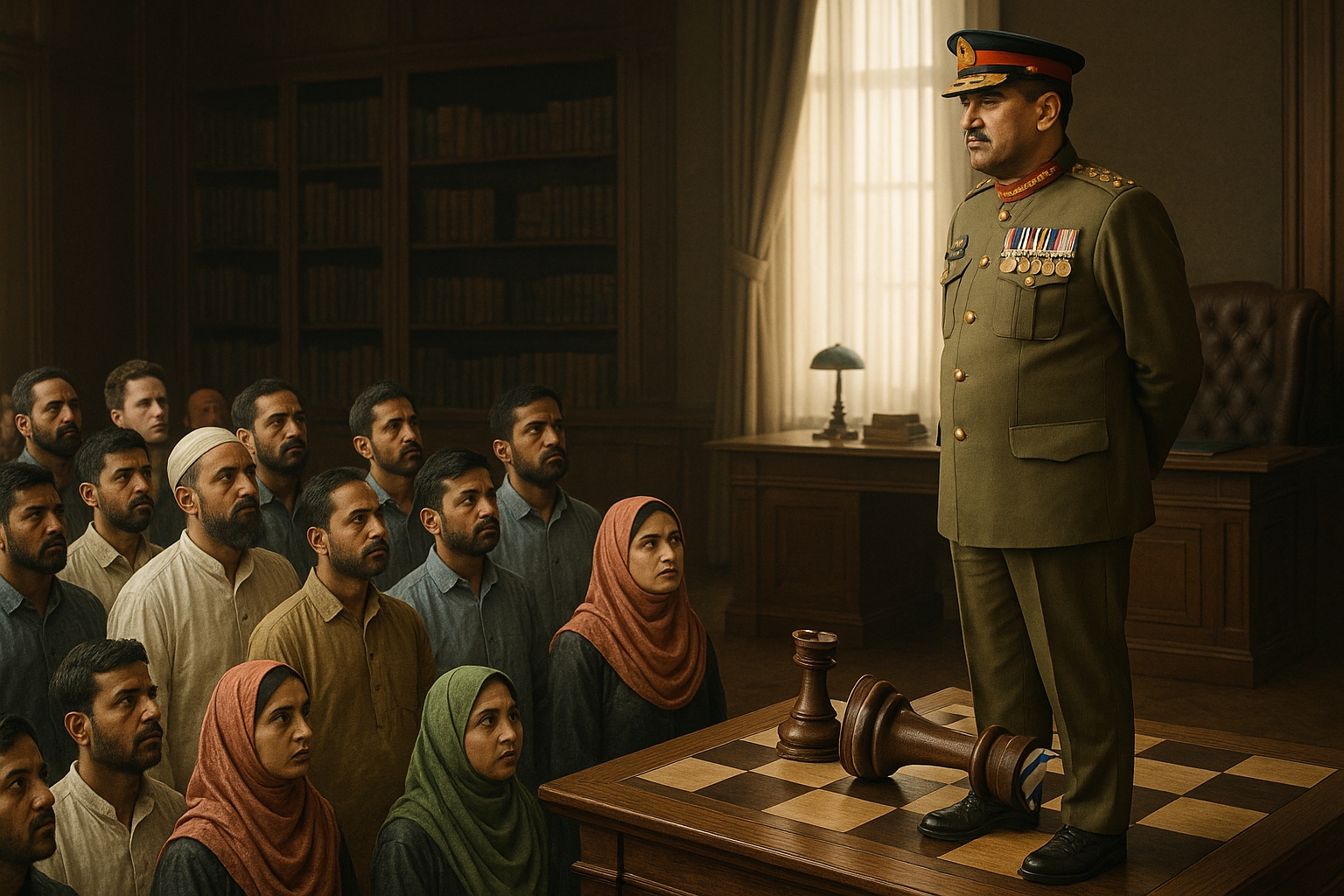
Like most states in Asia and Africa, Pakistan emerged from the bowels of British colonialism. While the idea was sound, its implementation was flawed, at several levels and has continued to bedevil the state ever since.
Pakistan emerged as a new state on the world map in 1947, as did India. The latter’s boundaries have always been flexible, depending on any particular ruler. Thus, the present-day map of India is also a British construct.
The British Indian army had a large contingent of Muslims in its ranks. They played no role in the creation of Pakistan. Yet, once Pakistan came into existence, they started to demand an ever-larger share of state resources.
Today, the military has monopolised all power and decision-making. It no longer asks for a share in the budget; it grabs what it wants and more. After all, if the gods of Rawalpindi are the real masters of Pakistan, why ask their civilian-puppets for handouts?
Ayub Khan was the first Pakistani-born commander-in-chief of the armed forces. He has written with great pride in his book, Friends Not Masters (it was actually ghost-written for him by his press secretary Altaf Gauhar), that Muslim officers in the British Indian army, true to their professionalism, remained strictly neutral during the partition of the subcontinent.
Their ‘neutrality’ resulted in the slaughter of more than one million Muslim men, women and children at the hands of Hindu and Sikh gangs. Ayub Khan’s incompetence as a military officer was well-known but he was a master political intriguer. He became the first general to grab power, setting a precedent for future military coups that have plagued Pakistan ever since.
Following Ayub Khan’s coup of October 1958, he elevated himself to the rank of ‘Field Marshal’. Does it sound familiar?
Today, Asim Munir has assumed all powers and acts as the chief of all branches of the armed forces. He also acts as prime minister, interior minister, foreign minister, chief justice and mufti-in-chief dishing out certificates of shahadahs to soldiers who die in Munir-instigated wars against other Muslims.
Long before his coup, Ayub had started indulging in political intrigue and inserted himself into the decision-making process of the country. His successors have buried their claws deeper into the body politic of Pakistan through intrigue, threats and outright gangsterism.
Let us list some of the horrors the men in khaki of grade-12 education have perpetrated in Pakistan.
Muhammad Ali Jinnah, the man who led the Pakistan movement, was seriously ill at the time of its creation. He had tuberculosis but it was kept a tightly-guarded secret.
In September 1948, he was returning from Quetta to Karachi. A military ambulance at Mauripur Airbase was arranged to take him to the Government House in Karachi. It broke down on the way, running out of gas or due to engine trouble. The critically ill Jinnah was left stranded in the stifling heat for over an hour before a replacement vehicle arrived.
Was the ambulance breakdown a deliberate attempt to get rid of the highest official in the country, the governor general? Jinnah was upright, honest and followed the law strictly. Such qualities were an obstruction to the opportunists’ ambitions who had jumped on the Pakistan bandwagon just before partition.
Jinnah’s sister, Fatima Jinnah decided to run against Ayub Khan in the presidential elections of 1964-1965. The military dictator, now calling himself ‘field marshal’, had rigged the system by imposing what was called ‘Basic Democracy’.
It was an indirect way of electing the president. Ayub believed the masses were too stupid to know who was best to rule the country. Fatima Jinnah was a strong critic of military rule and insisted that proper democracy should be established where the opinion of the people is respected.
Ayub and his henchmen launched a vicious campaign of slander against Fatima Jinnah. Many of the allegations were quite vulgar but when the aim is to get the head honcho back into power despite the rigged system, then nothing is considered too low.
Fatima Jinnah died in mysterious circumstances in July 1967. There are some who believe she was murdered on the orders of Ayub Khan. No official inquiry has been conducted into her death despite calls from several quarters. The ladies who washed her body before burial said there were stab wounds on her body.
Pakistan is one of those strange entities where anyone critical of the person in power is branded a ‘traitor’. This was true of Fatima Jinnah as well as Shaikh Mujibur Rahman.
The Awami League, the party led by Shaikh Mujib, won the 1970 general elections grabbing all seats in East Pakistan. The West Pakistani feudal lords-turned politicians and the military, however, were not prepared to relinquish their hold on power. Mujib was denounced as a ‘traitor’.
To teach the upstart Bengalis a lesson, the army was unleashed against them in March 1971. After slaughtering hundreds of thousands of innocent people, the army surrendered in a disgraceful manner to the invading Indian army.
For the thuggish West Pakistani generals, it was preferrable to surrender to arch-enemy India than respect the wishes of the people. This was even more critical if power was to go to the Bengalis of East Pakistan.
The generals learned the wrong lesson from their East Pakistan debacle. Instead of ending their interference in politics and withdrawing to the barracks, they intensified their involvement.
They attributed their defeat in East Pakistan (now Bangladesh) to 1,000 miles of hostile enemy territory that separated them. What is left of Pakistan is compact. So, the army can now launch more vicious wars against the people.
This is what is being witnessed in Balochistan, KP province and now in Azad Kashmir and Gilgat Baltistan. Anyone critical of army interference in politics is, by definition, a ‘traitor’.
There is also another criterion the army applies. Anyone who is sincere and helps Pakistan must be humiliated and removed. Take the case of M M Alam, a fighter pilot and hero of the Pakistan air force. He shot down five enemy planes in one encounter and another five for a total of 10 planes in the September 1965 war against India. This is a world record.
What did Pakistan do to him? In 1982, there were reports that then air chief Anwar Shamim was involved in embezzlement of funds. M M Alam, now promoted to the rank of Air Commodore, wrote to the air chief and asked him to set up an inquiry to clear his name.
Far from clearing his name, Air Marshal Shamim wrote to General Zia to dismiss M M Alam whom he accused of being a ‘Bengalis’ (Alam was a Bihari and had stayed back in Pakistan instead of going to Bangladesh). Zia dismissed Alam in 1982 and protected his corrupt colleague, Anwar Shamim.
M M Alam was thoroughly dejected—nay disgusted—at such mistreatment. He realized that being a hero or honest were not virtues in Pakistan. Keeping one’s mouth and eyes shut about corruption were preferable and often led to rewards.
Then there is the saga of Dr Abdul Qadeer Khan, popularly known as the “father of Pakistan’s nuclear bomb”. He had obtained a PhD in nuclear physics and metallurgy and worked in Belgium. Following India’s first nuclear explosion of May 1974—dubbed by the west, a “peaceful nuclear test”—Dr Khan came to Pakistan and established the country’s nuclear program in 1976.
In 2004, the Bush regime alleged that Pakistan was involved in nuclear proliferation. Then Pakistani military dictator, General Pervez Musharraf forced Khan to go on television and admit to being responsible for nuclear proliferation. Nuclear blue prints were found in Libya under Muammar Qaddafi.
In Pakistan, the nuclear file and all related works are under military control. Yet, Khan was forced to take the blame. He remained under house arrest for many years until the Islamabad High Court dismissed the charges against him and was released in 2009 when Musharraf had been removed from power.
Dr Abdul Qadeer Khan spent the last days of his life in isolation and deep depression. He bitterly said that being a patriot is a sin in Pakistan. He died a heart-broken man.
The latest victim of the thuggish generals is Imran Khan. His contributions to Pakistan are immense. Before entering politics, he had brought glory to Pakistan by winning the Cricket World Cup.
He also set up three world class cancer hospitals and a leading university in the country. All these he did by donating his own money as well as raising funds from people. Not one politician or general has done anything to help the people. They have no time from steal whatever they can lay their grubby hands on.
So, what did the thugs in uniform do to Imran Khan? On orders from the US, they threw him out of power. He has languished in jail on bogus charges since August 2023 as has his wife. And now his sister Aleema Khan has also been arrested.
The thuggish generals and their civilian puppets, do not believe in helping the masses. They want yes-men to do their bidding and keeping their mouths shut about the generals’ corruption and incompetence.
How can a country make progress in such horrific circumstances?
Related Articles