October 7 Cannot Be Divorced from Decades of Palestinian Subjugation
Iqbal Jassat
Rabi' al-Thani 17, 1448 2026-09-29
Daily News Analysis

by Iqbal Jassat
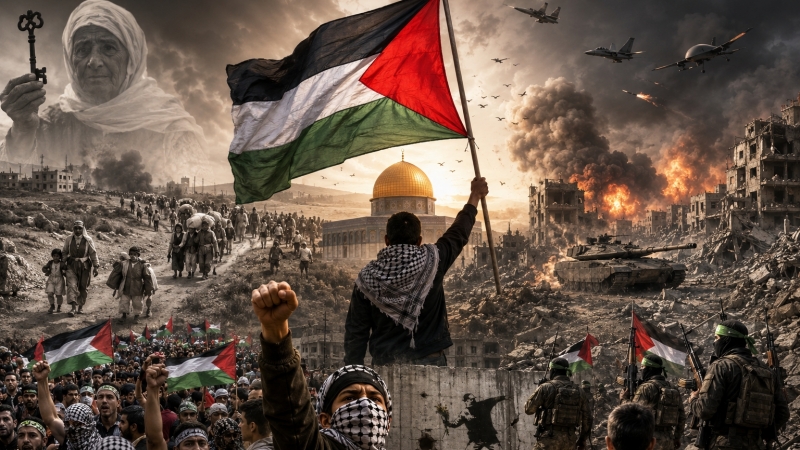
Zionist terrorism against the Palestinians did not begin on October 7, 2023.
To present the events of that day as an isolated, unprovoked flashpoint is to erase over seven decades of systemic dispossession, military occupation, and ethnic cleansing of Palestinians.
While public relations campaigns—such as those propagated by the South African Zionist Federation (SAZF) and its lackeys—attempt to frame the ongoing violence and genocide as a sudden war against unprovoked terror, international law, historical records, and human rights frameworks demand a deeper, more honest examination.
For South Africa, this is not merely a distant foreign policy debate; it is a profound moral obligation rooted in its own history of overcoming institutionalized racial segregation and oppression.
For more than 75 years, the Palestinian people have lived under a continuous reality of oppression and displacement.
The foundational trauma of 1948, known as the Nakba, saw the violent expulsion of some 750,000 Palestinians from their ancestral homes.
This was not a historical event that neatly concluded in the mid-20th century; it is an active, ongoing process.
From the West Bank to East Jerusalem, the expansion of illegal zionist squatter colonies, state-sanctioned land theft, and the systematic demolition of homes continue to squeeze Palestinians into fragmented, unviable enclaves.
In Gaza, this subjugation manifested as a brutal, 16-year land, air, and sea blockade.
Described by human rights organizations as the world’s largest open-air prison, generations of young Palestinians grew up under a siege that stripped them of basic human dignity, clean water, medical care, and freedom of movement.
The United Nations has repeatedly warned that this blockade constitutes a form of collective punishment, creating an unlivable environment long before the current escalation.
When zionist advocacy groups focus exclusively on a timeline starting in October 2023, they intentionally obscure these root causes.
Without understanding the structural violence of the occupation, it is impossible to understand why resistance erupts.
South Africa’s foreign policy framework, heavily shaped by its transition from apartheid to a constitutional democracy, explicitly rejects the normalization of this status quo.
Driven by the principles of universal human rights and the peaceful resolution of conflicts, the South African government has consistently utilized multilateral forums to challenge what it identifies as a contemporary system of apartheid in the occupied territories.
This policy crystallized globally when South Africa took the historic step of launching a case against Israel under the Genocide Convention at the International Court of Justice (ICJ).
After filing its initial Memorial in October 2024, South Africa’s legal interventions have systematically forced the international community to look beyond single-day narratives.
By submitting detailed evidence and dossiers to the ICJ monitoring committee—most recently in mid-2026—the Department of International Relations and Cooperation (DIRCO) has legally challenged the ongoing military operations, civilian displacement, and the deprivation of essential resources in Gaza.
To counter one-sided, ahistorical narratives, the international community must ground its discourse in universal human rights and established law, just as South Africa has done by demanding compliance with ICJ provisional measures.
Justice for Palestine cannot be built on the foundations of endless military subjugation, illegal blockades, and the denial of self-determination.
Critically, South Africa’s defense of Palestinian human rights has transitioned from isolated state actions to a coordinated global movement.
Through the formation of the Hague Group, an important transnational coalition established alongside countries like Malaysia, Cuba, Namibia, and Senegal, the Global South has united to shift from mere rhetorical condemnation to practical execution.
The Hague Group has adopted a definitive stance: it demands adherence to the July 2024 ICJ Advisory Opinion declaring the occupation unlawful, actively supports the enforcement of International Criminal Court (ICC) arrest warrants, and champions robust measures such as enforcing arms embargoes and blocking military fuel shipments at state ports.
However, state-level legal mechanisms are only half the battle.
The ongoing erasure of Palestinian history is sustained by an aggressive global misinformation apparatus.
To achieve lasting justice, civil society groups, trade unions, community organizations, and independent journalists must step forward as a critical line of defense.
It is the urgent duty of civil society to actively combat the false, ahistorical narratives emanating from the Netanyahu regime—narratives that are routinely parroted, sanitized, and amplified by localized zionist lobby groups.
Confronting the historical reality of the past seven decades, and aggressively refusing to let the public record be rewritten, is a necessary path towards dismantling the structures of zionist oppression and securing liberation for the Palestinian people.
Iqbal Jassat, Executive Member Media Review Network, Johannesburg, South Africa
Related Articles
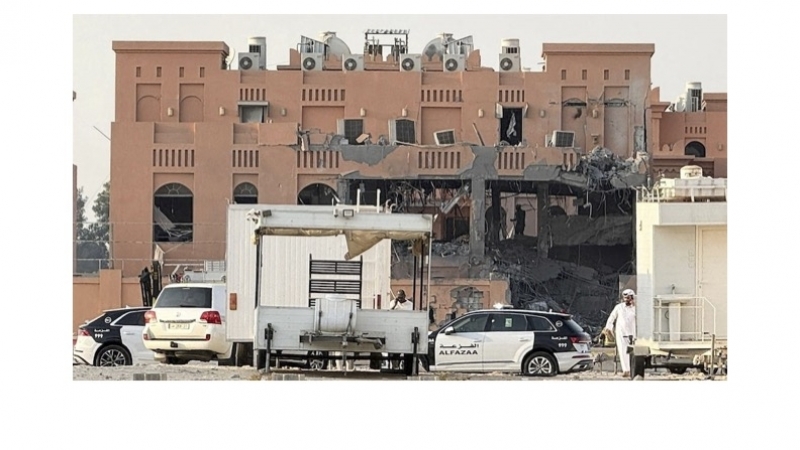
Zionist Israel confirms its terrorist nature by attacking Hamas officials in Doha, Qatar
Crescent International
Rabi' al-Awwal 16, 1447 2025-09-09
In martyrdom, Imam Khamenei has achieved eternal life
Crescent International
Ramadan 12, 1447 2026-03-02

As the clock ticks for ICJ decision, Netanyahu resorts to sabotage
Iqbal Jassat
Jumada' al-Akhirah 28, 1445 2024-01-10