Rifaat Al-Asad: From the Butcher Of Hama To Role As Opposition Figure
Developing Just LeadershipMohamed Ousman
Ramadan 11, 1447 2026-03-01
News & Analysis

by Mohamed Ousman (News & Analysis, Crescent International Vol. 56, No. 1, Ramadan, 1447)
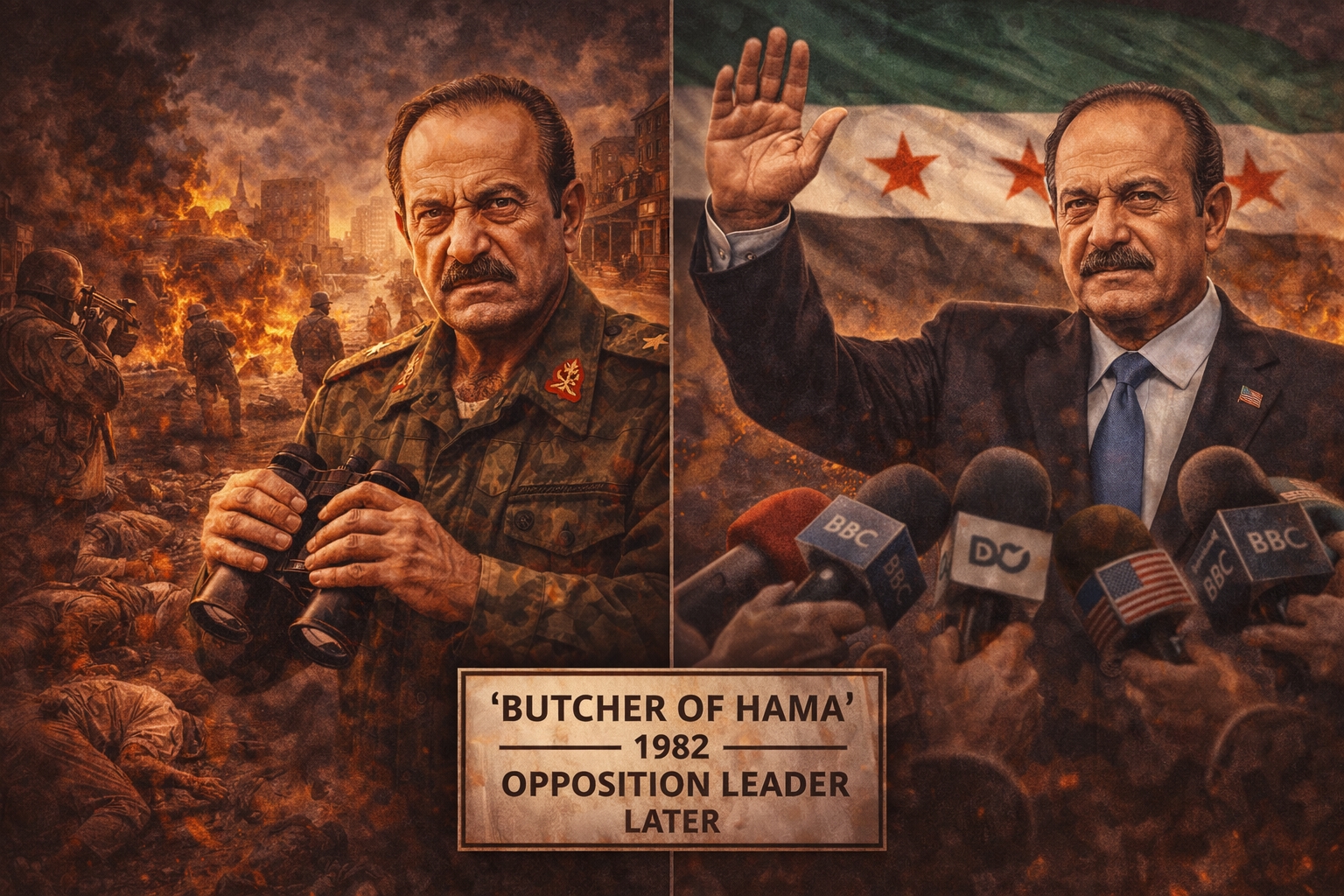
Rifaat al-Asad, who died on January 20, 2026 in Dubai, was the principal architect of the 1982 Hama massacre when his brother Hafez al-Asad was Syria’s president.
He later positioned himself as a Syrian opposition figure in 2011.
The instrumentalization of the Muslim Brotherhood within regional geopolitics, particularly Saudi Arabian alignment against Syria following Hafez al-Asad’s post-1973 rejection of compromise with Israel needs careful examination.
This analysis is further framed through Islamic political science using the theories of Dr. Kalim Siddiqui, Imam Zafar Bangash, and Imam Muhammad al-Asi, emphasizing the Qur’anic rupture between power, justice, and taqwā-based governance.
Most media present Rifaat al-Asad as both a perpetrator of extreme state violence and a paradoxical political actor who later emerged with opposition credentials.
This duality offers a productive site for Islamic political science inquiry, where power is evaluated not through institutional legitimacy but through moral, Qur’anic civilizational criteria.
We must interrogate how authoritarianism, Islamist (not Islamic) opposition, and foreign patronage converge to undermine the Islamic social contract grounded in taqwā.
Most media coverage foregrounds Rifaat’s command role in the 1982 Hama massacre, emphasizing military brutality, civilian casualties, and personal enrichment.
Rifaat is depicted as an extension of Baʿathist authoritarianism rather than an autonomous actor.
His later emergence (2011) as an opposition leader is presented as authentic, absent any skepticism.
This highlights a contradiction between evaluating his past and present depending on the benefit anti-Islamic forces seek to extract.
It also highlights how sectarian narratives lack understanding of political developments.
The Muslim Brotherhood appears as the principal Islamist antagonist in the Hama narrative, framed as a militant insurgency crushed by overwhelming force.
Most media outlets fail to explicitly mention, specify or contextualize that faction of the Muslim Brotherhood’s geopolitical entanglements with the closet, pro-zionist Arabian regimes, at the time.
The mainstream media mostly reproduces a secular moral economy in which legitimacy is measured by human rights discourse rather than moral authority derived from Divine accountability.
Here, the Muslim Brotherhood is implicitly de-Islamicized, treated as a political faction rather than part of a broader Islamic movement disrupted by Cold War and petro-political interests.
Rifaat’s 2011 opposition role reflects a deeper pathology: elite recycling within power struggles divorced from ethical transformation.
This pathology aligns with Imam Āsī’s diagnosis of the leadership crises rooted in the “excommunication of Allah” from political life.
Most mainstream media also position violence as a state monopoly and rebellion as aberration.
The broader Muslim Brotherhood resistance— rather than the faction of the Muslim Brotherhood’s geopolitical entanglements with the closet, pro-zionist Arabian regimes—is compressed into “extremism,” while regime violence is contextualized as historical tragedy.
This asymmetry reflects what Dr. Siddiqui identified as the modern state’s success in criminalizing Islamic political agency while normalizing coercive sovereignty.
The silence on Saudi patronage of Muslim Brotherhood elements—particularly after Hafez al-Asad rejected US-Israeli post-1973 accommodation—functions discursively to detach Islamic (not Islamist) movements from imperial political economy.
This omission reinforces nationalist rather than ummatic frames of analysis.
Hama symbolizes the annihilation of Islamic urban social memory.
Rifaat embodies the militarized state severed from moral restraint, while the broader Muslim Brotherhood is reduced to a symbol of disorder rather than moral dissent.
Rifaat’s later opposition symbolism in 2011 represents what Imam Bangash calls “counter-revolutionary masquerade,” where former oppressors rebrand as reformers without ethical rupture.
Kalim Siddiqui’s Islamic Movement Theory
Dr. Siddiqui’s theory emphasizes the Islamic movement as a civilizational project aimed at reconstituting power around divine sovereignty rather than nation-state legitimacy.
From this perspective, both the Syrian regime and its Islamist opposition failed to escape the structural logic of the modern state.
Rifaat exemplifies what Dr. Siddiqui would describe as the “internalized colonial elite,” exercising violence to preserve an inherited political order rather than transforming it.
The Muslim Brotherhood’s insurgency, meanwhile, lacked the epistemological independence necessary to resist co-optation by Saudi and western interests.
Their reduction to a security problem reflects their failure to articulate a comprehensive Islamic alternative.
Dr. Siddiqui would interpret Hama not as an aberration but as an inevitable outcome of an Islamic movement confronting a jahili state without sufficient intellectual and organizational autonomy.
Rifaat’s later opposition role further demonstrates the absence of principled leadership capable of transcending power cycles.
Zafar Bangash’s Sirah-Based Political Theory
Imam Bangash’s Sirah theory evaluates political action against the Prophet’s method of moral authority, patience, and principled confrontation.
From this lens, Rifaat’s conduct is categorically anti-Sirah, representing raw coercion devoid of prophetic ethics.
The Brotherhood’s militarization in Hama similarly diverges from Sirah-based gradualism and community rootedness.
Bangash would argue that premature confrontation without societal consensus invites catastrophic repression.
Saudi patronage further distorted the Muslim Brotherhood’s ethical compass, substituting petro-political expediency for prophetic integrity.
Rifaat’s 2011 claims to opposition legitimacy violate Sirah principles of accountability and repentance.
Leadership, in Bangash’s framework, cannot be retroactively claimed without moral transformation.
Imam al-Asi’s Qur’anic Political Theory
Imam Āsī’s Qur’anic theory provides the most comprehensive critique.
He argues that political collapse stems from severing governance from Allah’s authority, producing leaders who pursue “biased justice” aligned with nationalism, class, or geopolitical interests (Āsī, 2013, Vol. 8, p. 183).
Rifaat epitomizes this condition: a leader exercising power without taqwā, accountability, or moral restraint.
Āsī would argue that the Muslim Brotherhood’s failure lies not in resistance per se but in operating within a corrupted epistemic field shaped by taqlīd and foreign patronage (Āsī, 2017, Vol. 11, p. 218).
Saudi instrumentalization reflects globalist containment of Muslim potential, consistent with Āsī’s warning that powerful forces seek to “contain or confront” a taqwā-based social order (Āsī, 2010, Vol. 4, p. 282).
Āsī would argue that Rifaat’s reappearance in 2011 illustrates the Qur’an “without a human backbone” (Āsī, 2010, Vol. 4, p. 79): political discourse detached from moral substance.
Societal transformation, Āsī insists, cannot arise from coups, recycled elites, or Islamist analogs of western models (Āsī, 2013, Vol. 8, p. 316).
Both regime and opposition failed to reorganize life according to Allah’s command (Āsī, 2009, Vol. 3, p. 263).
Viewed through Islamic political science, the Rifaat narrative reveals not merely authoritarian brutality but a deeper civilizational crisis.
The suppression of Islamic political agency, the co-optation of Islamist movements, and the recycling of morally bankrupt elites reflect a fractured relationship with Allah.
Without restoring Qur’anic moral authority, political change remains cosmetic and catastrophic.
Bibliography
Al-Āsī, Muhammad: The Ascendant Qur’an: Realigning Man to the Divine Power Culture. Various Volumes. Institute of Contemporary Islamic Thought, (2008-2024).
Bangash, Zafar: In Pursuit of the Power of Islam: Major Writings of Kalim Siddiqui. Toronto: The Open Press (1996).
Bangash, Zafar: Power Manifestations of the Sirah. Toronto: ICIT. (2011).
Bangash, Zafar: Editorial introduction to Siddiqui’s collected works
Bangash, Zafar: Articles in Crescent International (various issues)
https://crescent.icit-digital.org/articles/power-dimensions-in-the-sirah-of-the-noble-messenger-saws
https://crescent.icit-digital.org/articles/the-importance-of-re-examining-the-seerah-of-the-prophet
Siddiqui, Kalim: The Islamic Movement: A Systems Approach. London: The Muslim Institute, (1976).
Siddiqui, Kalim: Issues in the Islamic Movement. Toronto: The Open Press (1982).
Siddiqui, Kalim: Beyond the Muslim nation-States. The Muslim Institute (1977).
Siddiqui, Kalim: Stages of Islamic Revolution. London: The Open Press, (1996).