The Final Pillar Of western Dominance Cracks: The Economic Unraveling
Empowering Weak & OppressedTahir Mustafa
Dhu al-Qa'dah 13, 1447 2026-05-01
News & Analysis

by Tahir Mustafa (News & Analysis, Crescent International Vol. 56, No. 3, Dhu al-Qa'dah, 1447)
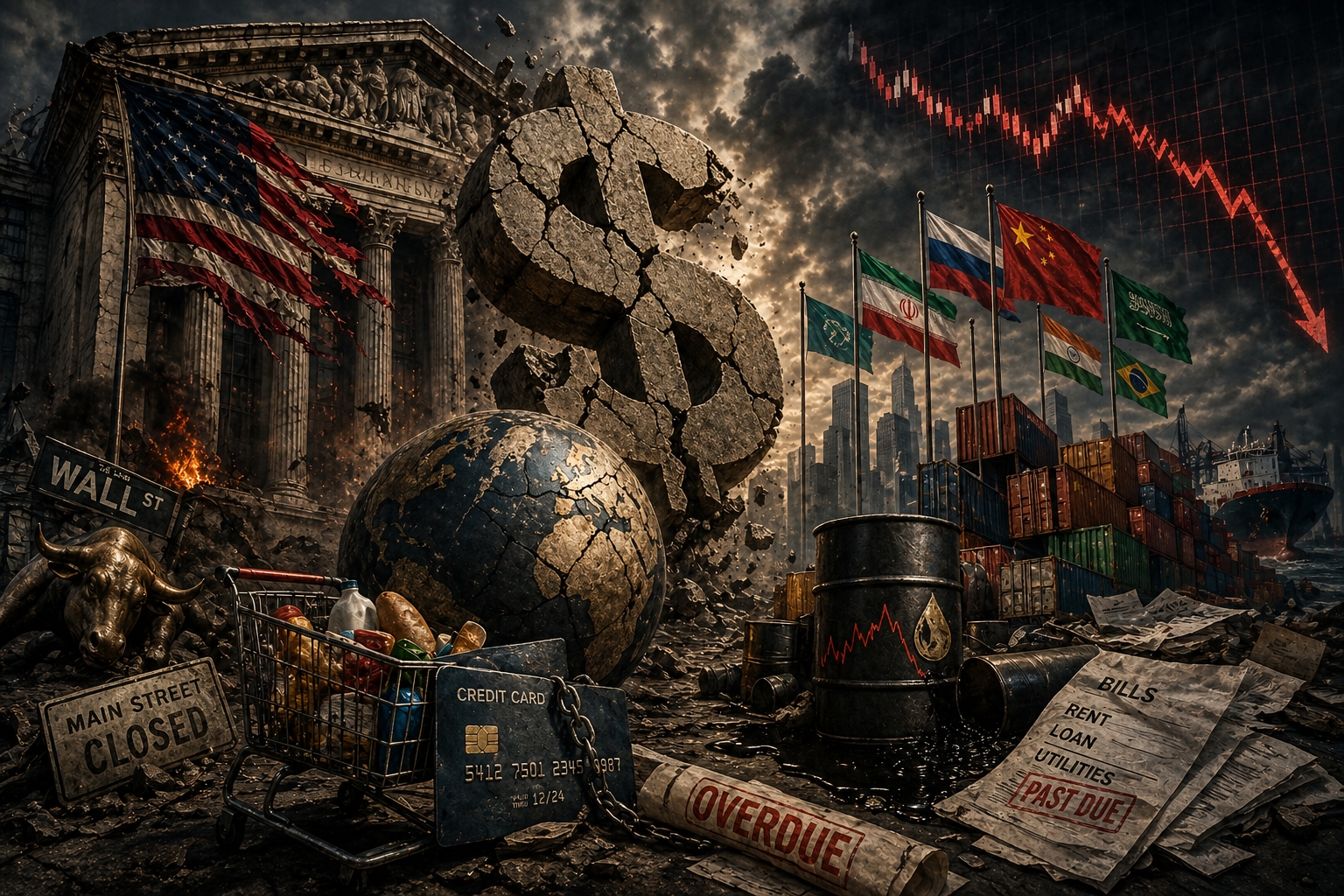
For decades, the western-imposed global order has been presented as the only model of economic stability, prosperity, and economic predictability. Its architects, led by the United States of America and its European surrogates peddled the western economic system as the only viable path toward development and modernity.
Participation meant access to markets, capital, and institutional support. Alignment meant economic stability and prosperity.
This economic promise was one of the central pillars of western dominance along with the threat of use of military force without limits. However, military power alone could not sustain global hegemony; it required legitimacy. That “legitimacy” was derived from the perception that the western system delivered material well-being not only to its own populations, but also to those subservient to it.
Today, that pillar is visibly eroding. The system no longer guarantees stability. It does not deliver broad-based prosperity. Instead, it produces volatility, inequality, and systemic fragility.
Although we are not witnessing a sudden and total economic collapse, a gradual and strategic economic disintegration is in full motion.
Myth of Economic Prosperity
The post-1945 order was built on institutions such as the IMF and World Bank, backed by the dominance of the US dollar. The Bretton Woods framework and later the petrodollar system ensured that global trade, especially energy—remained tied to western financial structures.
This arrangement allowed the US to project power far beyond its borders. By controlling the global financial system, it could impose sanctions, regulate liquidity, and influence the economic trajectories of entire regions. For some states, subservience to this system appeared beneficial.
However, this “stability” was never neutral. It was conditional and hierarchical. It required political compliance and economic alignment with western interests. Those who resisted, whether Iran, Venezuela, or others, were subjected to economic warfare, sanctions, and isolation.
The promise of prosperity was, therefore, inseparable from the reality of coercion and subjugation.
Internal Decay: The Crisis Within
The most significant challenge to the western economic order is no longer external, it is internal. The system is failing to deliver for its own populations, let alone its external surrogates.
In the US, the signs of economic distress are impossible to ignore. Rising living costs, record levels of consumer debt, and widening inequality have transformed the economic landscape. Millions of people are no longer pursuing upward mobility; they are struggling to maintain basic living standards.
Evidence from recent data shows households turning to the cheapest possible food options, delaying essential payments, and relying on debt mechanisms simply to survive. Borrowers are falling behind on loans, while entire segments of society are being pushed toward financial precarity.
This is not an anomaly. It is structural. The western model has evolved into a system that concentrates wealth at the top while hollowing out the middle and lower classes.
Fractures Within the Western Bloc
The erosion of the system is also evident in growing disunity among western regimes. What was once presented as a cohesive bloc is increasingly fragmented, driven by divergent economic interests and strategic uncertainties.
Canada provides a sober example. Prime Minister Mark Carney’s acknowledgment that close economic ties with the US have become a “weakness” reflects a profound shift in perspective. For decades, integration with the US economy was considered a strategic advantage. Now it is seen as a liability.
This shift is driven by the unpredictability of US policy, tariffs, trade wars, and unilateral decisions that undermine long-standing agreements. As a result, even close allies are seeking to diversify their economic relationships, including deeper engagement with non-western powers.
This is a critical development. When the inner circle of the western order begins to question its central node, it signals a loss of confidence that extends far beyond bilateral relations and economics.
Petrodollar and the Illusion of Permanence
At the heart of western economic dominance lies the US dollar, particularly its role in global energy markets through the petrodollar system. This arrangement ensured continuous global demand for dollars, reinforcing US financial hegemony.
While the dollar remains dominant, its position is no longer unchallenged. Sanctions regimes have forced countries like Iran and Russia to develop alternative trading mechanisms, often denominated in Chinese yuan.
These alternatives are not yet capable of replacing the dollar completely, but they are eroding its exclusivity. More importantly, they emerge during periods of crisis, when the western system is weaponized and access is restricted.
Each crisis leaves behind a structural residue. More countries gain experience operating outside the dollar system. More financial institutions develop alternative channels. Over time, this creates a parallel infrastructure that weakens the centrality of the dollar without immediately displacing it.
The result is a system that appears stable on the surface but is increasingly fragile at its edges.
Iran and the End of One-Way Economic Warfare
One of the most significant developments in recent years is the shifting balance of economic power in geopolitical confrontations. The western model has long relied on the assumption that economic pressure flows in one direction, from western capitals towards others.
Islamic Iran’s powerful asymmetric response changed this decades-long set up forever.
Despite facing unrelenting military and economic aggression, Iran demonstrated its ability to impose substantial economic costs on the entirety of western economies. Its strategic position over the Strait of Hormuz—a passage through which approximately 20 percent of global energy flows, allowed it to disrupt supply chains and trigger a global energy shock.
This disruption had immediate consequences: rising fuel prices, increased inflation, and heightened recession risks across western economies. More importantly, it exposed a critical vulnerability—the west’s sensitivity to economic pain.
The US, despite its material military superiority, was compelled to recalibrate its strategy, mainly due to internal and external economic pressures. Inflation, rising costs, and market instability translated into political pressure, forcing search for a face-saving political exit from a strategic quagmire.
This marks a turning point. Economic warfare is no longer a one-way instrument of western dominance. States targeted by sanctions and aggression can now see that leveraging structural vulnerabilities to impose reciprocal economic costs against American imperialism are quite realistic.
Financial Instability and the Decline of Trust
Another indicator of systemic decline is the changing behavior of global financial markets. The traditional role of US Treasury bonds as a safe-haven asset is being questioned.
Recent developments show central banks reducing their holdings of US treasuries during periods of geopolitical tension, contributing to rising yields and increased borrowing costs for Washington.
This is a significant departure from historical patterns. It suggests that confidence in the US as the ultimate guarantor of financial stability is weakening. When the core asset of the system begins to lose its safe-haven status, the implications are far-reaching.
It signals not only economic vulnerability, but also a deeper crisis of trust.
Israel and the Crisis of Western Credibility
An increasingly prominent factor in the erosion of western legitimacy is the role of the zionist entity in shaping western foreign policy. Across segments of western societies and even within parts of the political establishment, there is a growing perception that alignment with Israel has imposed significant political and economic costs.
Conflicts driven or intensified by this alignment, particularly in West Asia, have contributed to instability, rising energy prices, and economic strain. The recent aggression against Iran is a case in point, where western involvement closely tied to Israeli objectives, resulted in economic repercussions that directly impacted western populations.
This has led to a growing sense of disillusionment. Many perceive that their governments prioritize external agendas over domestic well-being. This perception erodes trust, undermines political cohesion, and further weakens the legitimacy of the western order.
In this context, the zionist entity is increasingly viewed not as a strategic asset, but as a key liability, one that accelerates the decline of western credibility on the global stage. It is now simply a matter of time before western regimes are forced to choose between their own strategic interests and those of Israel. Not out of principle, but due to the fact that alignment with Israel is too costly on multiple levels.
A System in Managed Decline
It would be premature to declare the immediate collapse of the western economic order. The United States still controls the most significant financial markets, the dollar remains the dominant reserve currency, and western institutions retain considerable influence.
However, the trajectory is unmistakable.
The system is transitioning from dominance to decline, characterized by fragmentation, volatility, and diminishing legitimacy. Alternative economic networks are emerging, not as complete replacements, but as functional complements that reduce dependence on western structures.
This transition is not linear. It will unfold through cycles of crisis and temporary stabilization. Each crisis will expose new vulnerabilities and accelerate the development of alternatives.
Collapse of the Final Pillar
The western-imposed global order was sustained by the belief that it delivered economic stability and prosperity. That belief is gone.
Internally, western economies face deepening inequality, rising costs, and declining living standards. Externally, allies are reassessing their dependencies, while adversaries are developing mechanisms to bypass western economic control.
At the same time, the political and moral credibility of the west is gone forever, with growing recognition of the role played by the zionist entity in driving policies that undermine both global stability and domestic well-being.
What remains is a system that still possesses immense power, but increasingly lacks coherence, legitimacy, and resilience. Its final pillar, economic stability is no longer a source of strength. It is a point of failure.
As this pillar continues to weaken, the western imposed order will continue its irreversible descent. It will lose its ability to shape the world, as it struggles to maintain control over itself.