The Islamic Forum of Africa’s Annual Event for Muslim Unity
Mohamed Ousman
Jumada' al-Akhirah 06, 1448 2026-11-16
Daily News Analysis

The 1971 Bangladesh Liberation War was a devastating tragedy rooted in political inequality, cultural discrimination, economic exploitation and the denial of democratic rights to the people of East Pakistan.
Following the December 1970 elections, the refusal to transfer power to the winners, the Awami League escalated tensions.
The Pakistani military launched Operation Searchlight in March 1971, resulting in widespread atrocities, mass displacement and human suffering.
Millions fled to India and the conflict culminated in India’s military invasion and Pakistan’s defeat in December 1971.
The emergence of Bangladesh left deep wounds, mistrust and lasting divisions among South Asian Muslims.
The Importance of Unity in Islam
Unity is a fundamental principle of Islam, rooted in the theodology that all Muslims submit to Allah and share a common responsibility towards humanity.
The Qur’an commands Muslims to hold firmly together to the rope of Allah and not become divided (3:103).
Islamic unity does not demand uniformity in language, culture or jurisprudence.
Rather, it requires shared commitment to justice, compassion, consultation and collective responsibility.
The Ummah must transcend nationalism, sectarianism and prejudice.
Genuine unity transforms Muslims from fragmented communities into a principled collective capable of confronting injustice, promoting dignity and serving humanity.
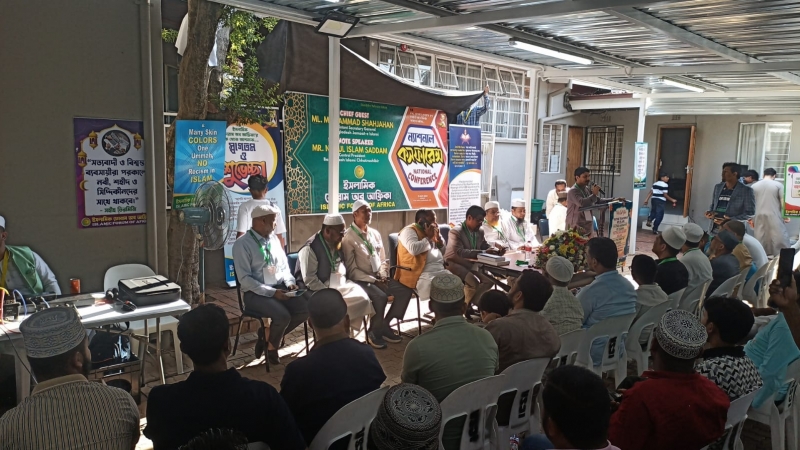
The Islamic Forum of Africa’s annual event, hosted through the Bangladeshi community at the Islamic Circle of Southern Africa (ICSA) premises by the Pakistani community, represents a significant initiative towards Muslim solidarity and reconciliation.
The gathering brought together Maulana Muhammad Shahjahan, Deputy Secretary-General of Jama‘at-e-Islami Bangladesh, and Nurul Islam Saddam, President of Bangladesh Islami Chhatra Shibir.
The platform demonstrated the potential of Islamic institutions to transcend historical grievances.
It provided an opportunity to strengthen brotherhood and reaffirm the shared responsibilities of the global Ummah.
Imam Muhammad Al-Asi’s Qur'anic Framework Analysis
The Islamic Forum’s annual event represents a meaningful step towards overcoming the historical, political and psychological divisions that have separated Pakistani and Bangladeshi Muslims.
Viewed through Al-Asi’s Qur’anic framework, the gathering is more than a community event: it is an expression of the Islamic principle that the bonds of Islam, justice and collective responsibility must transcend ethnic, linguistic and national identities (Al-Āsī, Muhammad: The Ascendant Qur’an: Realigning Man to the Divine Power Culture. (Vols 1-12). Institute of Contemporary Islamic Thought, Toronto (2008-2022)).
Beyond Nationalism
Al-Asi challenges nationalism as an ideological foundation for Muslim collective identity.
He argues that human communities should be consolidated according to their “emotional and mental proximity to Allah”, rather than racial, geographical or historical characteristics.
The 1971 tragedy illustrates the destructive consequences of nationalism when national identity and competing political ambitions become more important than justice, consultation and human dignity.
The subsequent separation of Pakistan and Bangladesh created distinct national identities, but it should not permanently determine the nature of relationships between Muslims.
This common Islamic gathering challenges inherited separation.
It demonstrates that historical differences need not become permanent barriers to Islamic cooperation.
The gathering therefore represents a practical rejection of the idea that national boundaries should determine the extent of Muslim brotherhood.
Tawhid as the foundation of collective identity
Al-Asi identifies the displacement of Allah’s authority by competing forms of human allegiance as a fundamental problem in contemporary society.
He particularly criticises the elevation of nationalism, racial identity and state sovereignty into competing sources of ultimate loyalty.
His argument is reinforced by the Qur’anic principle of Ibrahimi submission, which rejects false authorities and exclusive claims to religious superiority.
Al-Asi explains that Muslims must overcome “religious racism, racist religions, national interests, super-race concepts” and other competing allegiances.
Applied to this event, Pakistani and Bangladeshi Muslims are reminded that their ultimate identity is not determined by the events of 1971 or by competing national narratives.
Their commitment to Allah provides a higher foundation for cooperation.
This requires relegating national identities beneath the moral obligations of Islam.
Unity without uniformity
One of Al-Asi’s most important contributions is his insistence that Islamic unity does not require Muslims to become identical.
He states that Muslims must unite without abandoning their respective fiqhi schools or linguistic preferences.
He emphasises that these differences should not become divisive obstacles when Muslims share common Islamic purposes.
This principle is elevant to Pakistani-Bangladeshi relations.
Differences in language, political experience, organisational affiliation and historical interpretation should not prevent cooperation.
The presence of Maulana Shahjahan and Saddam alongside the Pakistani community demonstrates that meaningful cooperation can take place without uniformity.
Such interaction creates opportunities for mutual understanding, institutional cooperation and the development of shared priorities.
Justice as the foundation of reconciliation
Importantly, Al-Asi’s framework does not define unity as superficial friendship or the suppression of historical grievances.
Justice is indispensable.
Genuine brotherhood requires honesty, empathy and a commitment to preventing injustices in the future.
He identifies racism as a form of munkar, or social evil, requiring collective and organised action rather than merely individual expressions of goodwill.
He further explains that discrimination cannot be eliminated through private religious rituals alone, but requires disciplined social institutions and responsible administration.
The event is a positive beginning because it creates the relationships through which difficult historical issues can be approached constructively.
Al-Asi argues that Muslims cannot achieve meaningful influence while remaining divided.
He states that “if you are not united, you will not have any influence”, emphasising the need for transparent leadership, common purposes and collective action.
This is relevant to this event which provides an opportunity to develop cooperation beyond ceremonial gatherings.
Through Al-Asi’s Qur’anic framework, this event represents a constructive movement from historical separation towards an Islamic identity grounded in Tawhid, justice and collective responsibility.
Its greatest significance lies in refusing to allow divisions to dictate the future of the Ummah.
It provides an opportunity to transform historical pain into a renewed commitment to Islamic brotherhood.
Imam Zafar Bangash’s Seerah Framework and the Covenant of Madinah
Bangash’s Seerah-oriented approach places particular emphasis on the Prophet Muhammad’s (ﷺ) ability to transform fragmented communities into a united society through faith, principled leadership, consultation and collective responsibility (Bangash, Zafar: Power Manifestations of the Sirah. Toronto: ICIT. (2011))
The establishment of the Madinah community provides an important historical precedent. Upon arriving in Madinah, the Prophet (ﷺ)
brought together the Muhajirun (exiles from Makkah) and the Ansar (helpers from Madinah), overcoming differences in tribal affiliation, geographical origin and economic circumstances.
The Covenant of Madinah subsequently established a framework of mutual obligations, security, cooperation and justice among different communities.
The significance of this model is that unity was achieved through the establishment of common principles and responsibilities.
The Islamic Forum’s event reflects aspects of this Prophetic approach. Bangladeshi and Pakistani Muslims, whose communities carry the legacy of a painful political separation, came together within a shared Islamic institutional environment.
The participation of Maulana Shahjahan and Saddam alongside the Pakistani community demonstrates the possibility of developing relationships based on common Islamic commitments rather than inherited national antagonisms.
The Covenant of Madinah also reminds Muslims that social cohesion requires more than emotional solidarity.
It demands practical agreements, mutual respect, protection of rights and collective responsibility.
The Prophetic model demonstrates that historical divisions can be overcome through principled institution-building and shared responsibility.
Dr. Kalim Siddiqui’s Islamic Movement Theory
Siddiqui’s Islamic Movement Theory provides another important perspective for understanding the significance of this gathering.
His approach emphasises that Islam is not an individual religious identity or a collection of community organisations (Bangash, Zafar: In Pursuit of the Power of Islam: Major Writings of Kalim Siddiqui. The Open Press, Toronto (1996). Siddiqui, Kalim: Stages of Islamic Revolution. The Open Press, London (1996).)
It represents a comprehensive movement seeking to establish Allah’s guidance in collective human affairs through organised effort, principled leadership and the transformation of society.
From this perspective, Muslim unity must progress beyond occasional gatherings and ceremonial expressions.
It requires the development of a conscious, organised and purposeful Islamic movement capable of overcoming fragmentation within the Ummah.
The participation of representatives from Jama‘at-e-Islami Bangladesh and Bangladesh Islami Chhatra Shibir, alongside Pakistani Muslims, is significant.
These organisations represent different experiences of Islamic political and social mobilisation, yet their shared Islamic foundations provide opportunities for intellectual exchange and institutional cooperation.
The 1971 tragedy illustrates the dangers of allowing competing political interests, national identities and leadership failures to undermine the collective interests of Muslims.
Siddiqui’s movement-oriented perspective encourages Muslims to learn from such historical experiences and develop a higher understanding of their responsibilities towards the Ummah.
The event can consequently be understood as a step towards rebuilding relationships between communities whose historical experiences have produced mutual sensitivities.
It provides an opportunity to establish networks of Islamic leadership, strengthen organisational relationships and develop a shared understanding of contemporary challenges.
However, the real test will be whether this engagement develops into institutional relationships, sustained cooperation and collective action between Pakistani and Bangladeshi Islamic organisations.
Joint educational exchange programmes, youth engagement and leadership development, intellectual exchanges and coordinated social initiatives would give practical expression to Islamic Movement Theory and become a foundation for a broader culture of cooperation. Such initiatives could translate shared Islamic values into practical contributions towards justice and social welfare.
Ultimately, the gathering reflected the possibility of moving from fragmented national communities towards a more conscious, organised and transnationally connected Islamic movement.
The Islamic Forum’s annual event carries significance beyond its immediate programme.
It demonstrates that Islamic institutions can provide spaces for reconciliation where historical and national divisions have previously created barriers.
The 1971 tragedy must not be weaponised to perpetuate division.
Its lessons should inspire a commitment to justice, historical understanding and reconciliation.
The gathering offers an important opportunity to transform the relationship between Pakistani and Bangladeshi Muslims from one shaped by historical separation into one characterised by mutual respect, cooperation and common Islamic purpose.
The ultimate objective should be to move from reconciliation at community level towards a sustained partnership in the service of the wider Ummah and humanity.
Related Articles

Students’ Movement Drives Hasina From Power In Second Liberation Of Bangladesh
Khurshid Alam
Safar 27, 1446 2024-09-01

Campaign against madrassahs in Bangladesh
Mohammad Abul-Hayat Jalal-Abadi
Dhu al-Qa'dah 28, 1419 1999-03-16