Why Palestine Doesn’t Mobilize the Muslim Post-Soviet World, And What Needs to Change?
Empowering Weak & OppressedCrescent International
Sha'ban 21, 1447 2026-02-09
Daily News Analysis

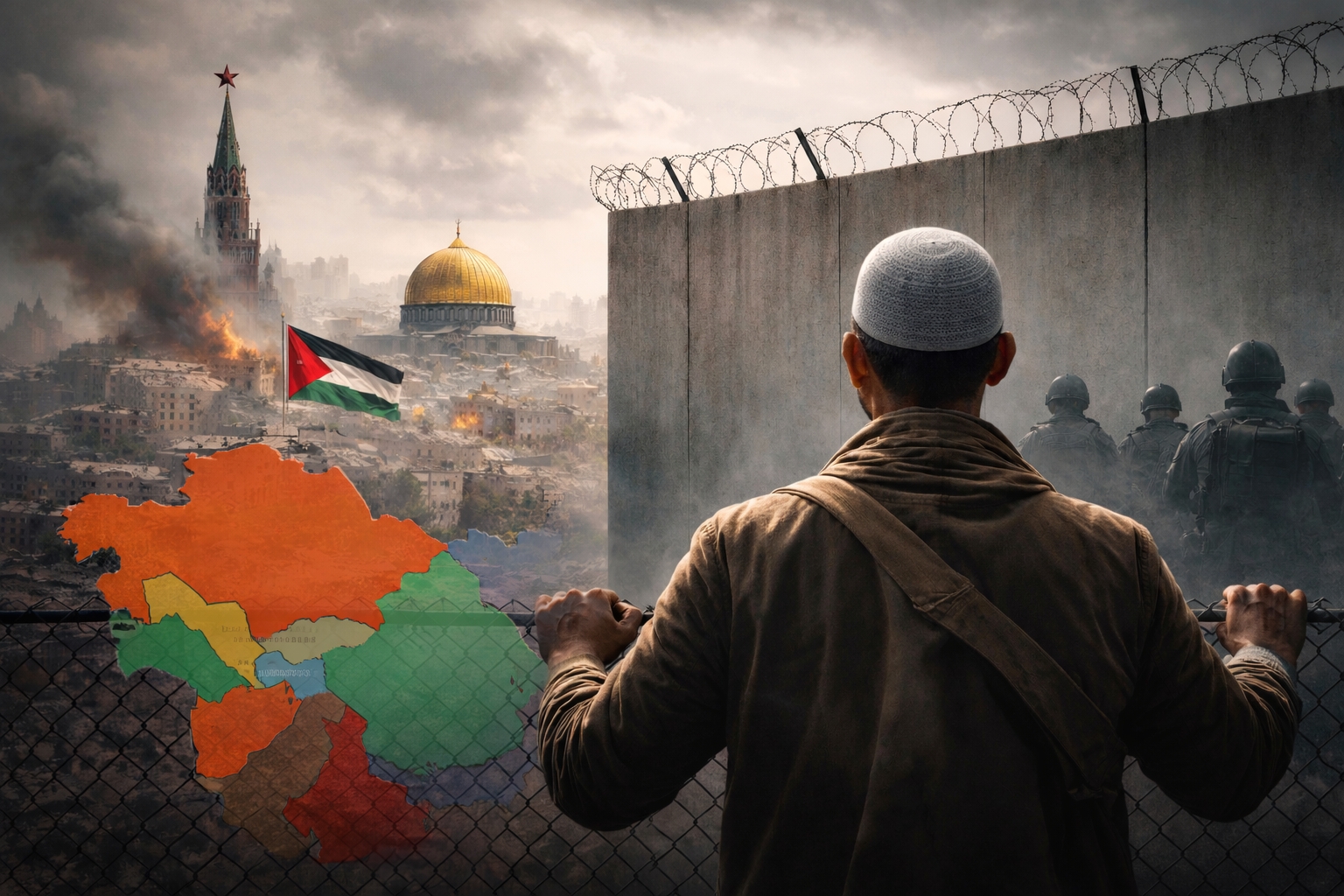
The limited public mobilization in support of Palestine across Muslim-majority countries of the former Soviet Union is often explained simply as indifference or ideological distance.
Such reading is incomplete. The reality is far more structural and historical.
The absence of large-scale public support is not rooted in disinterest in the Palestinian cause.
It is a combination of authoritarian governance, geopolitical dependency, organizational vacuum, and a historically disrupted Islamic identity shaped by seven decades of Soviet rule.
The most immediate constraint is domestic political repression.
Post-Soviet Muslim states such as Azerbaijan, Kazakhstan, Uzbekistan, and Turkmenistan are governed by regimes that view any form of mass mobilization as an existential threat.
Public protest — even when framed around distant humanitarian causes — is not seen as benign civic expression but as a rehearsal for domestic dissent.
The Palestinian cause, emotionally charged and transnational by nature, is especially sensitive.
It carries the potential to catalyze broader political consciousness, something these regimes are structurally designed to prevent.
As a result, demonstrations, independent fundraising, or religiously framed solidarity campaigns are routinely discouraged or completely banned.
Silence, in this context, is not consent; it is enforced political repression.
A second constraint lies in Russia’s enduring influence over the foreign policy behavior of former Soviet Muslim states.
Despite formal independence, these countries remain deeply embedded within Russia’s geopolitical orbit through security arrangements, economic ties, labor migration, and elite patronage networks.
Moscow’s own approach to Israel is cooperative.
While Russia rhetorically supports Palestinian rights at international forums, it simultaneously maintains close working relations with Israel — shaped in part by overlapping economic interests and elite connections.
A significant number of Israeli billionaires and political figures are of Russian origin, and Israel occupies a unique place in Russia’s strategic balancing between the Muslim world and Israel.
Moscow has little incentive to encourage staunchly anti-Israeli postures among its regional partners.
Former Soviet Muslim states, dependent on Russian goodwill, calibrate their public positions accordingly.
The third major factor is the absence of organized Islamic movements capable of mobilizing mass support.
Unlike parts of West Asia or South Asia, where Islamic political or social organizations — even under repression — can still function as vehicles for collective action, post-Soviet regimes have pursued near-total depoliticization of Islam through severe oppression.
Independent Islamic networks have been dismantled, co-opted, or criminalized under the banner of counter-extremism.
Islamic opposition is not merely marginalized, it is structurally prohibited.
Without organizational infrastructure, even genuine solidarity remains atomized and politically inert.
Layered onto these factors is a deeper historical rupture in Islamic identity itself.
Over 70 years of Soviet rule systematically stripped Muslim populations of religious institutions, education, and worldview.
Islam was reduced to folklore, ritual, or ethnic custom rather than a comprehensive moral or political framework.
Mosques were closed, ulama were persecuted, and religious knowledge was severed from public life.
Since the collapse of the Soviet Union, Islam has re-emerged, but unevenly and cautiously.
For many, Islamic consciousness is still relatively new, fragmented, and tightly regulated by the regimes in power.
It has not yet matured into a shared political or civilizational worldview capable of generating pan-Islamic solidarity.
In this context, national identity — carefully cultivated by post-Soviet regimes — takes precedence.
Causes framed in nationalist terms resonate far more strongly than transnational or pan-Islamic ones.
Palestine, while symbolically important, does not easily override the primacy of state-centric nationalism that these societies have been conditioned to prioritize.
Taken together, these dynamics explain why public mobilization for Palestine in the Muslim post-Soviet space remains limited.
The issue is not absence of empathy, but absence of political space, organizational capacity, historical continuity, and strategic autonomy.
It is, rather, the predictable outcome of history and power.
If this reality is to change, Islamic movements in the Muslim-majority countries of the former Soviet Union have only one viable path forward: the slow and deliberate construction of a formidable mass-based opposition that neither Moscow nor local despotic regimes can afford to ignore.
There are no shortcuts.
Symbolic gestures, moral declarations, or externally focused mobilization will not alter the structural constraints that currently suppress public action.
This is necessarily a long-term project, requiring disciplined, God-conscious, and politically competent Islamic leadership capable of embedding itself within society rather than existing on its margins.
Crucially, such movements cannot afford to place Palestine or other pan-Islamic causes at the center of their early activity.
In environments where even modest dissent is criminalized, survival and growth depend on addressing immediate local grievances — corruption, injustice, economic exclusion, and political repression.
Once a credible domestic base is established, only then can broader transnational solidarities be meaningfully and sustainably expressed.
Without this foundation, external causes will remain morally resonant but politically impotent.
Related Articles