Bothsides-ism: Israel and America’s Crude Propaganda Weapon
Empowering Weak & OppressedCrescent International
Rabi' al-Awwal 19, 1448 2026-09-01
Daily News Analysis

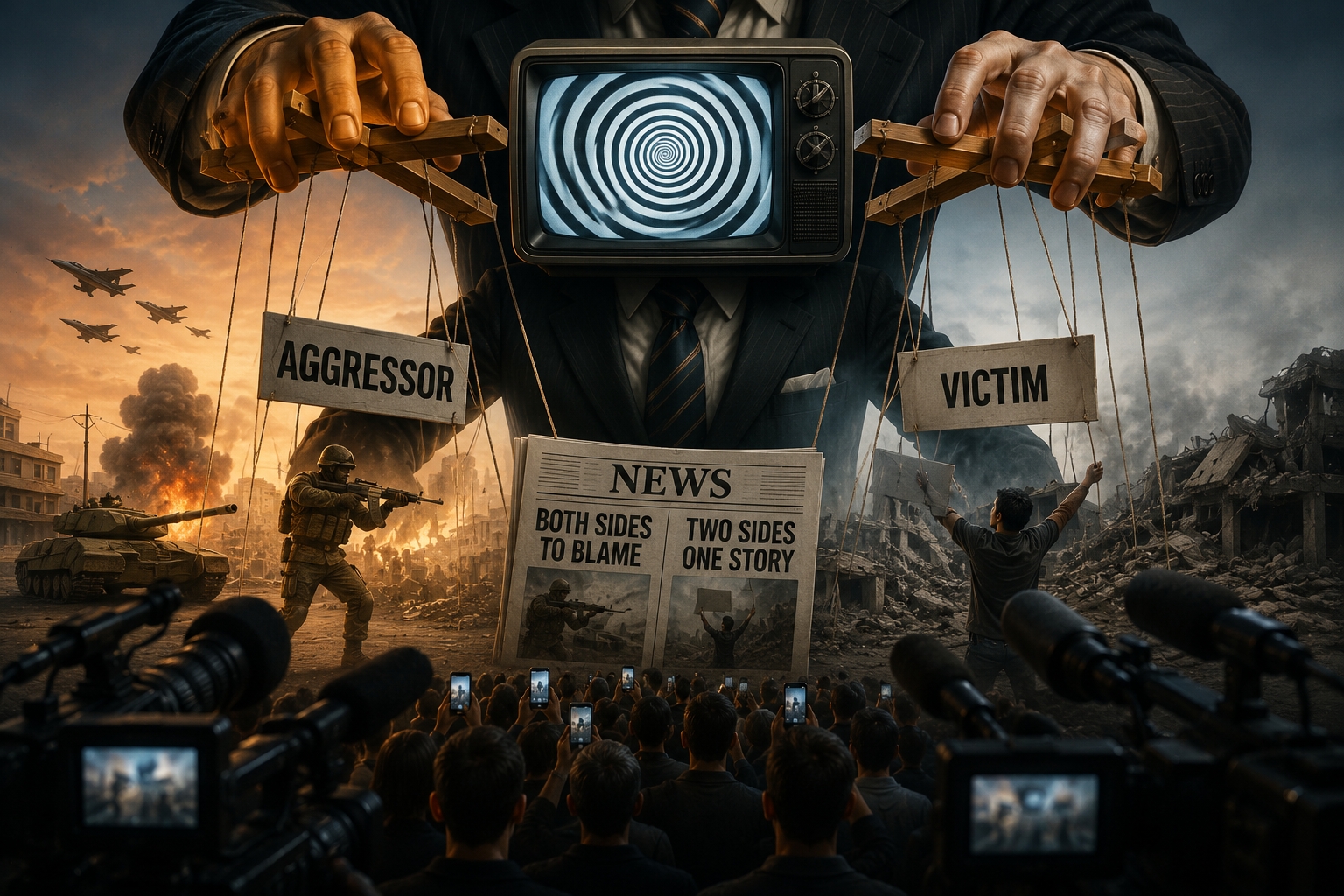
Since 2023, the mask has slipped.
Western regimes’ unconditional political, military and diplomatic backing for Israel has exposed their lack of principles and shattered the credibility of the old west-centric order.
A profound paradigm shift is underway.
Claims by western regimes and their media outlets are increasingly met with scrutiny and deep skepticism.
In response, the west-centric establishment is fighting back through crude bothsides-ism, false equivalence and moral relativism that attempt to blur the fundamental difference between aggressor and victim, imperial power and sovereign state.
A letter recently published in the Guardian is a good example of the ongoing information war.
Before analysing the propaganda framework advanced by the letter, it is worth noting that the circumstances surrounding its drafting and signing are already under serious scrutiny.
Prominent historian of Black radicalism Robin D. G. Kelley has withdrawn his signature, while Mumia Abu-Jamal, listed among the signatories, appears never to have authorised the use of his name.
Given that the Guardian continues to publish absolutely fake news on Iran, it is hardly surprising that this platform was chosen in an apparent attempt to restore credibility to a US-zionist propaganda narrative that has been severely damaged.
The letter in the Guardian should, therefore, be understood as one example of a much broader propaganda tactic: bothsides-ism.
Increasingly, when the credibility of western narratives is challenged, western propaganda resorts to false equivalence—placing two sides in the same moral frame regardless of the vast differences in power, history, responsibility and circumstances between them.
The purpose is not genuine balance, but to undermine moral clarity.
If both sides are equally guilty, then neither side can be clearly condemned; if every position is reduced to “both sides”, opposition to western policy can be portrayed as simplistic, extremist or hypocritical.
This is where bothsides-ism becomes a form of moral relativism.
It does not require denying that abuses occur on both sides; rather, it deliberately strips those abuses of context and hierarchy so that fundamentally different acts appear morally interchangeable.
The result is a political discourse in which aggressor and victim, coloniser and colonised, imperial power and sovereign state are presented as merely competing sources of violence.
The Guardian letter is simply one manifestation of this wider information strategy: when western narratives can no longer command automatic credibility, bothsides-ism becomes a means of manufacturing doubt, diluting responsibility and restoring a collapsing moral authority.
Yet the backlash against this letter reveals the deeper failure behind the tactic.
The desperate attempts to restore western dominance in the information field are evidence that this dominance is ending.
Bothsides-ism, false equivalence and moral relativism may once have been effective tools for managing the narrative, but they no longer command credibility.
The fact that such crude tactics now provoke widespread scrutiny rather than passive acceptance signals a profound shift: the era of unquestioned western information dominance is ending—and it is not coming back.
With the above in mind, it is important to understand why even proponents of American imperialism increasingly recognize that Islamic Iran has ended Pax Americana on multiple fronts—from the military sphere to the economic and geopolitical one.
The significance of this confrontation extends far beyond Iran itself.
The deeper question is whether the Muslim Ummah has recognized the implications of this shift.
Has it understood that the era in which western regimes could dictate the political, military and information boundaries of the Muslim world is rapidly coming to an end?
More importantly, does the Ummah intend to learn from Iran’s experience by learning from its insistence on sovereignty, strategic independence, resistance to foreign domination and the development of indigenous capabilities?
Iran’s direct confrontation with the US represents a genuine rupture with the old order.
The question is no longer simply what Iran has accomplished, but whether the rest of the Muslim world has the political will and intellectual confidence to learn from it.
Related Articles

Zionists bomb, destroy 12-storey apartment tower in Gaza
Crescent International
Shawwal 26, 1435 2014-08-23

Economic and Political Freefall of the zionist Pariah Regime
Crescent International
Ramadan 10, 1446 2025-03-10