Complicity in Plain Sight: Europe’s Moral Credibility Laid Bare
Javed Akbar
Dhu al-Qa'dah 10, 1447 2026-04-28
Daily News Analysis

by Javed Akbar
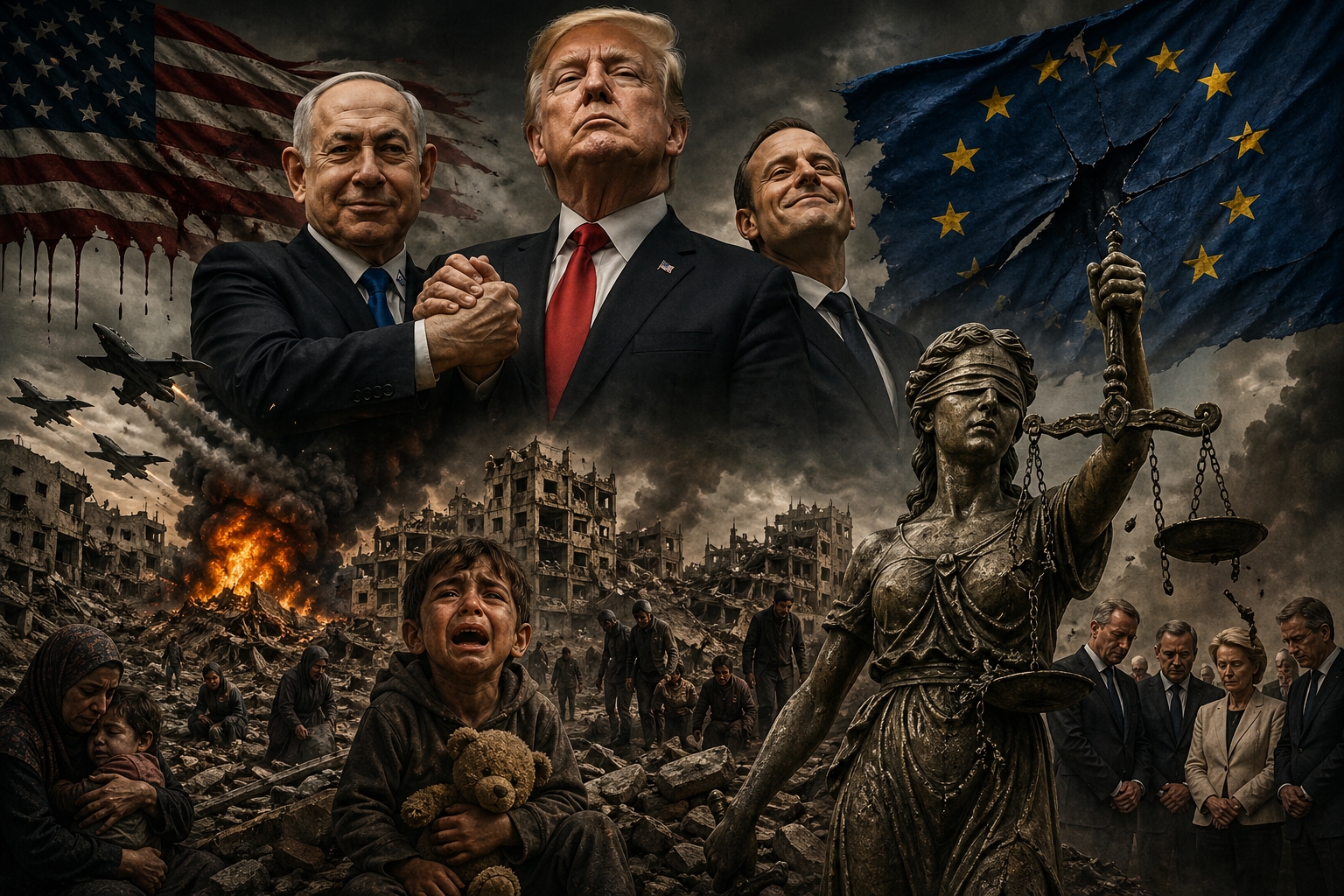
“A civilization that uses its principles for trickery and deceit is a dying civilization.”
The quote is attributed to Aimé Césaire, a Francophone poet, author, and politician whose work is deeply rooted in post-colonialism and who critiques European colonialism.
Césaire highlights the dangers of hypocrisy and moral decay in societies that claim to uphold certain values but fail to practice them.
The Donald Trump horror show, meanwhile continues—not merely as political theatre in Washington, but as a governing ethos that normalizes impunity, erodes accountability, and emboldens allies to act without consequence.
Its most dangerous expression now extends beyond Gaza to the unprovoked US–zionist war on Iran, a reckless escalation that has further shredded the already fragile fabric of what passes for international law.
What began as a rupture in norms has hardened into policy: a system in which the US abuse of power and the Israeli regime’s genocidal zeal for destruction are not restrained, but effectively enabled by western institutions—none more so than the European Union (EU).
By refusing to suspend even part of the EU–Israel Association Agreement, the EU has, in effect, shielded the Israeli state despite mounting allegations of war crimes and genocide.
Rather than invoking the very mechanisms designed to uphold international law—sanctions, trade restrictions, or even symbolic censure—it has chosen to preserve normal relations, signalling continuity over accountability.
This is not neutrality; it is calibrated protection.
Principles are proclaimed with solemnity, yet withheld in practice—revealing not a failure of capacity, but a failure of will.
The contrast with Europe’s response to Russia’s invasion of Ukraine is stark.
Then came swift, coordinated sanctions—decisive, unambiguous, and morally framed.
Now, in the face of Gaza’s devastation, the EU has neither sanctioned nor imposed trade restrictions on Israel.
It has not offered even symbolic gestures of censure.
This is not mere inconsistency; it is selective enforcement—duplicity and deception, where principles are invoked as instruments rather than upheld as commitments.
International law invoked with urgency against adversaries, yet diluted, deferred, or quietly discarded when allies stand accused.
Jerusalem Patriarch Cardinal Pierbattista Pizzaballa so aptly declared in a letter on April 26: “In Gaza, our brothers are plunged into extreme tribulation, They have lived for years under the bombs, without water, without food, without medicine. And now they live in rubble.”
And how did Europe respond to an unprovoked US–zionist regime’s attack on Iran—and to the bombing of a primary school in Minab that killed 168 children, an act that would constitute a grave war crime?
With silence, or at best, evasive restraint—an unsettling reflection of a moral hierarchy in which power dictates whose lives matter and whose suffering is deemed tolerable.
Italy’s posture under Giorgia Meloni illustrates this duplicity.
The much-publicized suspension of a defense memorandum with Israel proved largely cosmetic—no contracts canceled, no arms halted, no meaningful reduction in cooperation.
Symbolism substituted for substance, calibrated to ease domestic pressure while preserving the status quo.
Germany’s role is pivotal.
Its unwavering support for Israel, rooted in supposed historical responsibility, has hardened into unconditional political cover.
Calls to suspend the agreement are dismissed as “inappropriate,” replaced with appeals for “critical dialogue,” even as arms exports continue and Berlin blocks collective EU action.
Responsibility has been reinterpreted as immunity—transforming moral obligation into a strategic shield.
Nowhere is this moral inversion clearer than in the EU’s broader regional posture.
While escalating sanctions on Iran and echoing Washington’s priorities, Europe avoids meaningful pressure on Israel.
The asymmetry is unmistakable: accountability is geopolitical, not universal.
Grand designs flourish while civilians remain displaced, infrastructure shattered, and aid insufficient.
This is the convergence of US abuse of power and an Israeli regime’s enthusiasm for genocide—enabled, excused, and effectively underwritten by those who claim to defend international law.
Europe now stands at odds with its own narrative.
It cannot invoke international law selectively and expect legitimacy.
It cannot punish one violation while subsidizing another.
The question is no longer whether Europe understands what is unfolding in Gaza; it is whether it possesses the will to act against it.
If principles are only applied when convenient, they are not principles at all—they are instruments of power.
And when power is exercised without conscience, it ceases to be order and becomes something far more dangerous: a sanctioned injustice that history will record not as failure, but as willing complicity in the face of human suffering.
Javed Akbar is a freelance writer with published works in the Toronto Star and across diverse digital platforms. He can be reached at: mjavedakbar@gmail.com
Related Articles

The Donald is back: Heaven help the world!
Crescent International
Jumada' al-Ula' 04, 1446 2024-11-06
The Abraham Accords: Strategic Cornerstone for Regional Stability or a Calculated Diversion?
Muslim Mahmood
Dhu al-Hijjah 14, 1447 2026-05-31