Limits of Firepower: Why the US Wins Battles but Loses Wars
Empowering Weak & OppressedMuslim Mahmood
Rabi' al-Thani 19, 1448 2026-10-01
News & Analysis

by Muslim Mahmood (News & Analysis, Crescent International Vol. 56, No. 8, Rabi' al-Thani, 1448)
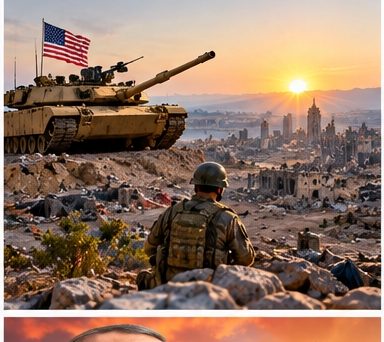
For a country that spends more on its military than the next ten states combined, the United States has an oddly consistent habit of losing the wars it starts. Korea, Vietnam, Iraq, Afghanistan, and now West Asia’s newest conflagration in Iran all follow a recognisable script: overwhelming initial dominance, a rapid degradation of the victim’s conventional defences, and then years—sometimes decades—of grinding, inconclusive struggle that ends in withdrawal, stalemate, or a negotiated retreat dressed up as victory.
Understanding why requires looking past the hardware and toward the far less quantifiable variables of political will, occupation costs, and time.
Overwhelming Force, Undefined Goals
A recent analysis by the Caspian Report lays out the mechanics of this recurring failure with useful clarity. American power is built for destruction, not governance. Washington can flatten a radar station, sink a fleet, or decapitate a command structure from thousands of kilometres away—and it usually does so within days.
The trouble starts precisely at the moment that early dominance is achieved, because battlefield superiority tempts American rulers into expanding the war’s objectives before its political purpose has been settled. A punitive air campaign drifts into regime change; regime change generates an occupation; an occupation creates an insurgency; and an insurgency cannot be resolved by any weapon in the American arsenal, because it is not, at root, a military problem.
The historical record bears this out. In Korea, Washington’s aim of containing communism collided with a Chinese leadership that regarded American forces approaching the Yalu River as an existential threat at its doorstep—and Beijing proved willing to commit hundreds of thousands of soldiers to remove that threat, regardless of the cost.
Three years of fighting ended almost exactly where the war began. In Vietnam, the US fought through the distorting lens of Cold War domino theory and the fear of appearing weak, while Hanoi and the National Liberation Front needed only to survive long enough to outlast American political patience—which, tied as it is to election cycles and public opinion, has a far shorter life-span than the resolve of a movement fighting for national reunification on its own soil.
Iraq in 2003 repeated the pattern in even more stark form. Saddam Hussein’s regime had already been contained, sanctioned, and stripped of weapons of mass destruction. He had no connection to the September 11 attacks. Yet the invasion’s aims ballooned from regime removal into full state-building and, in the more grandiose formulations of the period, the democratic remaking of the entire region.
Toppling Saddam’s regime took three weeks. Governing what followed took years, and in doing so, Washington inadvertently manufactured new adversaries in Tehran and Damascus, both of which understood that a successfully transformed Iraq on their borders would put them next in line.
Afghanistan told the same story on a longer timeline: retaliation against al-Qaeda for alleged 911 attacks metastasised into two decades of nation-building in one of the world’s poorest countries, ending in 2021 exactly where the Taliban had patiently waited for it to end—with their return to Kabul even before US forces had fled.
The exception that proves the rule is the 1991 War, where President George H. W. Bush matched the political objective precisely to the strategic interest at stake: expel Iraqi forces from Kuwait, degrade its military, and stop. Washington did not march on Baghdad, did not attempt occupation, and did not manufacture a new mission out of an old victory.
It is the only major US conflict of the postwar era that ended cleanly, and it did so because restraint, for once, was treated as a strategic choice rather than a political liability.
Iran: The Pattern Repeats in Real Time
The war launched against Iran by the US and the zionist entity on February 28, 2026 is following the same trajectory with uncomfortable fidelity. The stated objectives at the outset — destroying Iran’s ballistic missile arsenal, neutralising its navy, dismantling its nuclear programme, and severing its support for the Axis of Resistance—were already expansive. Trump regime officials went further still, openly calling for regime change and, according to the Congressional Research Service, framing the campaign’s underlying goal as rendering the Islamic Republic’s government “impotent.”
By any narrow military metric, the campaign has been devastating. US War Secretary Pete Hegseth claimed by mid-March that American forces had struck more than 7,000 targets inside Iran and had flattened its air defence network. Supreme Leader Ayatullah Seyyed Ali Khamenei was martyred on the first day of the war, a deliberate criminal act that went well beyond any conventional military objective and virtually guaranteed a protracted Iranian response.
Iran’s retaliation has included missile and drone strikes against American positions across Iraq, Jordan, Kuwait and Bahrain, and repeated attempts to assert control over the Strait of Hormuz—moves that have blocked global shipping and pushed millions across the region toward acute hunger, according to UN reporting.
Yet seven months in, the political objectives Washington set for itself remain unmet. The Islamic Republic has not collapsed; leadership passed, within days, to Seyyed Mojtaba Khamenei as the new Supreme Leader, and the Islamic Republic’s institutions continue to function.
A ceasefire reached in April and a subsequent memorandum of understanding in June both collapsed within weeks, and by September the conflict had settled into what the Congressional Research Service now describes as a war of attrition—one in which Iran’s capacity to sustain strikes is limited by economic strangulation, but in which Washington and its Arabian and zionist puppets likewise face finite tolerance for the war’s mounting military, economic, and political costs.
The Trump regime’s own “economic D-Day” sanctions push, intended to hasten Iran’s collapse, was framed even by sympathetic voices as something that would need to prove itself within a month or be abandoned—hardly the language of an assured strategy.
This is precisely the pattern the Caspian Report identifies: initial battlefield triumph mistaken for strategic victory, followed by a slow discovery that no amount of precision-guided munitions converts military destruction into political submission.
Iran, unlike Iraq, Libya or Afghanistan, is a country of 93 million people with a functioning state apparatus, a deeply entrenched revolutionary ideology. It needs only to endure.
An Empire That Cannot Admit Error
What the Caspian Report leaves comparatively underexamined is the institutional dimension of this failure. The Pentagon studies its tactical failures obsessively—refining logistics, doctrine, and weapons systems after every conflict. But the political class in Washington rarely subjects its war-initiation decisions to the same scrutiny.
Advocates of intervention who are proven catastrophically wrong in one conflict routinely resurface as authoritative voices in the next, insulated by a foreign-policy establishment that treats hesitation as a greater sin than repeated failure. This asymmetry between military self-correction and political self-deception is arguably more consequential than any single tactical error, because it guarantees the pattern will recur.
Geography compounds the problem. Shielded by oceans, a nuclear arsenal, and a friendly hemisphere, the US rarely faces a war that is existential to its own survival. Intervention feels comparatively cheap and low-risk to policymakers in Washington, even as it remains existential for the societies on the receiving end.
Iraqi insurgents were fighting for their own country as were the Taliban. The Islamic Republic’s leadership and its allied resistance forces across West Asia are, in their own understanding, fighting for the survival of an entire political and civilisational project. Washington can always go home. The defenders are at home. They have counted on this asymmetry to work in their favour sooner or later.
The lesson of eight decades of US warfare is not that Washington lacks the power to win battles. Firepower and political will are not the same currency, and no arsenal, however vast, can purchase what only patience, legitimacy, and a genuinely achievable objective can provide. Sometimes, as the pattern from Pyongyang to Kabul to Tehran suggests, the war is won by whichever side can simply outlast the other.