by Abu Dharr (Opinion, Crescent International Vol. 56, No. 8, Rabi' al-Thani, 1448)
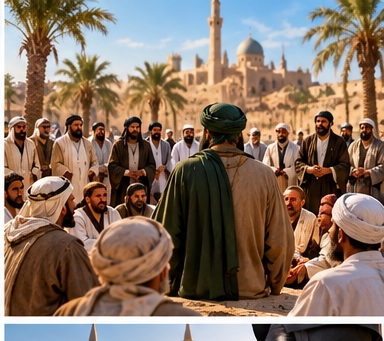
The opposition to ‘Uthman within the shura committee was marginal even though he had other luminary companions of the Prophet (ﷺ) who contested his suitability for the position of khalifah. This chapter of inactive opposition to ‘Uthman has its undercurrents (pros and cons) in our historical recollection which is composed of “two minds.”
To begin with, one of those who did not keenly champion ‘Uthman becoming the khalifah was ‘Abdullah ibn Mas‘ud. When he first met the Prophet (ﷺ), ‘Abdullah ibn Mas‘ud was a young shepherd who tended to the flocks of ‘Uqbah ibn Abi Mu‘it.
As our annals of history have it, one day the Prophet (ﷺ) and Abu Bakr approached ‘Abdullah ibn Mas‘ud and asked him for water to drink. The latter declined saying, I am entrusted with what I have (in other words this water in my possession does not belong to me).
The Prophet (ﷺ) then performed a miracle which we will not describe here and consequently ‘Abdullah ibn Mas‘ud became a muslim and kept a close relationship with the Prophet (ﷺ). He became a remarkable memorizer of the Qur’an, one who stood out for narrating its verses and never failed to stand by the significance and substance of the Qur’an in mushrik Makkah.
‘Abdullah ibn Mas‘ud undertook two hijrahs: one to al-Habashah and the other to al-Madinah. Upon arrival in al-Madinah the Prophet (ﷺ) joined the two muhajirs ‘Abdullah ibn Mas‘ud and al-Zubair ibn al-‘Awwam as brothers-in-faith. The Prophet (ﷺ) also joined him with the Ansari Mu‘adh ibn Jabal. ‘Abdullah ibn Mas‘ud was a veteran of the battles of Badr, Uhud and the rest of the battles in which the Prophet (ﷺ) participated.
It was ‘Abdullah ibn Mas‘ud who decapitated Abu Jahl in the battle of Badr. He was an inseparable companion of the Prophet (ﷺ) so much so that some would say that he belongs to the family circle of the Prophet (ﷺ). Wherever the Prophet was, Ibn Mas‘ud would be there. Wherever the Prophet (ﷺ) traveled, Ibn Mas‘ud would travel with him.
The Prophet (ﷺ) displayed fondness for and cherished Ibn Mas‘ud. One day some companions saw Ibn Mas‘ud climbing a tree and they chuckled at his slender legs. For that, the Prophet (ﷺ) redressed them by saying: In the scale of Judgment Day they (Ibn Mas‘ud’s skinny legs) are weightier than Mount Uhud.
When the Prophet (ﷺ) departed to heavenly company and military duty became widespread, Ibn Mas‘ud joined the mujahideen in Bilad al-Sham where he regimentally positioned himself in the area of Hims (Homs). Later, ‘Umar reassigned Ibn Mas‘ud to al-Kufah while telling its people that I chose and preferred that you (the people of Kufah) gain his presence despite the fact that I will lose his presence [with me].
Ibn Mas‘ud lived through the assassination of ‘Umar and the ascent of ‘Uthman to the responsibility of khilafah. When ‘Umar was assassinated, Ibn Mas‘ud at first did not oppose the headship of ‘Uthman.
Ibn Mas‘ud became the treasurer of al-Kufah during the time when Sa‘d ibn Abi Waqqas was the governor there. When Sa‘d ibn Abi Waqqas was relieved of his position in al-Kufah and al-Walid ibn ‘Uqbah became the governor, Ibn Mas‘ud continued to be the treasurer for a while.
Then the following happened. Al-Walid the governor borrowed some money from al-Kufah’s treasury and Ibn Mas‘ud, the financial officer, authorized it. Nothing unusual or irregular so far.
But when the time came for al-Walid to pay back his debt, he equivocated. Then Ibn Mas‘ud urged and pressured him to pay back the debt. Al-Walid wrote to ‘Uthman a complaint and objection about Ibn Mas‘ud.
Consequently, ‘Uthman wrote to Ibn Mas‘ud saying in effect: you are one of our bookkeepers, so do not aggravate al-Walid because of the money he borrowed from the treasury. This infuriated Ibn Mas‘ud who threw down the keys to the treasury and went home. From where he began to speak his mind and sound off publicly.
From that point on, Ibn Mas‘ud became a public “political opponent” of ‘Uthman especially in financial matters. His opposition intensified and became complicated when ‘Uthman decided to consolidate the ayahs and surahs of the Mus-haf as soon as he assigned Zaid ibn Thabit and others this task.
In the culmination of that process of compilation and consolidation of the Mus-haf there were scrambled, jumbled and disorganized sporadic collections of some of the Mus-haf here and there that were destroyed by fire on orders from ‘Uthman. This was considered by Ibn Mas‘ud a suboptimal decision as well as others who took issue with such a resolution. Ibn Mas‘ud’s criticism and disapproval of ‘Uthman intensified in the course of his public outcry every Thursday of every week.
Al-Walid then reported to ‘Uthman saying that Ibn Mas‘ud is defaming and insulting you (Uthman). ‘Uthman ordered al-Walid to send off Ibn Mas‘ud to al-Madinah. When Ibn Mas‘ud left al-Kufah he was given a hero’s departure.
Finally, Ibn Mas‘ud arrived in al-Madinah. He entered the Masjid while ‘Uthman was delivering the khutbah from the Prophet’s minbar. When ‘Uthman caught sight of him (Ibn Mas‘ud), he said: Indeed, a gnome/dwarf has turned up among us… to which Ibn Mas‘ud replied: But I am a companion of the Prophet (ﷺ) on the Day of Badr and the Day of Uhud and during the Ridwan Bay‘at.
Then ‘A’ishah called out and said: O ‘Uthman! Are you saying such a thing about a companion of the Prophet (ﷺ)? Thereafter ‘Uthman ordered Ibn Mas‘ud expelled from the masjid. He was so forcefully and aggressively removed from the masjid that he suffered a fractured rib.
Then Imam ‘Ali stood up and blamed ‘Uthman’s unbecoming behavior and followed that up by saying: you (‘Uthman) are behaving this way towards a companion of the Prophet (ﷺ) because of what al-Walid said [to you]!? ‘Uthman replied: I didn’t do what I did just because of what al-Walid said; I sent out Zubaid ibn Katheer and he relayed to me that he (Ibn Mas‘ud) turned me into a target for assassination. Imam ‘Ali replied: but Zubaid is not trustworthy. Imam ‘Ali then assumed responsibility for Ibn Mas‘ud and took him home.
‘Uthman did not stop at that. He discontinued Ibn Mas‘ud’s remuneration and put him under “city arrest”—banned from leaving al-Madinah. Ibn Mas‘ud wanted to volunteer and join the military in Bilad al-Sham but ‘Uthman refused to let him join, most likely influenced by al-Walid’s report which said: he (Ibn Mas‘ud) turned the people of al-Kufah against you; don’t let him turn the people of al-Sham also against you.
Thus, Ibn Mas‘ud’s opposition changed locations from al-Kufah to al-Madinah. The historical record about Ibn Mas‘ud in al-Madinah forks out in two different directions. Some say that Ibn Mas‘ud and ‘Uthman buried the hatchet and settled their differences and when Ibn Mas‘ud departed this life ‘Uthman himself conducted the janazah (funeral prayer).
Others say that Ibn Mas‘ud rebuffed ‘Uthman when the latter paid him a visit when he was bedridden. ‘Uthman asked Ibn Mas‘ud, what pains you? He said: my failings. Here is the exchange between them:
‘Uthman: What is it that you desire?
Ibn Mas‘ud: My Sustainer’s mercy.
‘Uthman: Should I call a doctor for you?
Ibn Mas‘ud: The doctor distressed me.
‘Uthman: I will pay you back your remuneration.
Ibn Mas‘ud: You withheld my remuneration when I needed it and now you want to allocate it to me when I don’t need it!
‘Uthman: But it will benefit your kith and kin.
Ibn Mas‘ud: Their sustenance comes from Allah (سُبۡحَٰنَهُۥ وَتَعَٰلَىٰ).
‘Uthman: Please ask Allah (سُبۡحَٰنَهُۥ وَتَعَٰلَىٰ) to forgive me, O father of ‘Abd al-Rahman.
Ibn Mas‘ud: I will ask Allah (سُبۡحَٰنَهُۥ وَتَعَٰلَىٰ) to extract from you the right that belonged to me.
Then ‘Uthman departed and Ibn Mas‘ud instructed that ‘Uthman shall not perform his janazah prayer.
Ibn Mas‘ud died and ‘Ammar ibn Yasir performed his janazah salat. When ‘Uthman came to know what happened he was upset and chided others who “kept him in the dark” about Ibn Mas‘ud’s death.
‘Ammar told ‘Uthman that Ibn Mas‘ud made it clear that he did not want him (‘Uthman) to conduct his janazah service. This may have been another incident that contributed to the tension between ‘Ammar and ‘Uthman.
This writer is inclined to think that Ibn Mas‘ud admirably dismissed ‘Uthman’s errors knowing that it was ‘Uthman’s relatives who were calling the shots, and held no grudges because he had acquired the refined character and characteristics of a compassionate and kind Prophet (ﷺ) throughout a lifetime of standing with, standing by, and standing for the Prophet (ﷺ); much in line with the guidance of the following ayah:
But withal, whoever is patient and forgiving – that indeed is a challenge [most demanding upon human nature]. [al-Shura, ayah 43].