by Abu Dharr (Opinion, Crescent International Vol. 56, No. 10, Jumada' al-Akhirah, 1448)
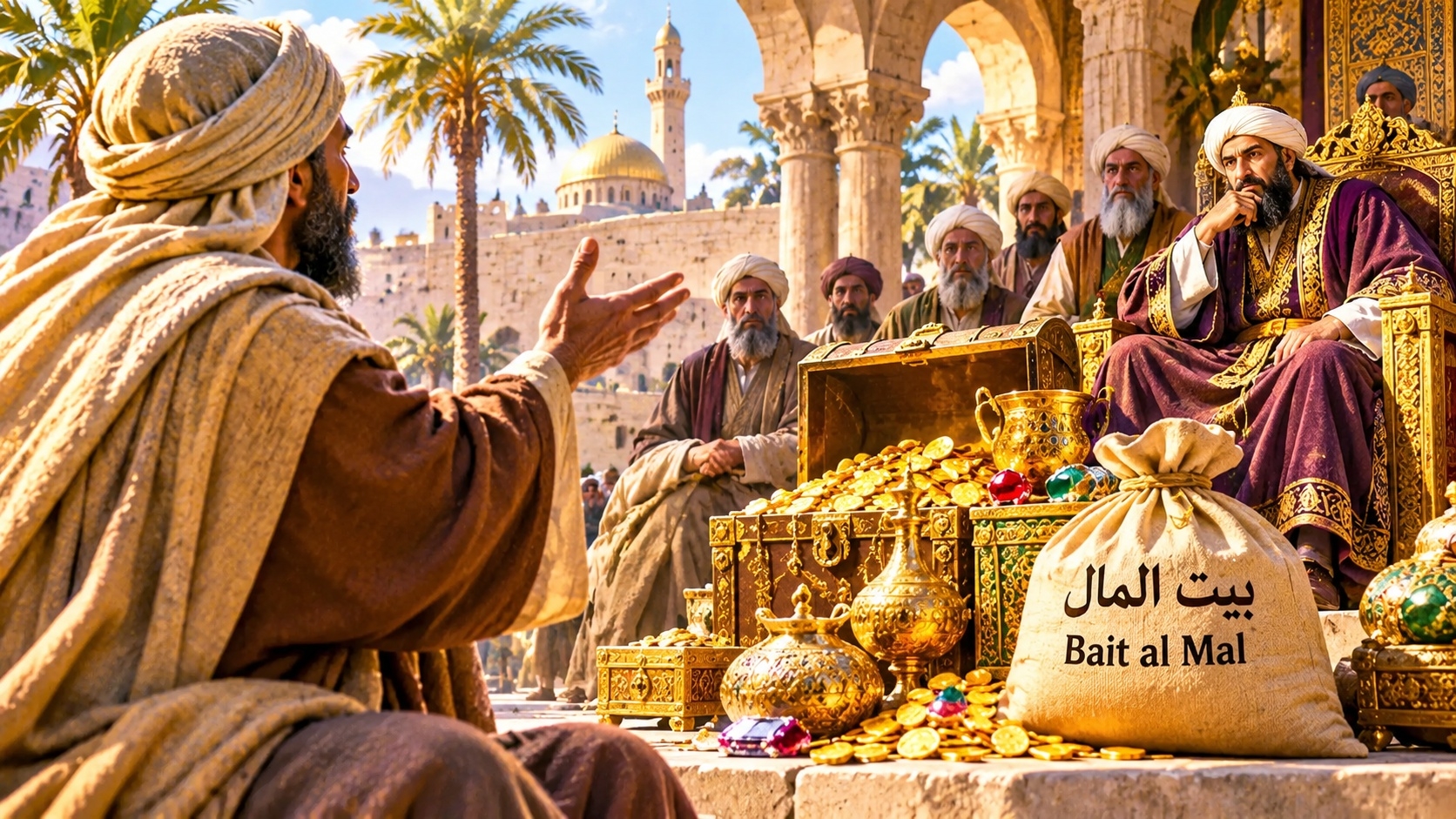
As narrated in previous articles, Abu Dharr’s opposition to ‘Uthman was primarily due to social justice issues and the maladministration of Bayt al-Mal [the Islamic Treasury Department]. Abu Dharr could not live with the fact that some people were getting rich while other people remained poor.
He couldn’t justify some individuals collecting and accumulating gold and silver during a time when poor people were living out and braving their poverty. Abu Dharr could not tolerate a leader, who without warrant or necessity doled out money to rich individuals.
Abu Dharr was watching a society that was becoming polarized by the few who were striking it rich and the many others who were coming up empty handed. From Abu Dharr’s perspective the assets in the Treasury could very well be spent on those who deserved it rather on those who were not in need of it.
He also objected to ‘Uthman’s attempt to silence him or “neutralize” him. Islamic opposition should never be unlawful. It is always better to speak your Islamic conscience rather than remain silent or look the other way.
Abu Dharr’s opposition to financial irregularities developed into political opposition or at the very least was developing into a political opposition movement as he went beyond criticizing or condemning financial mismanagement. He took issue with who ‘Uthman appointed as governors and administrative office holders seeing that ‘Uthman chose or approved of the sons of the tulaqa’ [those life-long enemies who were amnestied by the Prophet (ﷺ) after the liberation of Makkah] as well as those who were inexperienced, unseasoned or amateur muslims.
It must be remembered that in all forms of his opposition, Abu Dharr never withdrew his loyalty or retracted his pledge to the khilafah/imamah. He was not a person who publicly disagreed with, criticized, or actively opposed the recognized Islamic government. Rather it was the wrong decisions that were made within that Islamic governance that Abu Dharr was unsympathetically and unforgivingly opposed to.
Some may read this history and say that Abu Dharr was trying to initiate civil disobedience against the trespasses and infringements in the highest office of the ummah. It has not been reported, as far as this writer knows, that Abu Dharr was violent with ‘Uthman or that he agitated for his overthrow. But he did insist that he had all the right in the world to oppose the infractions and violations of the Quran’s principles and the Prophet’s teachings that had the potential of derailing the Islamic form of governance in the future.
Abu Dharr as well as other frontline companions of the Prophet (ﷺ) were watching and living a political, partisan, and policy making deviation and they had no choice but to disagree with and go up against it. The Umawiy branch of Quraish led by Abu Sufyan sensed that the doors of upper political mobility were flung wide open during the reign of ‘Uthman and these Umawiys harbored an avid aspiration to reclaim their missing social status that vanished when Makkah was liberated by the Prophet (ﷺ) and his close companions.
The Umawiys by means of their long established tribalism could not live with the fact that their Quraishi counterparts (the Banu Hashim) from which the Prophet (ﷺ) and Imam ‘Ali hailed, would, after the liberation of Makkah, outrank them.
During the years of the Prophet’s leadership as well as Abu Bakr and ‘Umar’s reign, the Islamic Treasury was virtually a non-existent quantity. But when the Islamic territory expanded and brought in Egypt, al-Sham and ‘Iraq into the fold, the Islamic Treasury overflowed at the seams.
These two factors: the Umawiys working their way up within ‘Uthman’s administration coupled with the inflow of wealth and financial inundation of the Islamic Treasury turned the leadership of ‘Uthman into one that could not continue to uphold the non-tribalist and universal standards set by Allah (SWT) and His Prophet (ﷺ). His administration began to crack under the weight of super abundance, unchecked affluence, and lavishness.
The fertile and productive territories that used to belong to Caesar, Khosrau, and other feudal lords when liberated by muslims, became part of the Islamic Treasury but during ‘Uthman’s time in office, the newly liberated and added territories were being claimed by some companions who took advantage of ‘Uthman’s “liberal” policy that relieved them from ‘Umar’s course of action that had them confined to al-Madinah.
The proceeds from these prosperous regions during ‘Uthman’s period in office was five hundred million dirhams (500,000,000), add to that the fact that during ‘Uthman’s time in power, fertile lands in ‘Iraq were privatized – meaning Terra nullius zones of productivity could be claimed and owned by muslims relocating from al-Madinah and Hijaz to ‘Iraq instead of those zones being allocated and appointed to the Islamic Treasury.
Imam ‘Ali not as an enemy but as a sincere and honest advisor and authority cautioned and warned ‘Uthman when it became clear that a popular revolt was brewing, he said to ‘Uthman: ‘Umar was in the habit of pounding the ear of whoever he appointed in public office and if such an appointee was to deviate, ‘Umar would inflict severe punishment upon him. But you (‘Uthman) do nothing. You have become faint and over-accommodating towards your kinsfolk. Then ‘Uthman answers Imam ‘Ali and says: But they are also your relatives. Then Imam ‘Ali replies: Of course… they are my kith and kin but others are more qualified. Then ‘Uthman tries to justify renewing Mu‘awiyah’s governorship of al-Sham by saying: But ‘Umar appointed him (Mu‘awiyah) prior to me. Then Imam ‘Ali responded by saying: I adjure you by Allah! Don’t you know that Mu‘awiyah was afraid of ‘Umar more than Yarfa’ [‘Umar’s aide/servant] feared ‘Umar? But now Mu‘awiyah has asserted himself and has taken charge by overlooking and ignoring you. And Mu‘awiyah tells people that he does what he does because you have authorized it. You (‘Uthman) know that but you do not take corrective measures.
‘Uthman’s appointed governor of al-Kufah Sa‘id ibn al-‘As acts with impunity and behaves as if his jurisdiction is his personal property. The region in ‘Iraq that ‘Umar had affixed to the Bayt al-Mal and proclaimed it to belong to the ummah, Sa‘id announced that this fertile land in ‘Iraq has now become Quraish’s orchard. In the ummah of the Prophet (P) there will remain those who speak truth to power as al-Ashtar Malik ibn al-Harith al-Nakh‘i responded to Sa‘id ibn al-‘As’s claim saying: Are you making what Allah has attached to the ummah due to our sword and spear sacrifices some type of personal property belonging to you and your folks?
Abu Dharr and other prophetically educated and principled companions of the Prophet (P) could not stand for individuals becoming “filthy rich” even if they had hitherto a sterling reputation; case in point al-Zubair ibn al-‘Awwam who constructed stately homes and mansions in al-Basrah, al-Kufah, al-Iskandaria (Alexandria) and other areas; at his time of death he left behind fifty thousand dinars, one thousand stallions, a thousand bondmen and bondwomen, etc…
Talhah ibn ‘Ubaidillah who also built for himself elaborate residences in al-Kufah and al-Madinah with an income of one thousand dinars daily coming from ‘Iraq alone some sources say it was more than that.
‘Abd al-Rahman ibn ‘Awf upon dying left behind two and a half million dirhams, etc…
Add to the above those who no doubt were very loyal to the Prophet (P) during his lifetime but who could not honor the Prophet’s standards in their later years such as Zaid ibn Thabit, Ya‘la ibn Umayyah (or ibn Minyah), and Sa‘d ibn Abi Waqqas, etc…
The Prophet (P), Abu Bakr, and ‘Umar died having no wealth. But ‘Uthman died having had in his possession one hundred and fifty thousand dinars (150,000), one million dirhams (1,000,000) not including his properties in al-Hijaz estimated to be worth about one hundred thousand dinars (100,000) as well as horses and other properties.
These individuals were generous and charitable and may Allah (SWT) reward them for that but social justice demands that wealth transfers to those who are in need when personal generosity or individual charity are not enough.
Abu Dharr was keenly conscious of the social change that began to take hold during ‘Uthman’s period of influence. This social change in summary may be described as follows: Not long after ‘Uthman legitimately became the khalifah the spiritual-social attitudes began to differ and diverge. The first most obvious discrepancy was reflected by ‘Uthman’s relatives who combined wealth with influence and power. This emerging social bracket of key opinion leaders around the khalifah led to an ethical and evenly balanced Islamic society turning into a society of “inequality consciousness.” As a result we had a rank of authoritarians and a group of landed gentry and a class of “aristocrats;” distinct from them were the commoners, the labor class and the sons of the mujahideen and others who had spent their lives sacrificing and forgoing worldly attractions for the cause of Allah (SWT) and his Prophet (P). There was a gap in the making between those who are gaining and those who are falling short or losing out. This social discrepancy led to a widely held feeling of exclusion, marginalization and omission among the “underclass” in an Islamic society that didn’t have an underclass during the time of the Prophet (P) and his two successors Abu Bakr and ‘Umar. The first one who was keenly aware of this was none other than Abu Dharr.
The [financial and budgetary] offerings given for the sake of Allah are [meant] only for thte poor and the dispossessed, andthose who are [administratively] in charge thereof (of collecting and distributing wealth and resources), and those whose hearts are to be won over [into the fold of iman] and for the freeing of human beings from bondage, and [for] those who are overburdened with debts, and [for every struggle] in Allah’s cause, and [for] the homeless: [this is] an ordinance from Allah – and Allah is all-knowing, wise. [al-Tawbah, 60]