Türkiye’s Regional Shifts From Justice to Strategic Transaction Convergence
Developing Just LeadershipMohamed Ousman
Rabi' al-Thani 19, 1448 2026-10-01
News & Analysis

by Mohamed Ousman (News & Analysis, Crescent International Vol. 56, No. 8, Rabi' al-Thani, 1448)
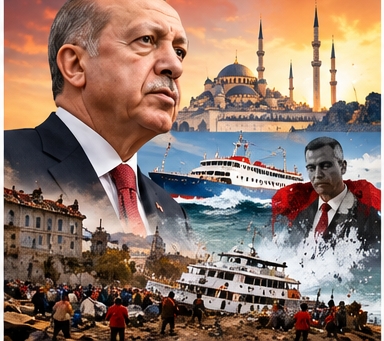
The zionist attack on the Mavi Marmara occurred in May 2010, when the Turkish-registered ship joined an international flotilla attempting to reach Gaza and challenge the blockade. Israeli commandos boarded the vessel in international waters; 10 Turkish citizens were killed. Ankara downgraded relations, expelled Israel’s ambassador, and demanded an apology, compensation for victims’ families, and changes concerning Gaza.
In 2013, Israeli Prime Minister Benjamin Netanyahu apologized to Erdoğan. In June 2016, Türkiye and Israel agreed to restore diplomatic relations: Israel would pay $20 million to victims’ families, while Türkiye would regain humanitarian access and pursue projects in Gaza.
Ambassadors returned, and military, economic, and diplomatic ties gradually revived yet Gaza was expended. The normalization illustrated a shift from punitive diplomacy toward transactional reconciliation, despite the unresolved grievance surrounding the deaths.
Relations ostensibly deteriorated after October 2023 as Israel’s Gaza genocide intensified; and notwithstanding Türkiye claims to have suspended bilateral trade in May 2024 until a permanent ceasefire and humanitarian access were secured, Türkiye-Israel trade flourishes.
The killing of Jamal Khashoggi
Jamal Khashoggi, a Saudi journalist and Washington Post columnist, entered Saudi Arabia’s consulate in Istanbul on October 2, 2018 to obtain documents for his marriage. He never emerged from the building. Turkish investigators concluded that a Saudi hit team was sent for the purpose of killing him.
His body was dismembered and dissolved in acid inside the consulate. It has never been recovered. Saudi authorities initially denied knowledge of his fate but later acknowledged an unlawful killing.
A Saudi prosecution eventually convicted eight people, but command responsibility remains. A UN special rapporteur concluded that Khashoggi’s killing was an extrajudicial killing for which Saudi Arabia bore state responsibility.
Türkiye initially internationalized the case, publicized evidence and pursued a trial in absentia. Yet in April 2022 an Istanbul court transferred the proceedings to Saudi Arabia, effectively ending Türkiye’s judicial pursuit. Erdoğan then visited Saudi Arabia and relations were restored, demonstrating the tension between accountability, sovereignty and economic interests.
The Türkiye–Saudi Pact in light of Khashoggi’s murder
The Makkah Joint Defence Agreement, signed on August 7, 2026 by Türkiye, Saudi Arabia and Pakistan, marks a regional move beyond the reconciliation that followed Khashoggi’s murder. The pact states that an armed attack against one signatory will be regarded as an attack against all, creating a NATO Article 5-style collective defence.
It also institutionalizes political-military coordination, exercises and defence-industry cooperation. Its official rationale emphasizes historical ties, “Islamic” solidarity, shared strategic interests, collective deterrence and greater regional stability.
Turkish officials stress that it targets no particular country. In light of Khashoggi’s murder, the agreement is significant because Erdoğan’s regime had made accountability for the Saudi killing a major diplomatic issue, then transferred the Turkish case to Saudi Arabia in 2022 while seeking normalization.
The pact, therefore, illustrates how strategic interests can supersede unresolved accountability. It does not erase Khashoggi’s murder, but shows that states may dispense justice for bilateral interests and collective security.
Imam Muhammad Al-Asi’s Qur’anic Framework Analysis
Read through al-Asi’s Qur’anic framework, the movement from “justice for Jamal Khashoggi” and “justice for the Mavi Marmara Turkish citizens” toward the Makkah Pact exposes a conflict between principled accountability and nation state-centred strategic calculation. Al-Asi’s starting point is not that Muslims should reject diplomacy or alliances. Rather, political choices must remain subordinate to Allah’s authority, justice, taqwā and an independent Islamic purpose.
Taqwā is the central concept. Al-Asi calls it “the internal government in the conscience” that makes “Islamic law self-enforced; without it, government becomes a shell”. Treaties, Islamic symbolism, and institutions, therefore, do not establish Islamic justice by themselves. A pact signed in Makkah while rhetorically Islamic reflects conventional calculations of deterrence, regime security, economic resilience, and regional power.
Al-Asi’s claim that Islamic laws in Saudi Arabia are “meaningless because taqwā does not back them up” makes Khashoggi especially relevant: custodianship of the Haramayn and performance of rituals cannot, by themselves, prove Islamic justice.
His observation that “Individuals and societies conscious of Allah’s power and authority transcend fear or any cost-benefit-analysis” is central. Türkiye initially used the Istanbul location of Khashoggi’s killing to demand accountability and expose Saudi responsibility. Yet in April 2022 its court transferred the case to Saudi Arabia, ending the Turkish prosecution; Erdoğan then restored relations with Mohammed bin Salman.
This can be read as a shift from justice-centred diplomacy toward pragmatic statecraft, despite the continuing moral claim of Khashoggi’s family. The Mavi Marmara trajectory presents a similar tension: Türkiye secured compensation and other concessions, but normalized relations with Israel after 10 Turkish citizens were killed.
Al-Asi’s critique of nationalism sharpens the problem. He writes that Muslims can mistakenly characterize the straight path through “Arabian, Persian, Turkish, etc. nationalism” rather than Islam. Thus, “Turkish interests” cannot automatically become decisive merely because the Turkish state represents Muslims.
The question is whether Ankara’s policy advances justice and ummah interests or primarily protects its economic, security and diplomatic position. The Makkah Pact’s language of Islamic solidarity is significant, but its institutional form remains inter-state: Türkiye, Saudi Arabia, and Pakistan pledge collective defence, treating an attack on one as an attack on all.
This raises questions about contemporary control of the Haramayn. If authority is measured by the Prophetic leadership model, ritual administration of Makkah is insufficient; leaders must demonstrate principled submission to Allah rather than merely deploy Islamic legitimacy. Yet Al-Asi provides a qualification. He permits political arrangements with blocs not opposed to the Islamic order, provided Muslim leaders safeguard Islamic priorities and principles and are not inferior partners. The Makkah Pact could therefore fit his framework if it increases collective Muslim autonomy, security, and resistance to aggression without surrendering independent priorities.
His discussion of Jews and Christians adds nuance. Al-Asi distinguishes religious Jews and Christians from political actors who “plan coalitions, set up alliances and promote common policies,” to whom the Qur’anic prohibition is relevant. Yet theological difference does not abolish social relations: marriage with women of scripture and eating their lawful slaughter are permitted.
The Mavi Marmara reconciliation should be condemned because it involved Israel, who “plan coalitions, set up alliances and promote common policies” against the Ummah. This normalization subordinated Islamic principles and Palestinian justice to Turkish state interests.
Likewise, the Saudi pact should not be celebrated merely because it is signed in Makkah or framed as “Muslim” solidarity.
Al-Asi’s reading is, therefore, neither “never negotiate” nor “always prioritize national interest.” It is a hierarchy: Allah’s authority and justice first; political, economic, and security interests second.
Khashoggi and Mavi Marmara became symbols of justice, but Türkiye’s state diplomacy subsequently made both grievances expendable within broader nation-state relationships. The Makkah Pact changes the diplomatic geography by bringing Türkiye and Saudi Arabia into security cooperation.
Whether that represents Islamic convergence or merely strategic nation-state interest convergence depends on taqwā, independence from hegemonic pressures and fidelity to justice. Its Islamic vocabulary is insufficient; its value must be judged by its consequences for Muslim dignity, accountability and political autonomy.
Imam Zafar Bangash’s Seerah Framework Analysis
Through Bangash’s Seerah framework, the Turkish shift can be assessed by asking whether diplomacy reproduces Prophetic political method or merely reflects conventional nation-state interests. Bangash argues that the Qur’an, Sunnah and Seerah provide an integrated model for Muslim political action, while the Prophet’s experience in Madinah demonstrates how an Islamic power base was consolidated amid ideological, social, economic and security pressures.
The Covenant of Madinah is relevant because it organized diverse communities through agreed obligations, mutual security, political coordination, and recognition of distinct religious communities without reducing the polity to tribal solidarity.
The 2016 agreement with Israel obtained compensation for the families of the 10 Turkish dead and expanded Turkish humanitarian activity in Gaza, but it also restored diplomatic relations. Türkiye’s post-Mavi Marmara normalization with Israel can, therefore, not be understood as legitimate diplomacy.
Similarly, Türkiye’s abandonment of the Khashoggi prosecution in 2022, followed by reconciliation with Saudi Arabia, demonstrates a transition from accountability toward nation-state accommodation.
From Bangash’s perspective, the issue is not whether alliances are permissible. The Prophet himself used alliances and negotiated arrangements when they strengthened the Muslim community and protected its interests.
The problem arises when tactical accommodation loses connection with an Islamic mission. The 2026 Makkah Pact, by contrast, creates institutional collective defence among Türkiye, Saudi Arabia, and Pakistan and, therefore, resembles the Madinan principle of coordinated security. Yet its legitimacy depends on purpose: if collective power protects Muslims from aggression and expands autonomous capacity, it can be read positively; if it merely consolidates regimes and suppresses accountability, it departs from the Prophetic model. Thus, Seerah shifts the question from consistency of rhetoric to the political purpose, structure, and consequences of alliance-making.
Dr. Kalim Siddiqui’s Islamic Movement Theory
Siddiqui’s Islamic Movement Theory places the Turkish trajectory within a problem of the fragmentation of the Ummah into nation-states whose governments calculate interests separately rather than developing a unified Islamic political consciousness. Siddiqui argues for a global Islamic movement and a new consciousness capable of overcoming sectarian fragmentation.
His critique of Muslim nation-states similarly rejects the assumption that colonial political boundaries should determine the horizons of Muslim political action. The analytical question is whether Türkiye’s policies strengthen the collective power of Islam or optimize the position of the Turkish nation-state.
For Siddiqui, Islam is a global movement whose horizon exceeds territorial sovereignty and cannot be reduced to diplomacy. The Mavi Marmara episode generated a form of Muslim solidarity around Palestine and Turkish victims. Normalization with Israel in 2016 transformed that confrontation into prioritization of bilateral relations, while retaining humanitarian commitments and compensation.
The Khashoggi case followed a sharper reversal: Türkiye moved from internationalizing Saudi responsibility to transferring the prosecution to Saudi Arabia in 2022, facilitating reconciliation. In Siddiqui’s terms, both episodes reveal the limits of state-centred diplomacy when national interests become primary.
The Makkah Pact represents a different direction by joining Türkiye with Saudi Arabia and Pakistan in a collective security mechanism. It could be interpreted as movement toward Muslim strategic coordination. Yet Siddiqui would likely distinguish coordination among states from the emergence of an Islamic movement. If the pact remains a regime-to-regime alliance driven by deterrence, investment, and geopolitical balancing, it does not overcome the nation-state system. If it develops autonomous Muslim capacity, transcends nationalism, and strengthens Ummah political consciousness, it moves closer to Siddiqui’s strategic vision. The key shift is therefore from justice rhetoric and national pragmatism to potential regional coordination between Muslims; whether the final stage becomes Islamic political convergence remains an open question.
Overall conclusion: across all three frameworks, the central analytical issue is the distinction between Islamic solidarity as a principle versus Islamic language as an instrument of state strategy. The 2026 pact may represent meaningful regional Muslim coordination, but its Islamic character cannot be established by its venue, participants, or rhetoric alone; its substance must be assessed through justice, taqwā, autonomy, accountability and the broader interests of the Ummah, particularly the implications of excluding Palestine from such a pact.