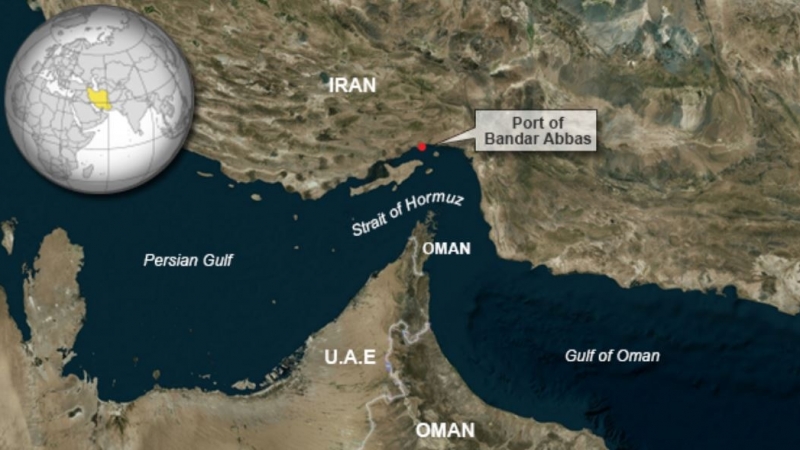
The Strait of Hormuz Blockade Vs. The Blockade of Gaza
Javed Akbar
Shawwal 26, 1447 2026-04-14
Daily News Analysis

by Javed Akbar
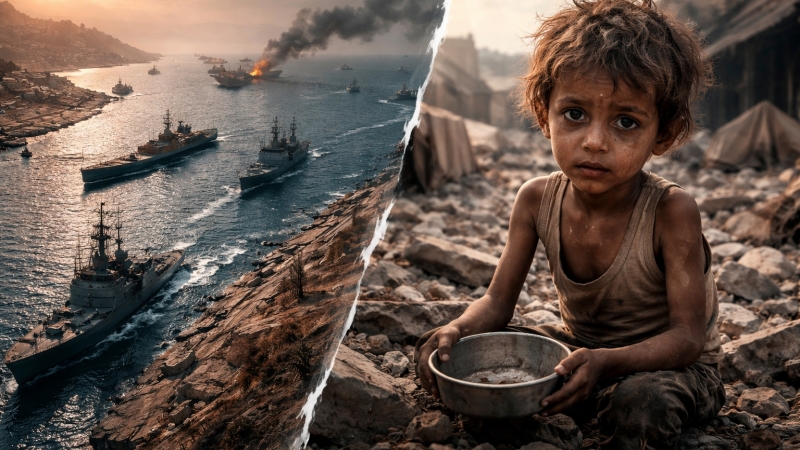
“Even though you make many prayers, I will not listen: your hands are full of blood.”
With these searing words from Isaiah 1:15, invoked by Pope Leo XIV on Palm Sunday, March 29, 2026, a timeless moral indictment was cast upon a world that has mastered the language of piety while abandoning the substance of justice.
It was a pointed response to the public display of prayer by US War Secretary Pete Hegseth at the Pentagon on March 26, an invocation that, in this light, rang hollow against the weight of unfolding realities.
This is a monthly ritual of Christian worship initiated by Hegseth at the Pentagon.
Today, a deeply unsettling reversal lies at the very core of the global order.
The mere whisper of disruption in the Strait of Hormuz sends tremors through capitals, markets, and militaries alike.
Yet the slow suffocation of human lives—most visibly in Gaza, but no less tragically in Lebanon and Sudan—elicits little more than ritualistic concern.
When commerce is threatened, urgency is immediate; when humanity is extinguished, indifference is methodical.
This is not an oversight. It is a clear ranking of what matters most.
The world has adjusted its conscience to the rhythms of the market.
Oil routes are arteries; human lives, it would seem, are expendable margins.
The calculus is stark and unsettling: economic instability is intolerable, but human suffering—especially when it belongs to the distant, the dispossessed, the “other”—is negotiable.
During the Iraq War, Susan Sontag captured this chilling detachment with devastating clarity.
When her daughter asked how many had died, she replied: “No one that we know, dear.”
Sontag, a renowned American writer, critic, and intellectual, was known for her profound impact on contemporary thought and art.
In that quiet admission lies the architecture of modern apathy—the narrowing of empathy to the familiar, the erasure of the unseen.
The recent specter of closure in the Strait of Hormuz exposed this moral fracture with brutal clarity.
After forty days of sustained and unprovoked US-zionist assault on Iran—marked by the deployment of overwhelming military force and culminating in a crushing setback—a rapid and coordinated global response was set in motion.
Washington, facing mounting pressure, moved with notable haste to embrace a ceasefire underscoring the stark realities on the ground.
US negotiators walked away after a few hours of talks as Iran would not budge on the re-opening of the Strait of Hormuz.
Yet this urgency did not arise from the cries of children in Gaza buried beneath rubble, nor from the collapse of hospitals and homes.
It was not conscience that stirred—it was the consequence.
For over two years, Gaza has endured systematic devastation.
Civilian infrastructure lies in ruins; medical systems teeter on the brink of total collapse.
The suffering is neither hidden nor ambiguous.
And yet, the response from the international system has remained confined to carefully worded statements—expressions of concern devoid of resolve, condemnations without consequence.
The contrast is not merely striking—it is damning.
It has become evident that not all blood carries equal weight in the scales of global politics.
The machinery of international response is not activated by the magnitude of human suffering, but by the proximity of economic risk.
Oil possesses the power to mobilize fleets and forge alliances; the deaths of children do not interrupt supply chains, nor do they disturb stock markets.
As long as tragedy remains geographically and economically contained, it is rendered politically tolerable.
This is the unspoken doctrine of our time: wars are objectionable not when they are unjust, but when they are inconvenient.
Even the sudden retreat from escalation when energy routes were threatened was not an awakening of moral restraint.
It was a calculation—precise, clinical, and entirely devoid of ethical introspection.
The same powers that tolerate prolonged devastation in one region will act decisively in another when their own stability is imperiled.
This is not leadership; it is selective urgency masquerading as diplomacy.
Meanwhile, countries like Iran continue to draw upon a deeply rooted spiritual consciousness, one that frames struggle not merely in geopolitical terms but as part of a broader moral and existential narrative.
This dimension, often ignored in western analyses, underscores a truth that technocratic calculations fail to grasp: societies are not sustained by power alone, but by meaning.
What emerges, then, is a world order profoundly out of balance—a system in which material priorities eclipse moral imperatives, where the value of human life is contingent upon its economic relevance.
A civilization that mobilizes for oil but not for blood is not merely inconsistent; it is in peril.
For when compassion becomes conditional and justice selective, the very foundations of legitimacy begin to erode.
No accumulation of wealth, no safeguarding of energy routes, can compensate for the corrosion of conscience.
The warning issued in Isaiah echoes with renewed urgency: prayers unaccompanied by justice are empty.
And the Qur’an succinctly declares: “O you who have committed yourselves [to the One and Only God’s power and authority]! Why do you say what you would not do? Most obnoxious in the sight of the One and Only God is for you to say what you do not fulfill” (Al-Qur’an 61:2-3).
In the final reckoning, no civilization will be judged by the fullness of its treasuries or the security of its oil routes, but by the weight it accorded to human life.
Humanity that does not bleed at the sight of blood has already begun to lose its soul.
Javed Akbar is a freelance writer whose opinion columns have appeared in The Toronto Star and numerous digital platforms. He can be reached at: mjavedakbar@gmail.com
Related Articles
Trump indulged in lies and hype to pacify Americans angry about the war
Crescent International
Shawwal 13, 1447 2026-04-01
Trump’s threatened blockade of Iranian ports leads to even higher oil prices
Crescent International
Shawwal 25, 1447 2026-04-13
October 7: Third Anniversary of the Palestinians’ Daring Operation
Crescent International
Rabi' al-Thani 25, 1448 2026-10-07