The West’s Decline Is Structural, And The World Is Adjusting
Empowering Weak & OppressedTahir Mahmoud
Sha'ban 13, 1447 2026-02-01
News & Analysis

by Tahir Mahmoud (News & Analysis, Crescent International Vol. 55, No. 12, Sha'ban, 1447)
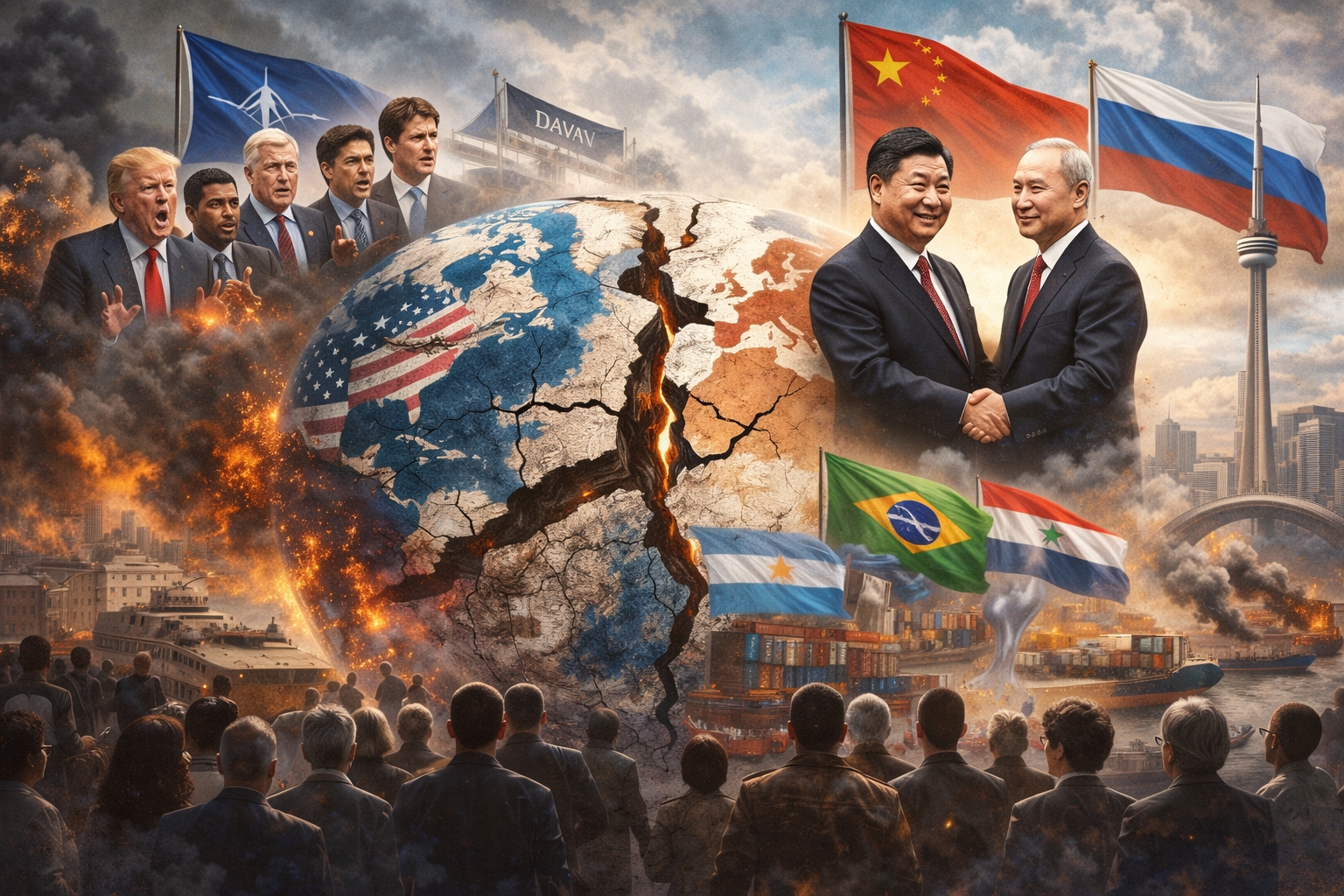
This year’s Davos get-together of the western political and economic elites produced a schadenfreude moment for the Global South: Canada’s Prime Minister Mark Carney publicly implied what many already knew —that the west-centric global order, marketed as the so-called “rules-based order,” was a sophisticated scam and is no longer working.
As the prominent Belgian journalist Elijah Magnier put it, the mask came off at Davos not because “Western leaders got honest,” but because “the lie no longer pays.”
The bickering among western regimes before and during Davos inadvertently acted as a smokescreen, distracting attention from the real developments that deserve deeper assessment.
One of the key developments is Canada’s open pivot toward China in search of greater economic benefits amid a global reordering. It is no longer possible to deny that the US is an empire in decline.
While some pundits immediately rushed to frame Ottawa’s rapprochement with Beijing as a dramatic geopolitical realignment, that assessment is hasty and largely an exaggeration.
Many of these commentators are conditioned to read great-power politics through a western prism, the same way many modern pundits treat religion only through the historical prism of Christianity.
They instinctively project western variables—coercive alliance logic, ideological export, regime-change habits, and securitized zero-sum thinking—onto China, even when those variables don’t actually map onto how Beijing operates.
This is why they keep misreading China the way they have misread Islamic Iran for decades: by applying shallow secular-liberal assumptions and then acting surprised when reality doesn’t cooperate.
China does not function like the US and it is not wired for the same style of imperial overreach.
Beijing’s presence in Canada will be economic first and foremost, because that aligns with its long-game approach: build leverage through trade, investment, supply chains, technology, and market access—then let those material ties shape the political environment over time, without the theatrics of a western-style crusade.
China reached its global position precisely by avoiding intense confrontations—let alone military conflicts. Beijing understands that this approach is working: it preserves stability, keeps trade and logistics flowing, and creates a global environment in which time is on China’s side.
At the moment, the greatest catalyst to fast-forward China’s rise is the clownish Trump regime. A real-estate merchant, supplemented by a reserve major running the Pentagon, is a gift to Beijing—because neither seems to grasp soft power, economics, or logistics.
In two of those three domains—economics and logistics—China is steadily acquiring an unmatched superiority, while Washington burns political and economic capital on spectacle.
While Canada’s economic reorientation is too little, too late, its open distancing from the US is not the only recent grand event: the EU has moved to lock in a major free trade agreement with South America.
The EU has reached a free-trade agreement with South America’s Mercosur bloc (Argentina, Brazil, Paraguay, and Uruguay), bringing to a close, negotiations that began roughly 25 years ago.
In practical terms, the deal expands two-way market access: EU firms gain a clearer runway to sell into Mercosur markets, while Mercosur’s prize is more predictable entry into the EU’s high-value market for agricultural exports—precisely the sectors that fuel farmer backlash in Europe—supported by streamlined customs “plumbing” that reduces border friction.
Crucially, many economic assessments suggest the relative upside may tilt toward South America. For a mature, diversified EU economy the modeled gains are often modest, whereas for smaller Mercosur economies even limited absolute gains can translate into a larger proportional boost—helping explain why Brussels markets the pact as strategic while Europe’s countryside views it as a threat.
Given how detached much of the western political elite has become from the populations it governs, the EU–Mercosur deal is likely to deepen an already growing perception that western regimes prioritize elite economic interests over domestic livelihoods.
Trade agreements of this scale tend to deliver concentrated gains—cheaper inputs, wider market access, higher margins—for large corporations and the investor class, while spreading the adjustment costs across politically sensitive sectors, especially agriculture and parts of manufacturing.
If the agreement is seen as having been designed primarily with the interests of the wealthy class in mind, it will further erode the already diminished economic confidence—and political legitimacy—of western elites. In that context, a backlash is not a question of “if,” but “when,” as citizens and organized constituencies push back against, yet another elite bargain sold as a national interest.
These developments would not carry the same strategic weight on their own. They matter because they coincide with Russia’s ability to push back hard in its indirect war with NATO in Ukraine. That is why NATO Secretary General Mark Rutte has insisted Ukraine must remain NATO’s priority. The outcome is not just about territory. It is about credibility and the future balance of power.
Western regimes can also see what comes next. If Russia cements its interests in Ukraine and the military phase winds down, Moscow and Beijing will shift gears. They will push harder in politics, economics, and soft power.
Their aim will be to further marginalize the US and its surrogates in a multipolar order. Once the guns fall silent, today’s urgency will fade. The superficial “unity” of containment will start to crack.
NATO regimes are already struggling, despite throwing almost everything at Russia short of nukes. At the same time, the Trump regime is wrecking western imperialism from within. It is bleeding credibility fast.
European imperialists understand the risk. If they cannot secure their objectives in the hot war, the cold one will be even harder. The world has changed, and the west no longer monopolizes economic gravity or diplomatic alignment.
Ultimately, they have only themselves to blame. They backed brutal regimes for decades. They waged warmongering campaigns worldwide. Now the strategic geopolitical blowback is landing at home.
With “genius” Trump still having roughly three years left in office, the western political elite understands the damage he will cause—even if not permanent—will take years to repair. His “brilliant” ideas are wrecking the US-imposed global order on multiple levels: diplomacy, trade, alliances, and institutional credibility.
At the same time, the Global South is responding on multiple levels as well—building alternative trade routes, financial mechanisms, and political alignments that reduce dependence on western regimes.
In that context, much of what still looks like American dominance is increasingly just optics. It is the empire lashing out—using pressure, punishment, and spectacle to preserve an order that is already slipping. The more Washington relies on coercion to prove it is still in control, the more it signals the underlying reality: a system in decline, struggling to postpone what looks like an inevitable collapse.
Related Articles