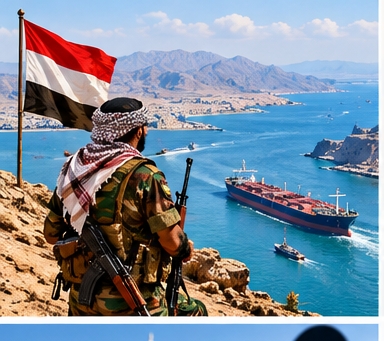
Yemen’s Asymmetric Power: From Northern Uprising to Regional Actor
Developing Just LeadershipMuslim Mahmood
Jumada' al-Ula' 02, 1448 2026-10-13
Daily News Analysis


Yemen’s conflict is no longer a localized civil war.
It has become a central factor shaping West Asian geopolitics and global maritime trade.
At its core are the Islamic revolutionary movement Ansar-Allah who have consolidated de facto state authority across northern Yemen and turned that domestic control into leverage far beyond its borders.
Through institutional state-building, coercive economic policy and long-range strike capabilities, they have altered the traditional deterrence calculus of the Arabian Peninsula and the Red Sea littoral.
Meanwhile, the Saudi-backed coalition arrayed against them has fractured.
Together, these two trends have made Sana‘a a primary actor in the region’s security architecture.
Governing from the Shadows
Since seizing the capital in September 2014, Ansar-Allah have evolved from an insurgent movement rooted in the northern Sa‘ada governorate into a consolidated administrative structure.
They created the Supreme Political Council (SPC) to oversee state ministries and set national policy.
Ministerial posts often go to figures from the former ruling General People’s Congress (GPC), but real authority rests in the network of mushrifin, the political and security supervisors.
Placed in every ministry, state institution, governorate and municipal authority, they hold veto power over administrative decisions, resource allocations and personnel appointments.
Answering ultimately to the movement’s leader Abdul-Malik al-Houthi, they override formal bureaucratic hierarchies to enforce the movement’s priorities.
In effect, Ansar-Allah have co-opted the pre-existing state apparatus rather than replacing it.
The courts reinforce this control.
The Specialized Criminal Court in Sana‘a regularly issues rulings against political rivals, including death sentences in absentia and asset confiscation orders.
War Economy
Control over roughly 80% of Yemen’s population has allowed Ansar-Allah to build a war economy.
Cut off from official international financial networks, the Sana‘a administration relies on double taxation, customs checkpoints along internal borders separating them from Saudi-backed mercenary-controlled zones, zakat levies and the expropriation of commercial enterprise revenues.
Public salaries are the central bargaining chip in talks mediated by Oman and the United Nations.
Over one million civil servants in Ansar-Allah-held territory have gone largely unpaid since the Central Bank of Yemen’s operations moved to Aden in 2016.
They demand that the so-called internationally recognized regime pay them from oil and gas revenues generated in governorates under the regime control such as Hadramawt and Ma‘rib, using the 2014 payroll as the baseline.
Ansar-Allah backed this demand with force.
In late 2022, it struck oil export terminals at Al-Daba, Al-Nashima and Qena.
The strikes halted the mercenaries’ primary source of sovereign revenue, depriving them of over $1 billion and induced severe fiscal distress in Aden.
They also forced the mercenaries to negotiate under direct pressure.
“Siege for Siege”: The Deep-Strike Doctrine
Ansar-Allah’s military thinking has moved well beyond localized guerrilla tactics.
Under a publicly declared policy of “siege for siege” and “strike for strike,” the movement ties its regional operations to the continuing blockade of ports and air access under its control.
Its arsenal of long-range ballistic missiles, cruise missiles and uncrewed aerial vehicle (UAV) swarms can bypass traditional air defense architecture.
Its strikes inside Saudi Arabia have fallen into three categories: energy nodes, including the Ghawar oil field, the East-West crude oil pipeline and the loading terminals at Yanbu port.
Included also are aviation hubs, most notably Riyadh International Airport, along with facilities in Abha, Jizan, Jeddah and Dammam; and transit corridors, including the Bab al-Mandeb Strait, Red Sea commercial lanes and selective airspace denial zones.
The consequences have been significant.
Riyadh International Airport faced repeated ballistic missile salvoes that hit Terminals 3 and 4, causing casualties, damaging commercial aircraft and forcing operational suspensions.
Attacks on Saudi energy infrastructure temporarily halted loadings at Yanbu, deferring European physical oil shipments and pushed Brent crude toward $108–$122 per barrel.
Ansar-Allah also issued warnings to international airlines, declaring Saudi airspace a military zone.
They explicitly exempted flight corridors over the holy cities of Makkah and Madinah, squeezing Saudi commercial aviation while avoiding religious grievances.
Western regimes and international carriers advised against using the targeted airports and recommended ground transport.
Saudi Arabia responded on several fronts.
It sought intelligence assistance through US CENTCOM, which involved indirect coordination with Israeli military entities.
It used Chinese-supplied DF-15A missiles in combat in Ma‘rib.
And it invoked the Makkah Pact to secure troop commitments from Pakistan and Turkey.
The Red Sea Chokepoint
Control of Yemen’s Red Sea littoral and the Bab al-Mandeb Strait gives Ansar-Allah the ability to interdict global commerce.
After Israel launched the genocide in Gaza in October 2023, the movement initiated a sustained maritime campaign using anti-ship ballistic missiles, surface attack drones and uncrewed underwater vehicles against commercial and naval vessels.
Major shipping companies suspended Red Sea transits and rerouted vessels around the Cape of Good Hope.
A standard voyage via the Bab al-Mandeb and Suez Canal costs approximately $1 million round-trip per container vessel.
The Cape route adds 10 to 14 days and raises the cost to nearly $1.7 million per ship.
The fallout spread widely.
Egypt recorded a $6 billion drop in Suez Canal transit revenues in 2024 alone.
Container shipping rates rose sharply, adding surcharges to consumer goods.
Insurers imposed steep war risk premiums on vessels within Ansar-Allah strike range, making unescorted transits economically unviable.
Western regimes responded militarily at first.
Operation Prosperity Guardian and Operation Poseidon Archer, led by the US and Britain, were joined by targeted strikes in 2024 and 2025.
Yet Ansar-Allah retained their capabilities through hardened underground launch facilities, mobile missile systems and localized assembly.
Recognizing the limits of force, western policy shifted toward diplomacy.
Oman-mediated backchannels led to direct contact between high-level US officials and Ansar-Allah representatives in Muscat, aimed at temporary truces to safeguard shipping lanes and stabilize energy markets.
Major powers were now dealing directly with Ansar-Allah’s political leadership.
A Coalition Undone
Opposition to Ansar-Allah has weakened as the movement has grown stronger.
The Presidential Leadership Council (PLC), formed in April 2022 under Saudi and GCC sponsorship, was divided from the start.
It brought together Saudi-backed unionist forces, Northern tribal elites, Islah elements aligned with the Muslim Brotherhood, and UAE-funded southern separatists in the Southern Transitional Council (STC).
Their goals diverged.
Saudi Arabia wanted a unified Yemeni state able to secure its 425-mile southern border, while the UAE backed the STC’s ambition to re-establish an independent South Yemen.
The rift broke into the open in December 2025.
On December 2, STC brigades pushed into Hadramawt, seizing key urban centers, oil infrastructure operated by PetroMasila and the strategic port city of Mukalla.
Between December 21 to 30, the STC advanced into Abyan governorate under the banner of counter-terrorism, effectively ending the regime’s administrative presence across the south.
Riyadh viewed Emirati-aligned separatist control of Hadramawt as an unacceptable encirclement of its southern border.
On December 30, 2025, the Saudi-backed mercenaries conducted airstrikes on Mukalla port, destroying military hardware and armored combat vehicles recently unloaded from Emirati vessels intended for STC forces.
The political response was swift.
PLC Chairman Rashad al-Alimi canceled the joint security and defense pact with the UAE, declared a national state of emergency and ordered all Emirati forces out within 24 hours.
Riyadh endorsed the ultimatum.
The UAE rejected the accusations but complied, announcing the withdrawal of its remaining counter-terrorism units and military advisors.
Without Emirati backing, and under pressure from Saudi-backed National Shield Forces, the STC collapsed, announcing its formal dissolution on January 9, 2026.
The result was a political vacuum in the south and a severely fragmented anti-Ansar-Allah camp, leaving the movement as the most unified power center in Yemen.
Autonomy and Consequences
Ansar-Allah’s place in the Axis of Resistance is that of an autonomous partner.
Iran supplies technological components, technical guidance, surveillance data and political alignment.
Ansar-Allah retain authority over target selection, domestic mobilization, internal taxation and the negotiation of tactical truces with foreign powers.
This autonomy was evident when the movement continued maritime attacks and long-range strikes independent of the tactical pauses observed by other regional actors.
Several implications follow.
Low-cost drone swarms and ballistic missiles have breached multi-billion-dollar air defense networks, showing that external guarantees cannot fully shield Gulf energy infrastructure and civil aviation.
A non-state movement with an advantageous littoral has shown it can impose costs on global shipping routes to force political concessions.
The Saudi-UAE fallout has shattered the cohesion of the Gulf Cooperation Council on regional security, limiting US-sponsored integrated defense architectures and pushing regional powers toward separate bilateral arrangements.
And because neither air campaigns nor economic isolation have neutralized Ansar-Allah, western and Gulf regimes have accepted the need for direct diplomacy, which tacitly legitimizes the movement as a permanent political and military authority in West Asia.
Permanent Actor in West Asia
Ansar-Allah have moved from a localized northern uprising to an influential regional power center.
Their supervisory system, coercive economic tactics and asymmetric deep-strike capabilities have produced a hardened authority across northern Yemen that external military intervention has failed to undo.
Collapse of the anti-Ansar-Allah coalition has removed the primary ground challenge to its dominance, leaving the south politically fragmented while the north remains under centralized control.
Containment strategies built on military strikes have proven insufficient.
Any sustainable regional security framework will have to treat Ansar-Allah not as a mere insurgent faction but as a permanent, asymmetric actor capable of projecting power well beyond the borders they control.
Related Articles
Other Dimensions of the Saudi-Turkiye-Pakistan Pact
Crescent International
Rabi' al-Thani 27, 1448 2026-10-09
Ansar-Allah hit Saudi airports in retaliation for attacks on civilians in Yemen
Crescent International
Jumada' al-Ula' 01, 1448 2026-10-12