Architecture Of Inequality: Inside Israel’s New Death Penalty Framework
Empowering Weak & OppressedMuslim Mahmood
Dhu al-Qa'dah 13, 1447 2026-05-01
News & Analysis

by Muslim Mahmood (News & Analysis, Crescent International Vol. 56, No. 3, Dhu al-Qa'dah, 1447)
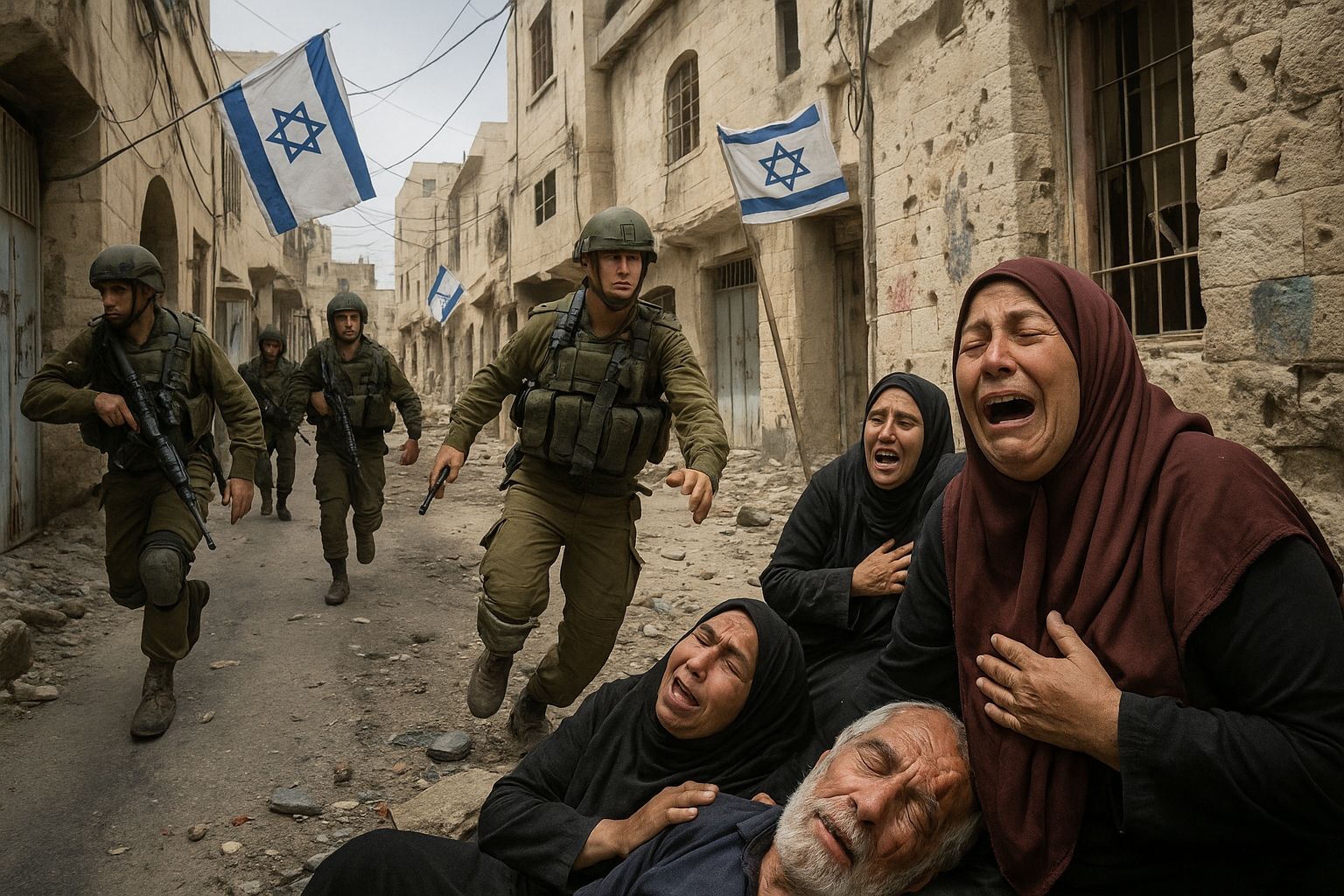
In the Israeli parliament (the Knesset), a legislative move has unfolded that marks one of the most significant shifts in Israel’s legal landscape since the implantation of the zionist entity in Palestine. For decades, the death penalty remained a historical artifact, a punishment reserved almost exclusively for the architects of the Holocaust, most notably Nazi war criminal Adolf Eichmann in 1962.
Today, that legal boundary has been dismantled. Under the pressure of a far-right coalition, Israel has moved to reinstate the gallows, but the language of this new law suggests that the blindfold on the scales of justice has been adjusted to see—and target—only one segment of the population.
The passage of this law was not met with the somber gravity usually associated with capital punishment. Instead, observers witnessed members of the far-right celebrate with champagne and toasts. National Security Minister Itamar Ben-Gvir, a primary architect of the bill, framed the legislation as a necessary act of sovereignty and protection. However, beneath the rhetoric of “deterrence” lies a legal structure that many legal experts and human rights researchers characterize as a “tool of apartheid.”
The Linguistic Architecture of Inequality
The primary controversy surrounding the law is not merely the existence of the death penalty, but the surgical precision with which it has been drafted. On the surface, the legislation claims to apply to any citizen who commits an act of “deadly terrorism.”
However, a closer look at the specific phrasing reveals a calculated distinction. Inside the internationally recognized borders of Israel, the law applies to citizens only if they are convicted of “killing to negate the existence of the State of Israel.”
This specific phrasing is seen by legal analysts as a linguistic filter. In the Israeli judicial context, Jewish Israelis—including settlers or soldiers who may commit acts of lethal violence against Palestinians—are almost never charged with “negating the state.” Their actions are typically framed as criminal, impulsive, or even misguided acts of “security,” but rarely as an existential threat to the state’s foundation.
By contrast, Palestinian resistance or violence is inherently categorized by the state as an attempt to negate its existence. Consequently, while the law is technically “colorblind,” its practical application creates a reality where it would almost exclusively target Palestinians.
A Tale of Two Courthouses
The disparity deepens when examining the geographic and jurisdictional reach of the law. For the nearly three million Palestinians living in the occupied West Bank, the legal reality is not one of civilian courts and due process, but of military tribunals. Under this new legislation, the death penalty becomes the default punishment for Palestinians tried in military courts for acts of terrorism.
The distinction is stark. An Israeli settler living in the West Bank who commits a crime is subject to Israeli civilian law, which offers a range of protections and a different sentencing rubric. A Palestinian neighbor, often living only hundreds of meters away, is subject to a military system where the conviction rate exceeds 96 percent. In these military courts, confessions are frequently obtained under extreme pressure, and some detainees report the use of physical and psychological torture. By making death the default sentence in this specific environment, the law essentially legalizes a fast-track to the gallows for one population while exempting another.
Erosion of Judicial Safeguards
In most democratic states that still utilize capital punishment, the legal bar for an execution is extraordinarily high, requiring unanimous judicial agreement and multiple levels of appeal. The new Israeli law systematically removes these safeguards.
First, the law allows for the death sentence to be handed down by a simple majority of judges rather than a unanimous decision. This lowered threshold significantly increases the likelihood of execution in a political climate where the judiciary is under intense pressure from the executive branch.
Second, for those tried in the West Bank military courts, the law removes the right to appeal. In a system where the conviction rate is already nearly absolute, the removal of appellate review creates a vacuum of accountability. Furthermore, the law explicitly denies the right to a pardon—a safeguard that exists in the vast majority of death penalty jurisdictions worldwide.
This “no-pardon” clause ensures that once the machinery of the state has decided on a death sentence, there is no executive or humanitarian valve to stop it.
Finally, the law mandates a rapid execution timeline. Once a sentence is issued, the execution by hanging is to be carried out within 90 days. This compressed schedule leaves little room for the discovery of new evidence, international intervention, or the cooling of political tensions.
The Political Engine: Ben-Gvir and the Far-Right
The push for this legislation is inextricably linked to the rising power of Israel’s far-right. For figures like Ben-Gvir and the Jewish Power Party, the death penalty is more than a legal deterrent; it is a political symbol of dominance. Proponents argue that the law is necessary to prevent “deals” where imprisoned Palestinians are swapped for kidnapped Israelis, a common occurrence in the region’s long history of conflict. By executing prisoners, they argue, the state removes the incentive for future kidnappings.
However, many analysts point out that the timing of the law’s advancement is deeply cynical. It is often used as a tool to boost popularity among right-wing voters during times of heightened security fears.
Critics note that while the law is framed as a response to terrorism, it specifically excludes the Hamas militants currently held for the October 7 attacks. Those individuals are to be dealt with under a separate, forthcoming set of regulations, suggesting that this death penalty law is designed as a permanent fixture for the future management of the Palestinian population rather than a specific reaction to the current war.
International Outcry and the “Apartheid” Label
The international community has reacted with significant alarm. In a rare joint statement, the governments of Britain, France, Germany, and Italy warned that the legislation undermines Israel’s commitment to democratic principles. In London, hundreds took to the streets to protest what they called a “heinous execution bill,” urging their government to impose sanctions and hold the Israeli regime accountable.
Human rights researchers, including those from Amnesty International, have been even more blunt. They argue that a law which targets one segment of the population based on their national or ethnic identity, while stripping them of fair trial protections, is a textbook example of an “apartheid tool.” By creating a dual-track legal system—one for the “sovereign” and another for the “occupied”—the state has effectively legalized a form of institutionalized discrimination that extends to the taking of human life.
The Shadow of War
The implementation of this law comes at a time when the West Bank is already experiencing unprecedented levels of tension. Since the outbreak of the war in Gaza, restrictions on movement, the establishment of illegal settlements, and settler violence have all surged. Human rights workers based in the West Bank describe a “grim reality” where Palestinians feel they are being systematically “broken” by the state.
Reports from within the Israeli prison system indicate that at least 89 Palestinian prisoners have died in custody since October 2023, with many families citing torture and medical neglect as the causes. For these families, the new death penalty law is not a new threat so much as the formalization of a risk their loved ones already face in detention.
Future of the Bench
Despite its passage in the Knesset, the law’s future remains uncertain. It is already being challenged in Israel’s Supreme Court, which has the power to strike down legislation it deems discriminatory or unconstitutional. The court will have to decide whether a law that effectively applies to only one ethnic group can coexist with Israel’s self-definition as a liberal democracy.
As the legal battle moves to the courts, the message sent by the legislative branch remains clear. By drafting a law that bypasses traditional safeguards and focuses its weight on the Palestinian population, the current regime has signaled a departure from the judicial norms that have governed the state for six decades.
Whether the gallows are actually built or the law is overturned, the rhetoric of its passage has already deepened the divide, reinforcing a system where justice is no longer a universal right, but a reflection of one’s identity in a deeply fractured land.
Related Articles