Kashmiris rally in Toronto to protest Pakistan Army’s Brutality in Azad Kashmir
Ensuring Socio-economic JusticeCrescent International
Muharram 20, 1448 2026-07-05
Daily News Analysis

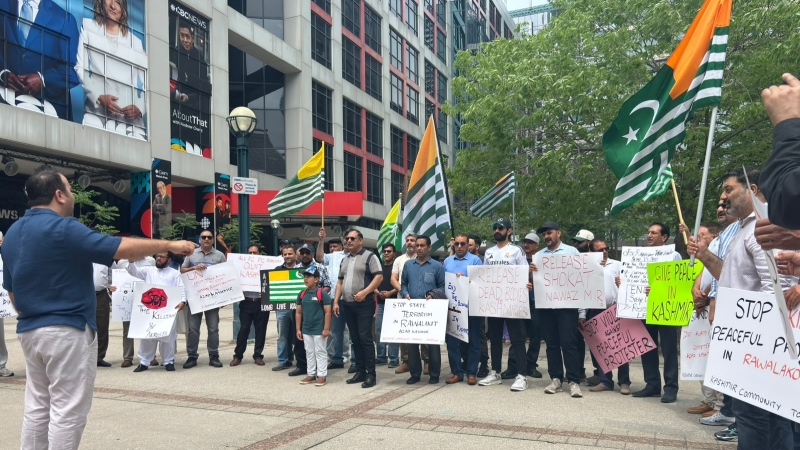
Responding to the call by the Joint Awami Action Committee (JAAC) in Azad Jammu and Kashmir (AJK), Canadians of Kashmiri origin held a rally on July 5.
Scores of Kashmiris including youth and children gathered outside Canada’s premier television network, the CBC, in downtown Toronto.
The JAAC, a grassroots Kashmiri organization, issued the call for worldwide rallies to draw attention to the rapidly deteriorating situation in AJK.
Several participants said their relatives in AJK have been killed or arrested.
Similar rallies were held in Europe, especially England where a large Kashmiri diaspora resides.
Some of them now members of the British parliament, raised concerns in Westminster.
The Pakistan army’s brutal actions against the people of AJK are beginning to resemble Indian army in occupied Kashmir (IoK) where for decades it has perpetrated horrible crimes against the people.
Worse, Pakistani security forces have imposed a food and fuel blockade, in the manner of the zionist occupiers of Gaza.
Since the beginning of June, dozens of Kashmiris have been gunned down by the police and Rangers.
The latter is a paramilitary force commanded by a serving Pakistan army general.
People have been shot and killed in Rawalakot, Barnala, and Kotli.
Even Amnesty International has been forced to condemn the killings.
Pakistani security forces have blocked the Kashmiris’ march to Muzaffarabad, the state capital.
What has forced the Kashmiris to protest?
In 2023, the JAAC put forward a list of 38 demands that included food and fuel subsidies amid rising prices.
It also called for the withdrawal of the 12 seats reserved for Kashmiri refugees from IoK, in the local legislative assembly.
They do not live in AJK.
With a total of 45 seats, the reserve seat quota constitutes almost a quarter of the legislature and effectively bar people who live in the state from contesting them.
Election are scheduled for July 27.
There are also calls for boycotting the polls.
The reserved seats idea was introduced decades ago.
The JAAC argues that the reserved seats undermine local representation.
They want all seats in the legislature to go to people who actually reside in the state.
But the authorities say the reserve seats are ‘essential’.
Why that is the case has not been explained.
Instead, they banned JAAC on June 5 under anti-terrorism laws, claiming that the group “engaged in terrorism” and behaved “in a manner prejudicial to the peace and security of the state.”
This is a standard allegation hurled at those who question the regime’s brutal policies.
AJK holds a semi-autonomous status within the broader, internationally recognized disputed territory of Kashmir.
It has its own Interim Constitution.
The Kashmiris elect their own president, prime minister and Legislative Assembly.
Pakistan exercises control over foreign affairs, defense, and finances.
Under international law, AJK is neither a sovereign state nor a formally integrated province of Pakistan.
Like Indian occupied Kashmir, its future status must be determined by an internationally-supervised referendum.
Why have the reserve seats issue become such a controversial issue?
The JAAC and most Kashmiris see this as an attempt to manipulate the state legislature to serve the interests of the Pakistani elite.
Kashmiris in Canada and elsewhere in the world have vowed to continue to speak out until their legitimate demands are met and all the leaders of the JAAC are released.
The military-installed Pakistani regime has shot itself in the foot by such political manipulation.
The Indian media is having a field day narrating the crisis in what they refer to as “Pak Occupied Kashmir” (see also here).
Related Articles
Call for Dialogue, Restraint, and Democratic Engagement in Azad Jammu and Kashmir
Crescent International
Muharram 02, 1448 2026-06-17

Indian regime, media froth with anger over Ilhan Omar’s visit to Azad Kashmir
Crescent International
Ramadan 20, 1443 2022-04-21
Protests over the killing of Kashmiris in AJK spread to Toronto, Canada
Crescent International
Dhu al-Hijjah 29, 1447 2026-06-15