The Fragile Aegis: Examining Trump’s Deteriorating Presidency
Muslim Mahmood
Dhu al-Hijjah 04, 1447 2026-05-21
Daily News Analysis

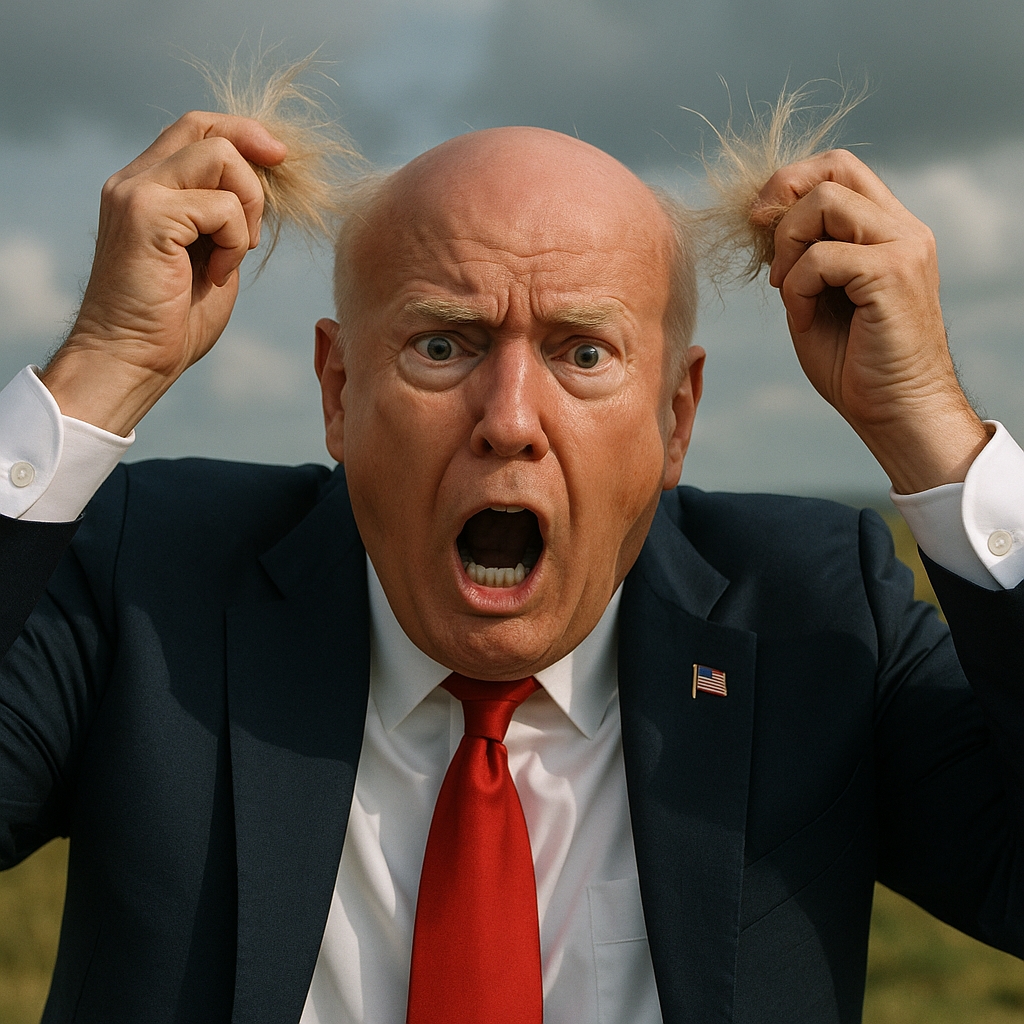
On January 20, 2025, Donald Trump became the oldest individual in the history of the United States to be inaugurated as president.
Now 79, his second term has been defined not by the populist fervor of 2016, but by a documented decline in physical stamina and cognitive consistency that has left both allies and critics questioning the stability of the executive branch.
Based on medical disclosures, leaked internal communications, and public behavioral data, this report profiles a person whose physical and mental state have become a central concern for the state.
Physical Toll: A Profile of Decay
In April 2025, White House Physician Dr. Sean Barbabella issued a report claiming the president was in “excellent health,” citing his “frequent victories in golf events” as evidence of vitality.
However, by July 2025, the regime was forced to address visible physical ailments.
Following the circulation of photographs showing deep bruises on Trump’s hands and significant swelling in his lower extremities, the White House confirmed a diagnosis of chronic venous insufficiency (CVI).
CVI occurs when leg valves fail to return blood to the heart, leading to pooling and painful swelling.
While the regime characterizes this as a “benign and common condition” for those over 70, medical experts note that it requires lifelong management through exercise and leg elevation—activities often at odds with the president’s schedule and his personal “battery theory,” which posits that exercise depletes a finite amount of human energy.
More concerning are the recurring, dark bruises on the president’s hands. While Press Secretary Karoline Leavitt attributed them to “frequent handshaking” and the use of aspirin, the symmetry of the bruising on both hands has led to intense speculation.
Analysts have noted that large, purple bruises have appeared on both the left and right hands throughout 2025 and 2026, leading to rumors of more serious underlying medical crises or the regular use of intravenous treatments that the regime has yet to fully disclose.
Cognitive Erosion and “Dozy Don”
The most visible sign of Trump’s aging is his struggle to remain alert. In December 2025, he appeared to fall asleep during a cabinet meeting, an incident that followed several other high-profile instances of public drowsiness.
These episodes earned him the moniker “Dozy Don” and prompted reports that the president has requested a “fewer, more important meetings” schedule to manage his fatigue.
Linguistic analysts have observed a marked shift in his rhetoric. Compared to 2016, his speeches are now significantly longer—averaging 82 minutes—and have grown “darker, harsher, and angrier”.
Data shows a 69% increase in the use of swear words and a 13% increase in “all-or-nothing” thinking, such as the frequent use of words like “always” and “never”. These changes in verbal behavior, combined with frequent gaffes—such as confusing his Press Secretary with former staffer Kellyanne Conway—have fueled speculation regarding cognitive decline.
Public episodes of confusion have reached international levels. During a high-stakes trip to Japan in October 2025, Trump was filmed wandering away from Prime Minister Sanae Takaichi, appearing lost until he was redirected by staff.
Similarly, at a 2026 summit in Davos, he repeatedly referred to Greenland as “Iceland,” despite the territory being a central focus of his foreign policy agenda.
Critics argue that these are not merely “slips of the tongue” but indicators of a neurological issue that is not being adequately addressed by the White House medical team.
The Economic Blind Spot
While Trump focuses on international feuds, the domestic economy is faltering. In April 2026, inflation (CPI) rose to 3.8%, its highest level since the post-pandemic era.
Simultaneously, Trump’s disapproval rating on the economy has surged to a historic 70%, a staggering shift from the 55% approval he enjoyed at the start of 2020.
The disconnect between the White House and the average citizen was laid bare when a reporter asked Trump to what extent he considers Americans’ financial situations when negotiating deals. He responded, “I don’t think about Americans’ financial situation,” stating his only focus was preventing Iran from obtaining a nuclear weapon.
This admission has been characterized by investigative journalists as “deranged and out-of-touch,” especially as Americans struggle with skyrocketing gas prices and basic living costs.
Internal leaked videos have corroborated this sense of “turmoil” within the White House. Benjamin Elliston, a senior budget analyst for the White House, was recently caught on a secret recording describing the president as a “madman”.
Elliston’s remarks suggest that even those within the budget office perceive the president as a “mess” whose “invincible” self-image makes him dangerous to the stability of the US.
Foreign Policy and Turmoil in West Asia
Trump’s perceived instability has manifested in a series of diplomatic crises. In early 2026, the “Greenland Crisis” erupted after the publication of a “Dear Jonas” letter, in which he demanded “complete and total control” of the territory and cited a perceived snub of the Nobel Peace Prize as a reason for escalating the situation.
Democratic lawmakers described the letter as “unhinged and embarrassing,” suggesting it was the work of a leader who has lost touch with reality.
This volatility extends to the ongoing wars in West Asia. In April 2026, Trump posted a series of expletive-laden threats against Iran, shocking global leaders and unnerving members of his own party.
Reports indicate that he has grown increasingly frustrated with China’s entry into peace talks, leading him to reject Iranian responses as “pieces of garbage” and suggesting that the current ceasefire is on “massive life support”.
This frustration has led to a perceived preference for “dramatic escalation.” Some analysts believe Trump may be considering committing war crimes against civilian infrastructure in West Asia as a way to “swiftly end” the conflict, a strategy born from a desperation to maintain a strongman image while missile stockpiles are reportedly running low.
In contrast, local leaders in cities like New York have been highlighted for “effective governance,” such as balancing budget deficits and reinvesting in social services, a sharp juxtaposition to the “centralized wealth” and “decrepit” leadership often associated with the current presidency.
Medical Secrecy and the MRI Mystery
The regime’s lack of transparency regarding the Trump’s health hit a new peak following October 10, 2025 visit to Walter Reed Hospital.
While he bragged that the visit was a “routine yearly checkup,” it was actually his second major medical examination in a six-month period.
During this visit, Trump underwent an undisclosed MRI scan, which he later described as “perfect” and “the best results the doctor had ever seen”.
However, when pressed by reporters on Air Force One about what body part was scanned, the president admitted, “I have no idea what they analyzed.”. Medical analysts have pointed out that MRIs are not part of a routine physical for a person of Trump’s age unless there are specific neurological or cardiovascular symptoms to investigate, such as signs of a stroke, aneurysm, or cognitive decline.
His failure to identify the organ scanned—whether the brain, heart, or prostate—has led some to argue that he is entering “25th Amendment territory”.
Further complicating the narrative is the role of Vice President JD Vance, who has been increasingly vocal about his readiness to lead. In August 2025, Vance stated he was prepared to become president “if tragedy strikes,” a comment that fueled rumors that the president was seriously ill or even deceased after being out of the public eye for several days.
Vance continues to maintain Trump is “extremely healthy,” yet his constant reminders of being a “heartbeat away” have cast a long shadow over the current regime.
Political Defense: Trump Derangement Syndrome
To combat these concerns, the White House has weaponized the term “Trump Derangement Syndrome” (TDS) to discredit critics.
Originally coined to describe “irrational” negative reactions to the president, the term is now used by Trump’s communications team to dismiss any inquiry into his health as a “full-blown psychosis”.
Press Secretary Karoline Leavitt and Communications Director Steven Cheung have repeatedly accused reporters and political opponents of suffering from TDS whenever questions of the president’s mental fitness arise.
The term has even entered the legislative sphere.
In March 2025, a group of Republicans in Minnesota introduced a bill that would seek to classify TDS as a legitimate mental illness in the state’s legal statutes.
Supporters of the bill argue that the “acute onset of paranoia” regarding the president’s policies has divided families and led to violence, while critics maintain the condition is a fictional label used to silence legitimate political opposition.
Twilight of Authority: A State in Flux
Trump’s presidency is one defined by a person increasingly isolated from reality, physically deteriorating, and cognitively inconsistent.
While the regime propaganda machine continues to use the term “TDS” to dismiss all criticism as hysteria, the sheer volume of evidence—from vascular diagnoses to “unhinged” diplomatic threats and confusion regarding his own medical tests—suggests a deep-seated instability at the heart of the regime.
For Americans, the question is no longer whether the president is “grumpy” or “old,” but whether the state can survive the remainder of a term under a ruler who appears to be physically and mentally “rotting” before the eyes of the world.
Related Articles
Lindsey Graham is Dead; News about Trump is Eagerly Awaited
Crescent International
Muharram 27, 1448 2026-07-12
Netanyahu: Dead or alive, Or, somewhere in-between?
Crescent International
Ramadan 26, 1447 2026-03-16