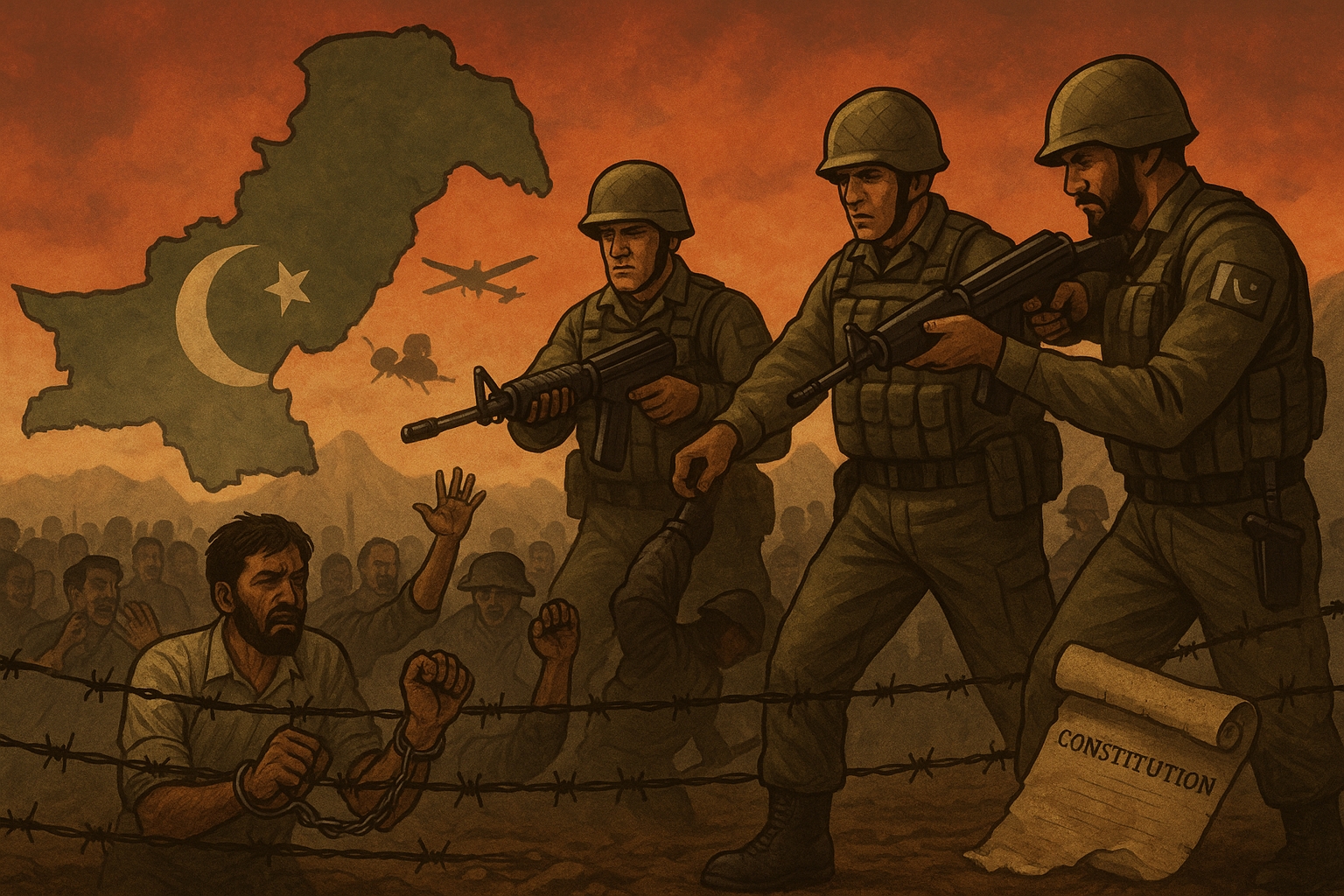
The Saudi-Pakistan-Türkiye military pact: Another paper tiger?
Developing Just LeadershipOmar Ahmed
Rabi' al-Thani 19, 1448 2026-10-01
News & Analysis

by Omar Ahmed (News & Analysis, Crescent International Vol. 56, No. 8, Rabi' al-Thani, 1448)
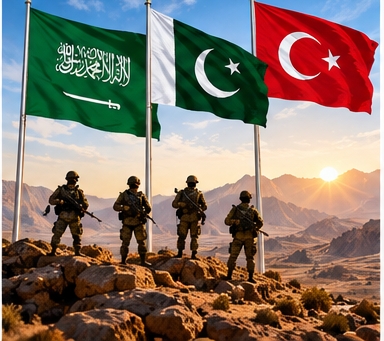
Yemen has delivered the first serious test of the Makkah Joint Defence Agreement (MJDA) scarcely six weeks after Saudi Arabia, Pakistan and Turkiye signed it. The Ansarallah-aligned Yemeni army’s advance through the south-west culminated in the liberation of Mokha, placing forces aligned with Sana‘a astride territory overlooking the Bab al-Mandab.
Missile and drone attacks have meanwhile reached Saudi cities and energy installations, including the East-West Pipeline. Riyadh’s air force can punish exposed positions, but bombing alone has not reversed the battlefield balance.
The pact’s two other signatories have proclaimed solidarity without entering the war. Islamabad has used unusually forceful language about defending Saudi territory and the two holy sanctuaries, while Ankara has offered technical military assistance.
Neither has promised to send combat forces into Yemen. That gap between collective-defence rhetoric and carefully limited commitments raises the question that has followed the pact since its signing: is this a Muslim security architecture in the making, or another paper alliance of regimes whose interests diverge when the shooting starts?
Solidarity stops at Yemen
Pakistan’s reluctance to join another Saudi war on Yemen is neither surprising nor new. Parliament rejected participation in the Saudi-led assault in 2015, reflecting public opposition, fear of sectarian blowback and the danger of opening a further front along Pakistan’s western approaches.
Those constraints are even sharper in 2026. Islamabad faces intensifying attacks by the Balochistan Liberation Army and Tehreek-e-Taliban Pakistan (TTP), as well as unrest in Pakistan-administered Kashmir. A large expeditionary deployment would consume forces needed at home and could rupture Pakistan’s sensitive relationship with neighbouring Iran.
The bilateral Strategic Mutual Defence Agreement, signed by Pakistan and Saudi Arabia in September 2025, was widely interpreted as a possible nuclear umbrella. Its timing, shortly after the zionist entity’s brazen attack on Doha, encouraged that reading.
Yet neither the bilateral accord nor the expanded Makkah pact has published operational provisions assigning Pakistani nuclear or conventional forces to Saudi defence. Strategic ambiguity may deter an external aggressor, but it does not answer who must fight whom, where, or by what means.
Islamabad has nevertheless stiffened its public position. After Saudi air defences allegedly intercepted a drone near Makkah on September 15, Pakistan’s military spokesman Lieutenant General Ahmed Sharif Chaudhry told Arab News that his country stood with the kingdom “both diplomatically and physically” and would go “to any extent.”
He tied that pledge specifically to Saudi security and the protection of Makkah and Madinah. He did not confirm a new deployment or commit Pakistan to combat inside Yemen.
Pakistan already has thousands of troops, a JF-17 squadron, drones and air-defence systems in Saudi Arabia. Reinforcing border defences, supplying intelligence or helping intercept missiles would allow Islamabad to honour Riyadh’s request without repeating the disastrous Saudi-led ground war.
Direct attacks on the Ansarallah-aligned Yemeni armed forces would be different. They would weaken Pakistan’s role in mediation between the US and Iran, inflame domestic tensions and place Pakistani forces on the side of a war that devastated Yemen without defeating its resistance.
Turkiye has drawn a similar line. Foreign Minister Hakan Fidan said on September 19 that Ankara was ready to meet Saudi “technical” military needs, while stressing that Riyadh had not chosen the US-Iran war and should not be dragged into it.
The offer points towards air defence, equipment and intelligence rather than Turkish ground forces at Mokha. Ankara needs access through the Red Sea for its expanding East African presence, especially in Somalia, but it has no interest in turning the Bab al-Mandab into another open-ended battlefield.
The zionist entity’s recognition of Somaliland has only increased the value Turkiye places on Mogadishu and the integrity of Somalia. Berbera gives Somaliland a commanding position on the Gulf of Aden, while Turkiye’s political, military and economic investment rests with the federal government.
A prolonged closure of the Bab al-Mandab would damage that project. Even so, protecting trade routes is not the same as volunteering for war against Sana‘a.
An alliance without settled rules
The MJDA is no longer quite as institutionally empty as its critics suggest. The three states have established a joint secretariat in Riyadh, with Pakistan holding the first three-year chairmanship, and their foreign ministers held the first committee meeting in Istanbul on August 31.
These steps correct the impression that the pact remains only a summit photograph. But its rules of engagement, consultation procedures, force commitments and geographical limits remain unpublished or undeveloped.
A genuine counterpart to NATO would require far more than the declaration that an attack on one is an attack on all. It would need a permanent command structure, shared planning, agreed budgets, exercises and forces capable of operating together.
Even NATO’s Article 5 does not automatically require every member to enter a war with ground troops. The attacked state must seek assistance, and each ally determines what action it considers necessary. The Yemeni armed forces struck the Saudi Aramco refinery in Jizan shortly after the pact was signed, but Riyadh did not invoke the MJDA or define the assistance it wanted.
Saudi Arabia can display Pakistani and Turkish backing without admitting that its old US security guarantee has failed. Pakistan can reassure a crucial financial patron while avoiding Yemen. Turkiye can advertise strategic leadership and sell military technology without accepting another war.
Yet an alliance built on deliberate uncertainty risks exposure once one member demands something the others cannot provide.
Egypt’s refusal to join underlines that problem. Cairo participated in the R4 consultations, and control of the Bab al-Mandab gives it an obvious stake. But the memory of Gamal Abdel Nasser’s ruinous intervention in North Yemen still weighs heavily. Bound to the Camp David order and dependent on Washington, Cairo has little appetite to fight Yemen, Iran or the zionist entity for an untested pact.
The choke points decide
The alliance’s real test is not a clause drafted in Makkah but the geography of two maritime choke points. Gulf hydrocarbon exports remain exposed to the Strait of Hormuz, while the Red Sea route depends on the Bab al-Mandab.
Iran and the Yemeni armed forces do not need to sink every tanker. They need only raise the danger, insurance cost and uncertainty high enough to make normal shipping commercially untenable.
Attacks on the East-West Pipeline, therefore, carry significance beyond the damage inflicted. The line moves Saudi crude to the Red Sea, bypassing Hormuz. Once that outlet comes under fire, Riyadh’s alternative becomes another vulnerability. Oil-importing Pakistan, Turkiye and China then share the economic pain even if they reject military escalation.
The original draft of this alliance was written against the shadow of the zionist entity and the collapse of confidence in Washington. Yemen now threatens to redirect it into a Sunni bloc against the Resistance Axis.
That would reproduce the sectarian architecture the US and the zionist entity have long cultivated across the region. It would also erase Yemeni agency by reducing Sana‘a to an Iranian instrument, despite a decade of indigenous military development and the unresolved consequences of the Saudi-led invasion and blockade.
The danger for Riyadh is that its partners may defend Saudi airspace while refusing to rescue the Presidential Leadership Council or retake Mokha. Pakistan could add air-defence crews, aircraft and border forces. Turkiye could provide drones, munitions and technical expertise.
Such measures would harden Saudi defences but leave Sana‘a’s new position overlooking the Bab al-Mandab largely intact. A return to mass bombing would again kill Yemenis while offering no assured route to a stable political settlement.
Events since the disputed Makkah incident have sharpened the dilemma. On September 19, the Yemeni armed forces said they struck sensitive sites in Riyadh with missiles and drones, hours after smoke was seen near the capital’s main airport.
Turkiye condemned the attacks, but Fidan’s carefully framed offer still stopped short of combat. Pakistan also said that no discussion of a military response had taken place under the pact, even as its generals promised to act when required. The language has escalated faster than the alliance’s operational response.
Saudi air strikes and so-called kill boxes may slow Yemeni formations in exposed terrain, but they cannot remove the political and logistical foundations of Sana‘as war effort. Nor can they guarantee the security of a long coastline and the shipping lanes beyond it.
Every interception also consumes expensive missiles against much cheaper drones. For a kingdom already absorbing disruption to oil exports and infrastructure, this exchange imposes costs that Pakistan and Turkiye are unlikely to shoulder indefinitely. Their strongest incentive is, therefore, to prevent Riyadh from demanding the very intervention the pact appears to promise.
The MJDA may, therefore, survive its first crisis precisely because its members avoid testing the most expansive interpretation of it. Limited assistance can be presented as collective defence; direct war can be deferred in favour of diplomacy.
But that outcome would also reveal the pact’s limits. Saudi money, Turkish technology and Pakistani military power do not automatically produce a common strategy.
For the Muslim world, the decisive question is not whether three ruling elites can assemble another military bloc. It is whether the pact restrains zionist aggression and reduces dependence on Washington, or merely protects existing regimes while turning its weapons against Yemen and Iran.
Unless it confronts that contradiction, the Makkah pact will remain impressive on paper and dangerously hollow when its members face a war they do not equally regard as their own.